Get Full Government Meeting Transcripts, Videos, & Alerts Forever!
Get email alerts on the Child Protection topic
No spam. Unsubscribe anytime.
Committee reviews bill to criminalize AI‑generated child sexual abuse material in Alaska
Summary
Rep. Sarah Vance introduced HB 47 to expand Alaska’s CSAM statutes to cover AI‑generated and computer‑edited material, align prosecutable conduct with obscenity standards (Miller test), and add safe‑harbor language for internet platforms; committee held the bill for further testimony
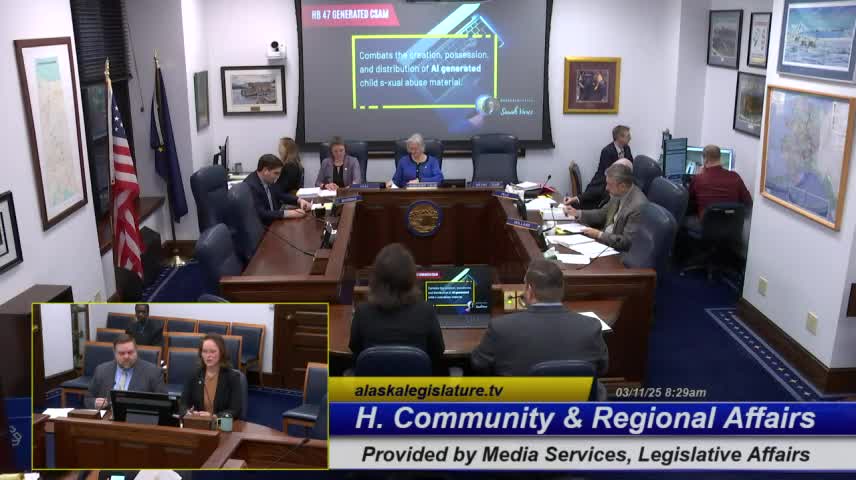
The Alaska House Community and Regional Affairs Committee on March 11, 2025, heard House Bill 47, sponsored by Representative Sarah Vance, which would expand state criminal statutes to explicitly prohibit the creation, possession and distribution of child sexual abuse material (CSAM) produced or modified using artificial intelligence or other synthetic media.
Representative Vance said last year’s lack of a state statute left Alaska reliant on federal prosecutions in such cases and pointed to reported incidents of AI‑generated CSAM involving youth in Alaska communities. “Currently, Alaska must rely on federal prosecutions due to our lack of state statute addressing this issue,” Vance said. The bill’s drafters told the committee it contains two principal approaches: (1) amend existing CSAM statutes to cover “identifiable” children depicted in synthetic images without requiring proof of obscenity, and (2) create a new offense that criminalizes obscene synthetically generated material that is not of an identifiable real child, aligning the new offense with the Miller obscenity test.
Bob Ballinger, staff to the sponsor, summarized the bill’s structure and said the new sections would be added to the criminal code (referenced in the hearing as amendments to the existing AS 11.61 provisions). Ballinger described a separate “safe harbor” provision in the bill to protect internet service providers and telecommunications workers who remove or report illicit material during the course of their duties.
Invited testimony came from Trevor Storrs, president and CEO of the Alaska Children’s Trust, who described the measure as necessary to empower state law enforcement and prosecutors. Storrs cited national data for context: the National Center for Missing and Exploited Children reported approximately 4,700 incidents involving generative AI in 2023, and the sponsor’s team noted that 37 states had enacted similar statutes, many in 2024.
Department of Law senior assistant attorney general Casey Schroeder was available to answer legal questions. Schroeder explained that having state statutes would allow Alaska prosecutors to pursue state charges when appropriate, supplementing federal enforcement and reducing reliance on federal prosecutorial discretion.
Committee members pressed staff about statutory elements and proof requirements. Representative Refridge asked why the bill’s language emphasizes an “identifiable child” in part of the draft; Ballinger explained that the identifiable‑child prong permits prosecution under existing CSAM statutes without invoking obscenity elements, while the separate “generated/obscene” prong addresses wholly synthetic material and includes elements of the Miller test to withstand First Amendment scrutiny. Casey Schroeder said the bill’s structure was intended to preserve constitutionally required distinctions while giving law enforcement clearer authority.
Representative Vance and staff described the bill as a response to local incidents and a national trend in which synthetic imagery has become both more prevalent and more realistic. The committee held HB 47 over for further invited and public testimony and requested that staff and Department of Law clarify federal/state enforcement overlaps and penalty differentials for members who asked.
No formal action or vote was recorded; the committee scheduled possible additional testimony and a follow‑up hearing.