Get Full Government Meeting Transcripts, Videos, & Alerts Forever!
Get email alerts on the Daylight Saving Time topic
No spam. Unsubscribe anytime.
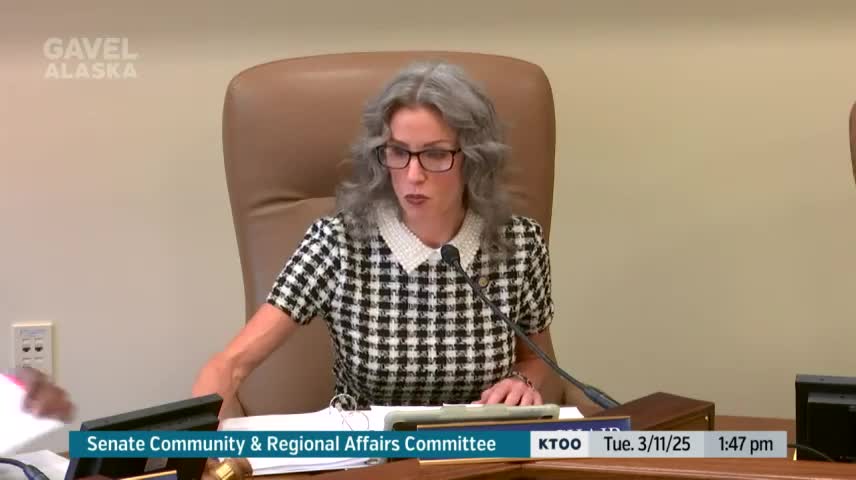
Senate committee hears bill to adopt permanent standard time in Alaska, cites health risks of clock changes
Summary
The Senate Community and Regional Affairs Committee heard testimony on SB 102 to exempt Alaska from Daylight Saving Time in favor of permanent standard time; supporters cited sleep-health studies and Alaska's extreme daylight variation; the bill was discussed and deferred for future consideration.
Senator Scott Kawasaki, representing Fairbanks, Fort Wainwright and Badger, presented Senate Bill 102 on March 11, 2025, explaining the measure would exempt Alaska from the annual practice of Daylight Saving Time and move the state to permanent standard time.
Kawasaki said the change would "benefit Alaskans mentally and physically and, and also benefit Alaska's economy" by removing the twice-yearly clock changes. Joe Hayes, staff to Senator Kawasaki, briefed the committee on the history and public-health research cited in the sponsor materials, saying studies link the twice-yearly clock shift to circadian disruption and increased cerebrovascular and cardiovascular risk, traffic accidents and workplace injuries. Hayes said the American Academy of Sleep Medicine supports permanent standard time and that the American Economic Association estimates an annual social cost associated with the clock changes.
During questioning, Senator Forrest Dunbar noted Alaska's high-latitude sunlight variation makes the daylight-versus-evening-light debate less relevant for many parts of the state, saying the principal harm for Alaskans is the changeover itself. "The thing that impacts us the most is the changeover," Dunbar said, adding that in places such as Fairbanks the day-to-day gain of daylight in spring quickly offsets a one-hour change. Kawasaki agreed, noting Alaska's latitude makes the twice-yearly shift especially disruptive and that adopting a permanent standard time "doesn't require congressional amendments," a point he raised during the presentation.
Committee members discussed neighboring states and jurisdictions that have exempted themselves from Daylight Saving Time; Kawasaki referenced Arizona, Hawaii and several U.S. territories that do not observe the practice and noted Washington and Oregon have introduced similar legislation. The committee did not adopt a formal position. Chair Senator Merrick closed the discussion by saying the issue resonates with constituents and that the committee will schedule further hearings.
No formal vote was recorded on SB 102; sponsors and staff left the panel open to return with additional information and public comment at a future hearing.