Get Full Government Meeting Transcripts, Videos, & Alerts Forever!
Get email alerts on the State Board Annual Report topic
No spam. Unsubscribe anytime.
State Board of Education delivers 2024 annual report, outlines five priorities and regulation changes
Summary
The Alaska State Board of Education and Early Development presented its annual report covering 2024 to a joint House and Senate education committee meeting, outlining five strategic priorities, recent regulation updates, and board actions including assessment changes, social studies standards revisions and school infrastructure grant lists.
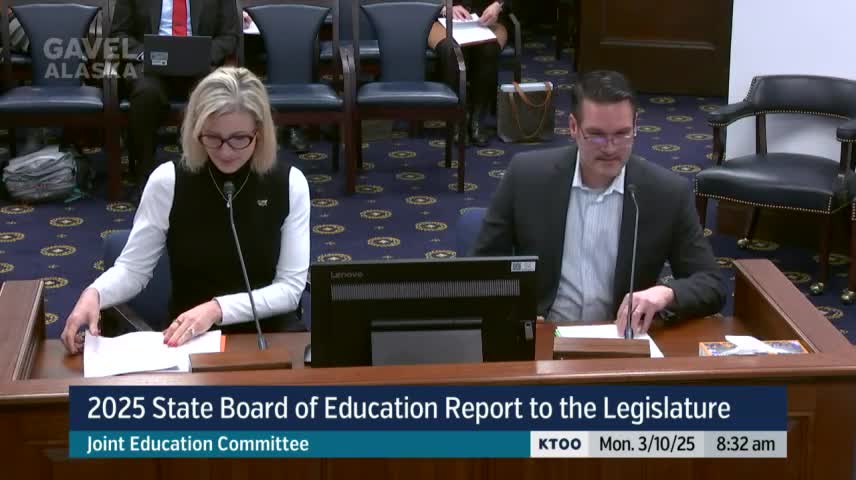
The Alaska State Board of Education and Early Development presented its annual report to a joint meeting of the House and Senate education committees on March 10, 2025, describing work carried out between Jan. 1 and Dec. 31, 2024.
The report, transmitted to the legislature on Feb. 6, 2025, is required by Alaska statute 14.07 0.168 and organizes the board’s work around five shared priorities of “Alaska’s education challenge,” the board said. The document includes approved regulation changes to statewide assessment participation guidelines, updates to assessments for students with disabilities, and revised cut scores and achievement levels for the AK STAR system. The board also approved revisions to social studies standards to emphasize civics, inquiry, geography, history and economics.
Board Chair James Fields said the report “reinforce[s] our commitment to providing an excellent education for every student, every day,” and noted the board’s use of five subcommittees that meet quarterly to align policy work with the priorities. Commissioner Dina Bishop described the department’s role in compiling the report and supporting board decisions.
The report lists actions the board took during 2024, including: approving the final lists for the school construction grant fund and the major maintenance grant fund; recognizing culturally relevant career and technical education programs; adopting a resolution encouraging local districts to limit student cell phone use during school hours; and expanding the nomination process for the student advisor position to include nominations from all students rather than only the Alaska Association of Student Governments.
The document also incorporates annual correspondence program reporting required under House Bill 202 and regulatory changes made in response to HB 193 (Internet for Schools), the board said. The board noted the FY2024 enrollment and allotment data were used for correspondence reporting and that the reporting requirement cited in the report is set to expire on July 1, 2025.
The board thanked former member Lori Van Deese for seven years of service and listed several ongoing departmental functions described in the report, including the Alaska Commission on Postsecondary Education, Alaska State Council on the Arts, Division of Libraries, Archives and Museums, information technology services and the state-run boarding school Mount Edgecumbe High School.
The board concluded the presentation by offering to provide requested follow-up information to committee members, including data that committee members identified in questions during the hearing.