Get Full Government Meeting Transcripts, Videos, & Alerts Forever!
Get email alerts on the Charitable Gaming topic
No spam. Unsubscribe anytime.
House committee considers expanding ‘snow classic’ fundraisers to more charities
Summary
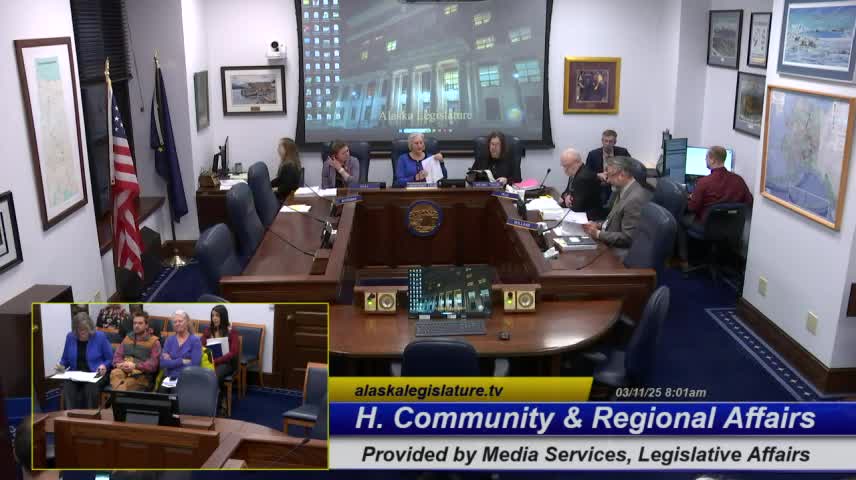
The Alaska House Community and Regional Affairs Committee on March 11, 2025, heard House Bill 50, sponsored by Representative Sarah Hannon, a one‑page measure that would broaden the statutory definition of a “snow classic” so additional eligible charitable organizations can host snow‑accumulation guessing fundraisers.
The Alaska House Community and Regional Affairs Committee on March 11, 2025, heard House Bill 50, sponsored by Representative Sarah Hannon, a one‑page measure that would broaden the statutory definition of a “snow classic” so additional eligible charitable organizations can host snow‑accumulation guessing fundraisers.
The bill would remove the current statutory requirement that a snow classic be operated exclusively by a single named organization at a single specified site, allowing other qualified permit holders to add the game type to their charitable‑gaming permits. That change would leave in place existing charitable gaming rules administered by the Department of Revenue Tax Division, including requirements for eligible entities and reporting.
Rep. Sarah Hannon told the committee the bill “broadens the definition of a snow classic that allows additional eligible charitable organizations to host snow classic fundraisers.” Hunter Meacham, staff to Rep. Hannon, explained the bill amends the definition in statute (noted in the hearing as an amendment to AS 05.15.69047) by removing the specific reference to Four Valleys Community School and the Mount Alyeska site.
Marty Abel, gaming manager for the Department of Revenue Tax Division, told the committee there is no statutory cap on how many snow classics a permit holder may run. “There's no limit as to how many snow classics a permit holder can have. If they have a permit, they can have as many as as they want,” Abel said. Abel also described the permit process: applicants must be qualified nonprofits or municipalities (which can include federally recognized tribes, cities or schools); they must meet organizational requirements such as having at least 25 Alaska‑resident members, bylaws and meeting minutes showing three years of activity, a dedicated gaming checking account, and annual gaming reports. Abel noted the Tax Division issued roughly 1,036 permits in 2023 and that permit holders add game types to their existing gaming permit.
Invited testimony came from Frankie Pilafont, president of the Juneau Nordic Ski Club, who said the club is a 501(c)(3) and would use proceeds mainly to support its youth program, which accounts for “half of our budget.” Pilafont described operational needs such as volunteer groomers and trail maintenance in multiple land‑management jurisdictions and said the club has not yet determined the measuring site but suggested places such as Eagle Crest or Montana Creek.
Committee members asked whether the measure could allow a proliferation of classics across the state and whether measuring disputes might trigger legal challenges. Rep. Kai Holland and Rep. Mike Prox asked whether the Tax Division limits the number of permit holders or events; Abel clarified the Division’s application and qualification processes but did not impose a numeric regional cap. Hunter Meacham said the permit application must specify the location and date for the measurement, which reduces ambiguity about what constitutes the measured snow accumulation.
The committee held the bill over for follow‑up and potential invited testimony. Co‑chair Rebecca Himshoo stated she would “hold this bill over” after testimony concluded.
Without making policy determinations, the committee record shows HB 50 would remove a site‑and‑beneficiary restriction and rely on existing Tax Division permitting and reporting rules to govern any new snow classics that permit holders choose to run.