Get Full Government Meeting Transcripts, Videos, & Alerts Forever!
Get email alerts on the Healthcare Reimbursement topic
No spam. Unsubscribe anytime.
Senate committee weighs bill to set minimum allowable charges for out-of-network care
Summary
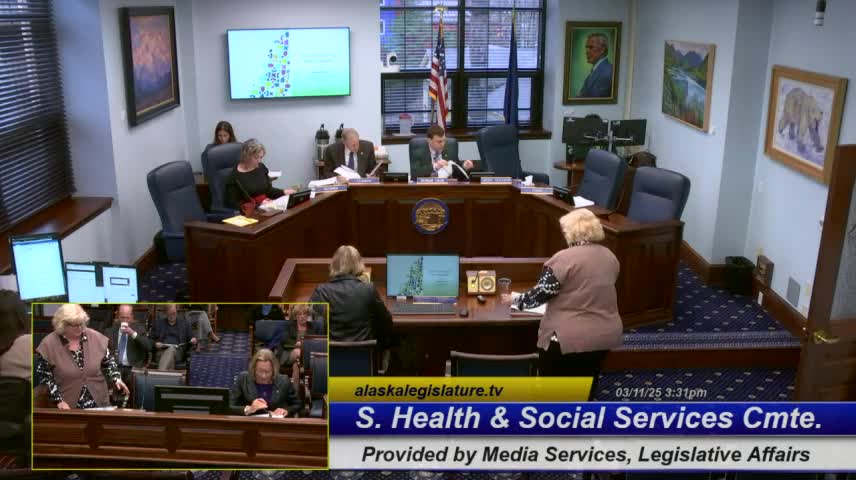
Juneau — The Senate Health and Social Services Committee on Tuesday heard testimony on Senate Bill 121, which would require the Division of Insurance to adopt market-based standards for allowable charges and set a state-defined minimum reimbursement floor for out-of-network health care services.
Juneau — The Senate Health and Social Services Committee on Tuesday heard testimony on Senate Bill 121, which would require the Alaska Division of Insurance to adopt standards insurers must use to determine allowable charges for out-of-network health care services and set a state-defined minimum reimbursement floor for providers.
Senator Kathy Giesel, vice chair of the committee and sponsor of SB 121, told the committee the bill is meant to restore a minimum reimbursement after the states previous regulation (the 80th-percentile standard) was repealed without a replacement. "The insurance companies now have no minimum reimbursement that they have to meet when providers provide services," Giesel said, adding that some clinicians face contract renewals with declining or flat reimbursement and that some practices have closed.
The bill would direct the director of the Division of Insurance to require insurers to use "statistically credible market-based methodology" based on the most recent 12 months of Alaskan data to set allowable charges and to ensure reimbursements are "not less than the 70 fifth percentile of charges statewide" or a floor equal to 450% of the Medicare (CMS) fee schedule, whichever is higher, according to the bill text read into the record and a sectional analysis provided to the committee. The bill also would require periodic audits of insurer methodology and mandate insurers update charges every 3 to 5 years.
Why it matters: Proponents said the lack of a floor after repeal has given insurers leverage to push down contract offers, threatening access to care in a state already designated as a federal health professional shortage area. "Without some minimum reimbursement requirement these health insurers are not reimbursing clinicians for the cost of the care," Giesel said.
Supporters and experts at the hearing argued the proposal is intended to create a balanced, Alaska-specific replacement that avoids the unintended consequences that critics say were produced by the former 80th-percentile rule. Jeffrey Davis, principal of Weston Group Consulting, told the committee the original rule (adopted in 2004) reduced patient balance billing but over time contributed to higher charges in parts of the market; he said a statewide, market-based floor would reduce the ability of a single provider group to distort statewide benchmarks.
Committee members pressed proponents on mechanics and trade-offs. Senator Hughes asked whether the proposal applies to all provider charges or only primary care; the sponsor and staff confirmed it would apply to all CPT-coded charges statewide, while primary care was highlighted as an especially fragile segment. Committee members also asked whether the 450% floor could make out-of-network rates higher than some in-network contracts and whether a percentile floor could simply move upward again if providers increased charges together in the future.
Division of Insurance Director Laurie Winghire told the committee the division already requires charges to be "reasonable" and that some insurers use a Fair Health-like database to set allowables. Winghire said the market segment directly affected by SB 121 is the fully insured market (about 118,000 Alaskans, as stated during the hearing) and that filings showed a 4% decrease in 2025 rate filings and about 2.5% in 2024 — figures the director said reflected multiple factors in addition to repeal.
Proponents asked for a mechanism that is both market-based and statewide to avoid the prior regulations geographic fragmentation and to limit the possibility a single provider group could capture a regions benchmark. The bill includes a transition provision allowing insurers to use data beginning as early as February 2023 during an initial adjustment period and sets an effective date for Jan. 1, 2026 in the draft sectional.
No formal action was taken at this hearing. Committee leadership said they would take additional testimony and posted letters for and against the bill online; the committee set the matter aside after the hearing and invited further written submissions and public testimony.
Ending: Senators and witnesses signaled the issue will return for additional hearings. Several members said they want more data on contract negotiations, insurer filings and the status of a lawsuit tied to the prior repeal before moving to committee action.