Get Full Government Meeting Transcripts, Videos, & Alerts Forever!
Get email alerts on the Liquor Commission Budget topic
No spam. Unsubscribe anytime.
Liquor Commission seeks staffing and technology investments as licensing backlog grows
Summary
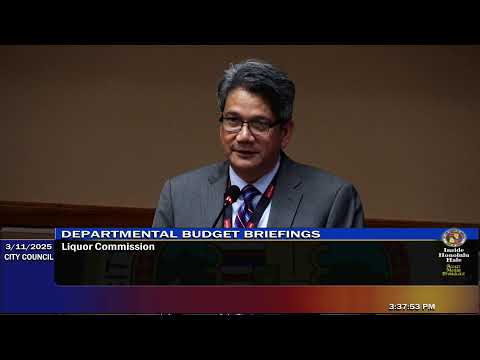
Administrator Salvador Petilos briefed the budget committee on the Honolulu Liquor Commission’s FY2026 budget, described vacancies and hiring plans, an ongoing LCIS software upgrade, a pilot for body‑worn cameras and vehicle replacements, and cited a licensing backlog that has lengthened average processing times.
Administrator Salvador Petilos told the Committee on Budget that the Honolulu Liquor Commission’s FY2026 operating budget is broadly comparable to FY2025 but reflects shifting line items for equipment and current expenses.
Petilos said the commission’s requested FY2026 budget includes a 1.1% reduction in salaries, an 8.1% increase in current expenses and a 38.9% decrease in equipment spending tied to phasing of the LCIS 2 information system. The commission has 53 authorized positions, 38 current incumbents and 15 vacancies — a 28% vacancy rate — and Petilos said the agency expects to hire nine additional employees by the end of the fiscal year.
The administrator said the commission is asking for an increase of $135,000 in non‑holiday overtime to address a licensing backlog; he told the committee that about 80% of overtime expenditure has been for licensing staff working to reduce a permitting backlog. The commission’s projected revenue for FY2026 is approximately $6.52 million from license and permit fees, charges for services and fines.
Licensing turnaround and LCIS: Petilos said the commission has been implementing LCIS 2 in phases and that the program will enter a final, eighth phase in FY2027. He acknowledged long licensing cycle times: the commission’s performance metric shows average application processing at about 285 calendar days in FY2024 and an estimated 353 calendar days in FY2025. Petilos and councilmembers agreed increased licensing capacity is a priority.
Equipment, vehicles and body cameras: The commission is requesting funds for vehicle replacement (replacement cycles and fewer, older vehicles in service were discussed) and a pilot of body‑worn cameras for investigators. Petilos said the agency seeks $45,000 for 10 body‑worn cameras and initial data storage as a pilot and plans to start a pilot program that could put cameras in the field in FY2027, subject to procurement and program‑administration considerations.
Staffing, training and internal review: Committee members cited a 2023 internal review that found the agency’s staff were underpaid, undertrained and overburdened; the commission reported progress in recruitment and a reorganization to create upward mobility, added a chief investigator and is continuing to assess hiring and training needs across licensing and enforcement teams.
Quotes from the meeting: “We anticipate to hire 9 additional individuals, 9 positions by the end of this fiscal year,” Administrator Salvador Petilos said. On licensing backlog and overtime, Petilos said about 80% of the overtime expenditure “were by licensing staff which is dealing with the backlog that we have in terms of licensing.”
Ending: Council members said they will continue to press for measures to reduce application cycle time and asked for follow‑up information about fines, LCIS phase timing and staffing fill rates. The commission will receive follow‑up budget questions in writing.