Get Full Government Meeting Transcripts, Videos, & Alerts Forever!
Get email alerts on the Education Finance topic
No spam. Unsubscribe anytime.
Business office reports positive second‑interim certification; staff cite ADA improvement, small COLA changes and a behavioral‑health grant
Summary
The district’s business office presented a second interim report showing a positive certification. Staff cited a modest enrollment/ADA uptick, updated COLA assumptions, a $560,000 behavioral‑health grant to fund social workers and ongoing vacancy savings.
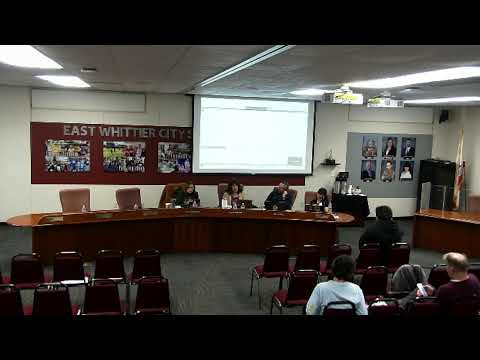
The East Whittier City School District business office presented its second interim budget update and asked the board to certify the financial projections for 2024–25 and the subsequent two years. Staff recommended and the board approved a positive certification.
Why it matters: a positive second interim certification signals that, based on current assumptions, the district anticipates it can meet its financial obligations for the current fiscal year and for the next two years. The presentation also lays out the risks the district is monitoring, including state revenue changes with the May Revise and federal funding shifts.
Key figures and assumptions presented by staff (as stated in the meeting): - Attendance (ADA) estimate increased from 94.33% to 95.88%; staff said the change yields roughly $166,000 in the current year and $1.3 million in the next year in improved revenue projections. - COLA assumptions: 1.07% for 2024–25, 2.43% projected for 2025–26, and 3.52% for 2026–27 (staff noted small year‑to‑year adjustments in the state numbers used in projections). - Grant: the Children and Youth Behavioral Health Initiative award (staff cited approximately $560,000) was described as funding two additional district social workers for two years, extending positions that otherwise might have been reduced under the fiscal stabilization plan. - Vacancies: staff reported roughly 52 vacancies across classified and certificated positions (special education and supervising assistants noted specifically) and said the budget reflects midyear vacancy adjustments.
During the presentation Miss Sorrell described the certification: “we have a positive which means we can make our financial obligations in the current year and the 2 out years.” Board members publicly thanked the business office and emphasized plans to prepare a near‑final budget ahead of the May Revise so the district can adjust quickly to state changes.
Next steps: staff said they will produce a near‑complete budget draft before the May Revise, adjust the draft as necessary after the May numbers, and return to the board with recommended changes. The presentation reiterated ongoing work on the fiscal stabilization plan and said staff is seeking ways to stretch one‑time funding while protecting priorities like student services and school staffing.
Ending: board members praised the business services staff for transparent reporting and the Citizens Oversight Committee for its role in ensuring bond‑measure compliance; staff emphasized the budget remains sensitive to May Revise outcomes and to federal grant timelines.