Get Full Government Meeting Transcripts, Videos, & Alerts Forever!
Get email alerts on the Criminal Justice Dui topic
No spam. Unsubscribe anytime.
Jared Major pleads guilty to DUI; judge offers conditional nonreporting to protect his job
Summary
In State Court of Clayton County, Jared Alexander Major pleaded guilty to driving under the influence (less safe) and accepted a plea package that included a 12-month sentence with most time probated; the judge said Major could be placed on nonreporting probation if he provides proof he completed required programs and paid fines.
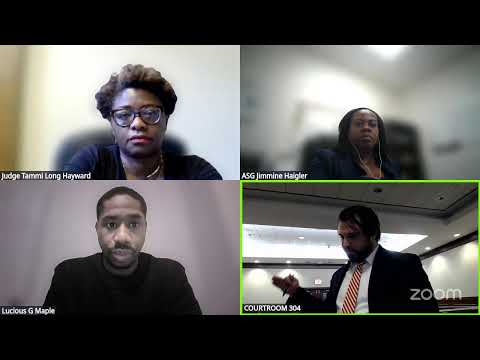
Jared Alexander Major pleaded guilty to driving under the influence (less safe) and entered no-contest pleas to related charges in State Court of Clayton County on March 11, 2025. Judge Tammy Long Hayward accepted the plea and imposed a sentence that included jail time with most of the term probated and several special conditions.
The judge said Major, charged in case 2021CR06860, would receive "12 months to serve, 24 hours credit for time served, balance probated," along with a $300 fine, 40 hours of community service, enrollment and completion of a risk-reduction course, a substance-abuse evaluation and any recommended treatment, a prohibition on drugs and alcohol during probation, and random testing. The court also imposed a $500 fine on the property-related count and a $100 suspended fine on the improper-lane-change count; the counts were to run concurrent with the DUI sentence.
Defense attorney Khalil Eady told the court Major had already completed many of the special conditions, saying, "at this point, he has done 80 hours of community service, double risk reduction, double testings, and everything of that nature." Eady said Major has started work as a flight attendant for Delta and travels frequently, which counsel said would be disrupted by regular reporting requirements.
Deputy prosecutor Wanda (first name not specified on the record) said the state was reluctant to make Major nonreporting immediately because the defendant's blood-alcohol concentration in the case was 0.192 and there was a victim. The prosecutor suggested a period of monitoring; the judge adopted a middle course.
Judge Hayward said she does not ordinarily place defendants on nonreporting supervision, but agreed to do so in Major's case if he could verify completion of the special conditions and payment of fines and fees. "If we can verify that Mr. Major has done all of the conditions ... and can pay the fines and fees, then the court will go nonreporting," she said, adding he would remain subject to periodic drug or alcohol screens.
The prosecutor described the case facts in court: officers responding to a hit-and-run on Forest Park near State Route 85 observed signs of intoxication, the defendant admitted drinking an eight-pack of Bud Light about four hours before the accident, and a blood test returned a BAC of 0.192. The state recommended 12 months to serve with significant conditions; the judge imposed largely the same sentence but allowed the conditional nonreporting arrangement.
Major was placed in a breakout room with the probation specialist to begin probation intake and to complete required paperwork; the court told him to provide proof of completed programs and payment of fines to effectuate the nonreporting status.
The court record shows the plea and sentence were entered in open court and the probation and reporting conditions were made part of the judgment.