Get Full Government Meeting Transcripts, Videos, & Alerts Forever!
Get email alerts on the City Budget Fy2026 topic
No spam. Unsubscribe anytime.
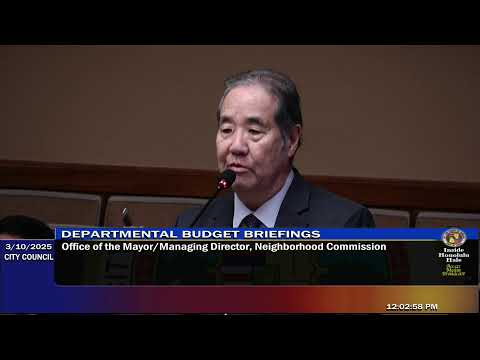
Mayor and Budget Office present $3.93 billion operating budget, $1.21 billion CIP in FY2026 proposal
Summary
Mayor Rick Blangiardi and the city’s Budget and Fiscal Services office presented the administration's proposed FY2026 operating budget of $3.93 billion and a $1.21 billion capital improvement program, citing uncertain economic outlook, rising employee-benefit costs and rail operations as major drivers.
Mayor Rick Blangiardi and the Honolulu Department of Budget and Fiscal Services on Wednesday presented the administration's proposed fiscal year 2026 operating and capital budgets, including a $3.93 billion operating plan and a $1.21 billion capital improvement program (CIP).
The proposal, presented to the City Council Committee on Budget, projects roughly a $46 million (2.6 percent) increase in real property tax revenue driven by assessed-value gains in residential classes and outlines new provisions for homelessness, federally funded grant contingencies and climate resiliency.
The administration described the document as its most developed attempt to date to match priorities with constrained revenues and growing fixed costs. "This was our best piece of work to date," Mayor Rick Blangiardi told the committee, adding that the team has tried to anticipate uncertain federal and national economic shifts.
The budget book presented by Budget Director Andy Kawano places the general- and highway-fund revenues as the unrestricted sources supporting operating services. "These revenues are the unrestricted revenues that come out of the general fund and highways fund," Kawano said while walking the committee through revenue charts. He said the administration expects real property tax increases to be concentrated in the residential classes (residential up about 1.4 percent, residential A more than 5 percent) and that property valuations have flattened in recent years.
Major cost drivers and proposals - Operating expenditures (proposed): $3,930,000,000. The administration said the largest single category (24.8 percent) is a miscellaneous grouping that primarily reflects employee benefits, including pension and post-retirement health liabilities (ERS, EUTF/OPEB). Public safety accounts for about 16.7 percent of the operating budget, followed by mass transit and sanitation. - CIP (proposed): $1,210,000,000, about $165.7 million more than the prior year. The administration flagged increases of $166 million for sanitation, $44 million for highways and $39 million for human services (largely affordable housing near transit-oriented areas). - Rail operations and maintenance: estimated FY2026 O&M of $120.7 million, with the second segment (stadium to Middle Street) carrying an estimated O&M component of $31.6 million. - New provisions called out in the proposal: $10 million for homeless shelter/respite/outreach, $10 million for federally funded grant contingencies, and $8.9 million for climate-resiliency activities.
The presentation noted that OPEB costs had dropped in FY2025 because of prior use of fiscal relief funds (FRF) to prefund liabilities, but that OPEB and pension-related costs will return to upward trends in FY2026. Kawano also described the debt-service mix (general improvement, wastewater, highway improvement and general-obligation/bridge financing for rail completion) and emphasized the need to preserve credit ratings as borrowing and operations shift from construction to O&M for rail.
Council members pressed for specific line-item clarifications and asked for department-level detail on carryover, vacancy savings and which budget items are recurring versus one-time. Committee Chair noted a slide (A3) listing $1.24 billion in carryover and asked the administration to provide a departmental carryover breakdown; Kawano said line-item and carryover detail is included in the budget booklet and staff will supply supplemental information.
Why this matters The proposal sets the administration's funding priorities for public safety, transit operations, deferred maintenance and affordable housing tied to transit-oriented development. It also charts how the city plans to transition from rail construction borrowing toward funding ongoing operations and maintenance—an immediate fiscal pressure that will affect future budgets and potential service levels.
What happens next Council members signaled they will use the budget review week to probe departmental requests, vacant position savings and CIP capacity; the administration said departmental teams would appear later in the week for line-by-line questioning. The mayor and Budget & Fiscal Services said they would provide requested carryover and line-item detail to the committee.
Ending note The committee hearing continued into department-level reviews after the overview presentation; council members and the administration said they expect a multiweek review and possible changes before the council adopts an ordinance.