Get Full Government Meeting Transcripts, Videos, & Alerts Forever!
Get email alerts on the Financial Oversight And Data Dashboard topic
No spam. Unsubscribe anytime.
Oklahoma City board reviews financial oversight, previews new student-data dashboards
Summary
At a Monday work session, the Oklahoma City Public Schools board heard presentations from district cabinet members on financial oversight and previewed interactive student‑data dashboards intended to make budget and student‑performance information more accessible.
At a Monday work session, the Oklahoma City Public Schools board heard presentations from district cabinet members on financial oversight and previewed interactive student-data dashboards intended to make budget and student-performance information more accessible.
Board members and senior staff framed the session as a step toward clearer internal controls and monthly reporting, citing policy CO1 and a district document titled Fiscal Management Goals as guides for aligning spending with student outcomes.
CFO Sydney Ward presented a revenue snapshot for the general fund through January, grouping receipts as local, state and federal. She said local revenue projections are about $108,000,000 (roughly 30 percent of the budget); state funds — largely foundation aid and other state sources — are about $186,000,000 (about 51 percent); and projected federal dollars are about $62,000,000 (about 17 percent). Ward said salaries and benefits account for the largest expense, projecting about $295,000,000, or roughly 80 percent of the general fund, with contracted services and property services at about $39,000,000 (11 percent) and supplies and materials about $28,000,000 (about 7.6 percent).
“The expenditure of our funds lines up with our vision,” Ward said while describing policy CO1’s role as a board guide for fiscal alignment.
Cabinet and staff also discussed enrollment and staffing as drivers of revenue and costs. A district overview noted OKCPS serves more than 32,000 students (and, with charter partners, more than 35,000). Staff said October 1 enrollment numbers are used for funding projections and that the district typically uses the higher of its October 1 and a mid‑January count when projecting staffing needs. Staffing figures shown to the board indicated the district was about 98 percent staffed on Oct. 1, leaving roughly 2 percent vacancy; of the vacancies reported on that date, 19 were in special education. The district reported a teacher retention rate presented in the meeting materials and said it is tracking multiple recruitment pipelines that have higher retention rates.
“We want our students to walk across the stage with a plan in their hand,” cabinet member Suffield told the board as staff described strategic alignment between budget, staffing and student outcomes.
The second half of the session focused on new dashboards developed by the Planning, Research and Evaluation (PRE) team. Director Malou Smith and designer Emily Murphy demonstrated dashboards built around six key performance indicators: academic growth, academic achievement, chronic absenteeism, English-language proficiency, postsecondary opportunities and graduation rate. Smith emphasized the dashboards’ purpose for school and district leaders and for counselors.
“As we look at the numbers tonight, it’s important to remember that they are not just numbers. They represent real experiences and challenges and successes,” Malou Smith said. “Every data point is a child.”
The postsecondary‑opportunities dashboard showed participation and outcomes for juniors and seniors. Presenters said 41 percent of juniors and seniors enrolled in at least one postsecondary opportunity last year and that approximately 37–38 percent completed one; among those who enrolled, the pass rate exceeded 90 percent. The district highlighted growth in CareerTech enrollment — from about 8 percent to about 16 percent of juniors and seniors year over year — while noting disparities in participation by economic‑disadvantage status.
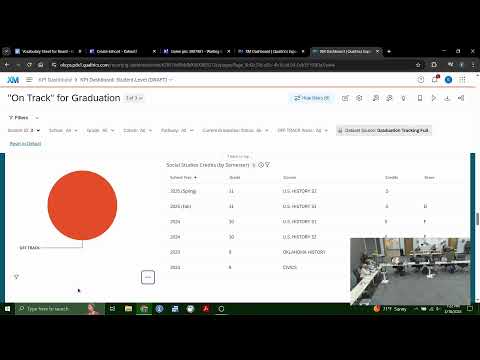
On graduation metrics, staff said the district’s four‑year graduation rate reported on the state data used for dashboards was 72 percent in the most recent report. The presenters noted the district received a failing grade on the state graduation indicator last year and said the threshold to move from an F to a D would have required roughly an 83.1 percent four‑year graduation rate. The dashboards also include an “on track / in danger / off track” status for individual students and school cohorts; staff said about 63 percent of the district’s high‑school students were currently labeled on track, and that 16 percent had failed one or more core courses without a planned makeup.
Staff demonstrated a planned student‑level view that counselors and principals will use to identify off‑track students, list required make‑up courses and export warnings or follow‑up lists. The district said counselors will receive training on that student view later in the week.
Board members asked for monthly high‑level financial reporting with deeper quarterly dives and requested clear guardrails for large contracts and expenditure lines; several members asked that high‑value contracts be easier for the public to review. The board chair set a deadline for board members to return written feedback on the draft Fiscal Management Goals so cabinet staff could assemble a consolidated version for the board’s April business meeting.
Brief motion and vote: the board adjourned by voice vote at the end of the session; members voted in favor and none opposed, and the chair declared the motion carried.
The district said the dashboards and monthly financial reports are intended to give the board and site leaders the tools to track alignment between spending and student outcomes and to catch students at risk of falling behind earlier.
What’s next: board members were asked to return annotated copies of the Fiscal Management Goals by April 7 so cabinet staff could compile feedback. Counselors will be trained on the student‑level dashboard, and finance staff said cabinet departments will be producing monthly budget summaries to improve transparency and oversight.