Get Full Government Meeting Transcripts, Videos, & Alerts Forever!
Get email alerts on the Child Welfare topic
No spam. Unsubscribe anytime.
Bill would require zones to notify military family‑advocacy programs of child‑abuse assessments (HB1338)
Summary
House Bill 1338 would require human‑service zones to determine whether individuals involved in child abuse or neglect assessments are military‑affiliated and, where appropriate, notify the nearest military Family Advocacy Program.
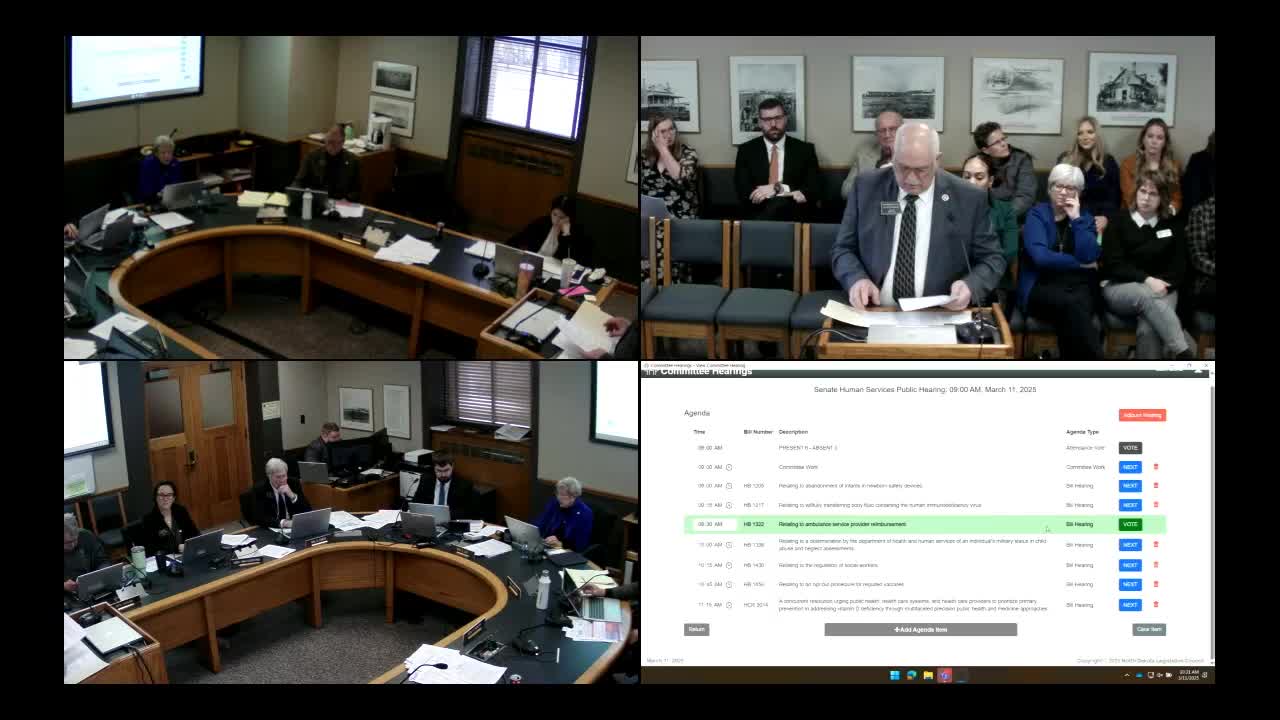
Representative Matt Ruby introduced House Bill 1338, which would require human‑service zones that conduct child abuse and neglect assessments to determine whether an individual involved in an assessment is military‑affiliated and, if so, notify the nearest military Family Advocacy Program (FAP).
"If that individual is military, the zone would notify the nearest military facilities Family Advocacy Program," Ruby told the committee, noting family advocacy programs on the state’s two Air Force bases provide clinical and nonclinical services and collect data used to tailor training and justify funding.
Jay Sheldon, strategy and policy officer for the North Dakota National Guard and administrator of the North Dakota Military Commission, said the commission supports consistent statewide procedures because memoranda of understanding already exist in Minot and Grand Forks but not uniformly across the state. He described the policy as a victim‑advocacy measure to ensure military families receive timely services and for DOD data collection purposes.
Kim Jacobson, director of the Agassiz Valley Human Service Zone and president of the North Dakota Human Service Zone Directors Association, told the committee zones support a statewide policy and worked with the sponsor to add definitions clarifying "military affiliated" and related terms so local staff can apply the requirement consistently. Jacobson said determining military affiliation could be added to initial intake and that the requirement should not pose an excessive administrative burden.
Michelle Richard, Midwest region liaison for the Department of Defense Defense State Liaison Office, testified in support and noted more than 35 states have passed similar laws requiring information sharing with military family advocacy programs. The Defense witness described the bill as not a law‑enforcement measure but a victim‑advocacy tool to connect families with services quickly.
Ending: Committee heard predominantly supportive testimony and no formal opposition; sponsors were asked to continue coordinating with zones and military liaisons on definitions and operational procedures.