Get Full Government Meeting Transcripts, Videos, & Alerts Forever!
Get email alerts on the Child Welfare topic
No spam. Unsubscribe anytime.
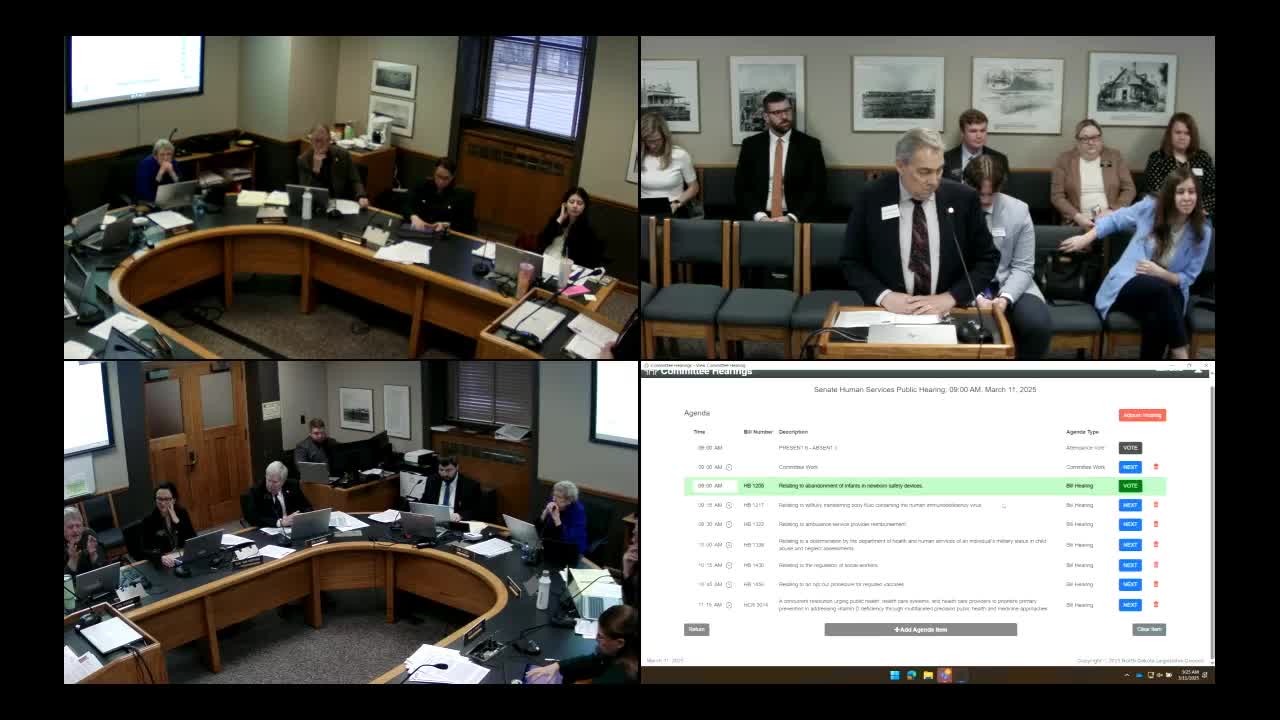
Senate Human Services committee hears testimony on safe-haven baby box pilot (HB1205)
Summary
Representative Dawson Holly asked the Senate Human Services Committee to approve a pilot program authorizing climate‑controlled safe‑haven baby boxes where a parent could anonymously surrender a newborn up to 60 days old.
Representative Dawson Holly urged the Senate Human Services Committee to approve House Bill 1205, which would authorize a pilot program allowing mothers to surrender a newborn under 60 days old by placing the infant in a climate‑controlled, monitored safe‑haven baby box.
"This legislation is not just about baby boxes. It's about hope," Holly said during his opening testimony, describing the boxes as a way to provide an anonymous, immediate, and medically supervised surrender option for parents in crisis.
Supporters including Bridget Turbine of North Dakota Right to Life, Jacob Thompson of North Dakota Family Alliance Legislative Action and Christopher Dodson of the North Dakota Catholic Conference testified the boxes offer a safer alternative to unsafe abandonment. Turbine said states such as Indiana, Kentucky and Arkansas have installed boxes, and that multiple states have recorded instances where boxes preserved infants' lives.
Holly told the committee each safe‑haven baby box costs about $20,000 with an annual program fee of about $500. The bill initially included a $50,000 appropriation, which Holly said would buy two boxes and fund public awareness; he said appropriations were removed during House consideration and the sponsor would like to restore them.
Committee members pressed supporters on operational details and legal safeguards. Senator Hogan and others raised questions about due process and reunification if a parent later changed their mind, and whether a completely anonymous handoff could complicate later claims or parental rights. Holly and witnesses said existing state procedures for safe‑haven surrenders would still apply and that public education and provider training would be part of any rollout.
Committee members also asked about market concentration and vendor dependency; Holly and Turbine said the market presently has a small number of manufacturers and that staff training and device certification were part of vendor materials they provided. Thompson and others described backup alarm systems and redundancy in vendor equipment to address concerns like power failures.
Supporters characterized the proposal as a limited pilot to be evaluated before any wider rollout. The committee did not take a final vote during the hearing; the bill received multiple proponents and no recorded opposition during the public hearing.
Ending: Sponsors asked the committee for a do‑pass recommendation and said they would work with the department and committee staff to provide additional operational language about training, power backups and how the boxes would interface with local law enforcement and hospital staff.