Get Full Government Meeting Transcripts, Videos, & Alerts Forever!
Get email alerts on the Criminal Justice,false Reporting topic
No spam. Unsubscribe anytime.
Senate Judiciary hears bill to require reports of false police reports; lawmakers seek clearer language on ID refusals
Summary
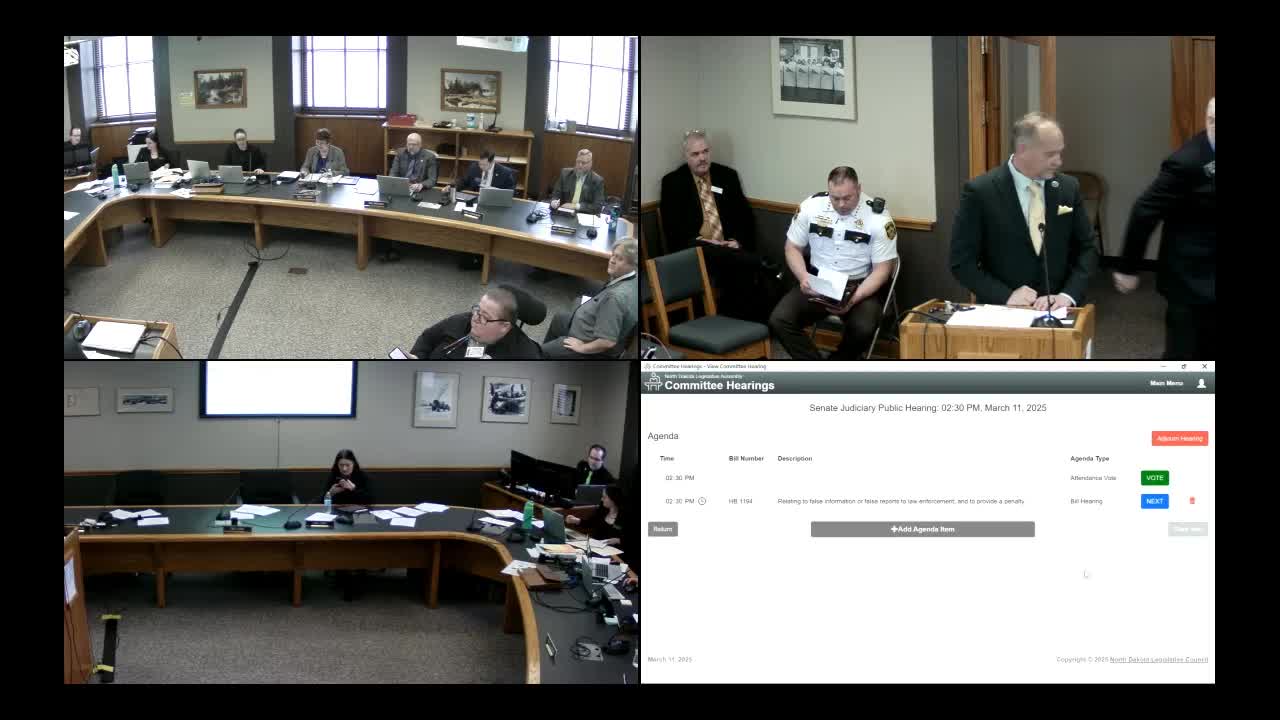
The Senate Judiciary Committee convened a hearing on House Bill 1194 on a proposal to require law enforcement officers to forward affidavits to state's attorneys when someone files a suspected false police report and to add penalties tied to identity refusals in lower-level offenses.
BISMARCK, N.D. — The Senate Judiciary Committee convened a hearing on House Bill 1194 on a proposal to require law enforcement officers to forward affidavits to state's attorneys when someone files a suspected false police report and to add penalties tied to identity refusals in lower-level offenses.
Representative Steve Vetter, R-District 18, introduced the bill and said its purpose is to ensure false accusations carry consequences. "False accusations have a victim, and they should have consequences," Vetter said, describing constituent complaints that officers did not file charges in cases they believed were fabricated.
The bill in its current form would require that when "someone files a complaint for false accusations or filing a false police report, the law enforcement officer agency would report an affidavit to the state's attorney on that individual for filing a fraudulent report," Vetter said, while noting the state's attorney would retain charging discretion.
Sheriff Jesse Jonner of Cass County testified that the change sought by the bill responds to practical problems for officers trying to identify people who refuse to provide true identity information on traffic stops or after minor property crimes. Jonner described relying in the past on investigative techniques or arrests for obstruction to secure identification and said some state's attorneys are now reluctant to prosecute under obstruction statutes. "We would then be arresting them for physical obstruction of a governmental function and bringing them to the jail because if we can get the person to the jail, then we can run their fingerprints there and try to identify them that way," Jonner said.
Jonner and Vetter proposed adding language borrowed from North Dakota Century Code 29-29-21 (the statute authorizing temporary questioning in public places) to give officers authority to act when they "reasonably suspect" a person is committing, has committed, or is about to commit a crime. The sheriff urged use of "reasonable articulable suspicion," a term witnesses said is rooted in case law, so officers must be able to record specific facts supporting a stop or identification request.
Opponents, including Blair Thorson speaking for the North Dakota Peace Officers Association, and Jonathan Byers for the North Dakota State's Attorneys Association, said they opposed the bill as originally written and raised concerns about removing discretion from officers and prosecutors. Thorson said the association had opposed the measure in the House but would review amendments. Byers said requiring officers to report every false-name incident to state's attorneys could be both burdensome and unnecessary: "I don't think it makes any sense for the legislature to mandate that a police officer report something to the state's attorney," he said, adding that officers and prosecutors need discretion to prioritize charges.
Senators on the committee questioned drafting details. Members asked whether the bill should keep a probable-cause threshold (which witnesses said would be too high for many of these encounters) or instead adopt the "reasonable articulable suspicion" formulation so reports survive court scrutiny. Senator Brownberger and others pressed witnesses on whether existing code provisions addressing refusal to identify apply and whether the new language would create definitions the Century Code currently lacks.
Committee members and witnesses agreed the measure needs more precise drafting. Several senators suggested working with legislative counsel and the bill sponsor to craft an amendment that would insert the temporary-questioning language into the bill while specifying that officers must articulate facts in reports so state's attorneys can evaluate prosecutions. Senator Castaneda volunteered to follow up on drafting and coordination with interested parties.
No formal vote was taken. Committee staff and several members said they would work with the sponsor, legislative counsel and stakeholders on revised language and possible amendments before the committee considers the bill again. The hearing was adjourned without action.
What happened next: The committee asked interested senators, the sponsor and legislative counsel to draft clearer language — including a proposed "reasonable articulable suspicion" standard — for future consideration. The exact amendment language and any vote date were not specified at the hearing.