Get Full Government Meeting Transcripts, Videos, & Alerts Forever!
Get email alerts on the Western Area Water Supply topic
No spam. Unsubscribe anytime.
Western Area Water Supply Authority seeks $46.5 million for supply, transmission and distribution upgrades
Summary
A Western Area Water Supply board member outlined WAWS’s service area, growth and a $46.5 million request across supply, transmission and rural distribution projects and stressed continued state partnership and funding for future upgrades.
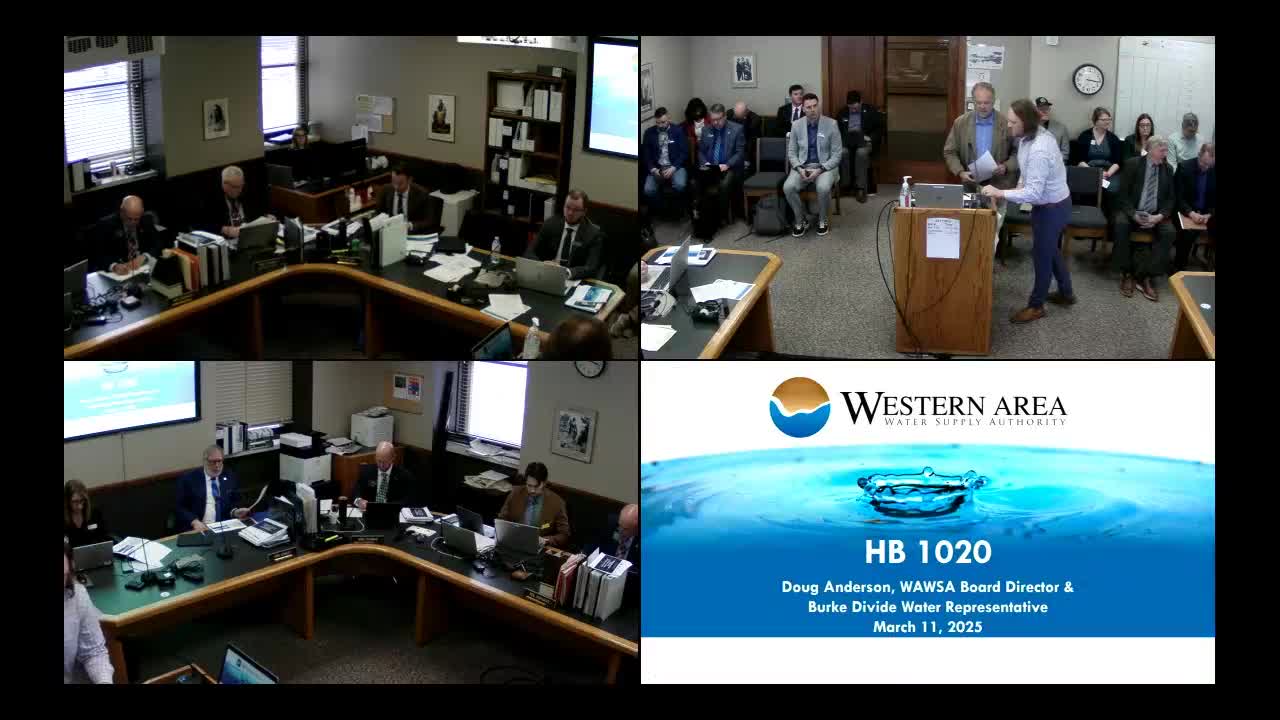
Doug Anderson, a board member of the Western Area Water Supply (WAWS) Authority, described the authority’s service area, recent growth and a funding request to the Senate Appropriations Education and Environment Division.
Anderson said WAWS serves roughly 70,000 people across a service area of several thousand square miles and provides water to five member entities, including the city of Williston and several rural water districts. He said the system has about 3,100 miles of installed pipeline, multiple treatment plants and storage reservoirs, and a mix of municipal and industrial customers.
WAWS has seen substantial growth, Anderson said, noting an 83% population increase since the authority’s earlier projections and that current service now exceeds initial expectations. “We are providing water services to upwards of 70,000 people — about 10% of the population of North Dakota,” Anderson told the committee, adding that industrial sales historically helped offset costs for domestic customers.
Anderson described three priority areas for WAWS projects: supply and treatment, transmission mains, and rural distribution. He said the authority’s current ask is roughly $46.5 million for supply/treatment upgrades, transmission improvements and rural distribution projects in the 2025–27 period. He asked the committee to continue state partnership and funding, saying WAWS cannot build or finance the program at scale without state support.
Committee members and Anderson discussed historical loan restructuring, the role of industrial sales in project payback and the authority’s ongoing capital needs. Anderson said WAWS aims to sustain and expand rural access and to plan upgrades for future industrial and municipal demands.
No committee vote or formal action was recorded during the presentation.