Get Full Government Meeting Transcripts, Videos, & Alerts Forever!
Get email alerts on the Southwest Pipeline Project topic
No spam. Unsubscribe anytime.
Southwest Pipeline Project outlines $131.7 million biennial ask, details major treatment plant costs
Summary
Southwest Water Authority and Department of Water Resources staff described current construction, repayment history and a $131.7 million request for 2025–27 covering transmission expansion, a supplementary intake, rural expansions and a treatment plant increase.
Jen Murray, manager and CEO of Southwest Water Authority, and Justin Froseth, Southwest Pipeline Project manager for the Department of Water Resources, presented the authority’s project list and budget requests to the Senate appropriations committee and described active construction, capital repayment history and system needs.
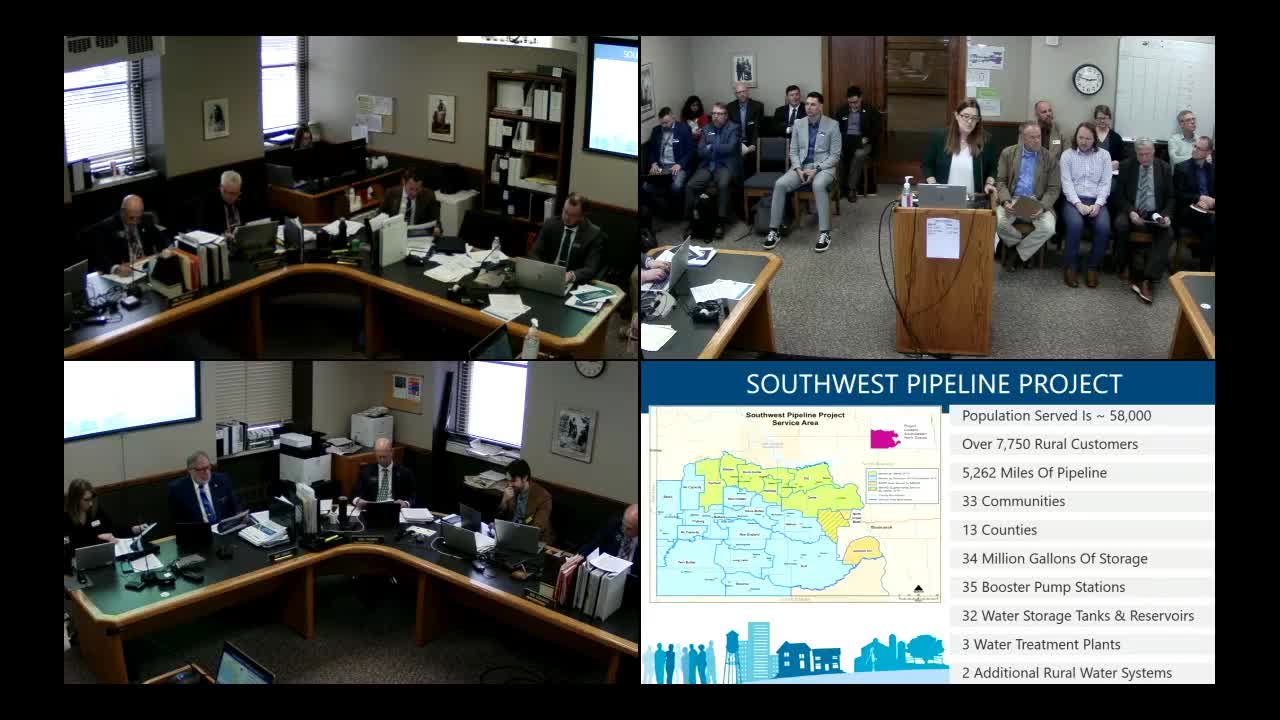
“We serve a population of about 58,000, almost 8,000 rural customers, over 5,000 miles of pipe in 33 communities,” Murray said, describing the system as a state‑owned regional water supply that returns capital repayment dollars to the Resources Trust Fund. Murray said capital repayment returned roughly $6.5 million in 2024 and that the project recently returned $100 million cumulatively to the state through capital repayment.
Froseth walked the committee through projects funded in the current biennium and seven projects proposed for 2025–27 that make up a $131.7 million request. He listed the main items as West Zone transmission expansion, a supplementary raw water intake, the Bert/Hebron rural expansion, strategic hydraulic improvements, Ray Christensen pump station upgrades, metallic pipeline replacement and the Southwest Water Treatment Plant expansion.
On the treatment plant Froseth said the total project cost is now estimated at $106 million; he said $40 million was budgeted in the last biennium and an additional $66 million is planned for the upcoming biennium. He told the committee the construction contract has mobilized and that the work will extend over multiple years on a roughly three‑year schedule.
Committee members questioned the widening gap between earlier estimates and current cost expectations. Senator Sorvaugh and others said many water projects are coming in significantly over prior estimates. Froseth attributed much of the difference to inflation on construction costs but acknowledged the difficulty the inflationary environment creates for multi‑biennium budgeting.
Froseth outlined amounts included in the 2025–27 request: approximately $20 million for West Zone transmission expansion, about $16 million for a raw water intake, $13.6 million for the Bert/Hebron expansion, $6 million for strategic hydraulic improvements, $5.4 million for Ray Christensen pump station upgrades and $3 million for metallic pipeline replacement; the treatment plant represents the largest single cost in the package.
Murray and Froseth said system priorities include ensuring transmission capacity does not limit growth, completing targeted distribution and hydraulic improvements so waiting customers can be connected, addressing microbiologically induced corrosion in metallic raw water lines and continuing rural service expansion. Murray said the authority maintains a policy to avoid degrading service to existing customers when adding new connections; if a new connection would reduce flows or pressures below standards it is placed on a waiting list until upgrades are completed.
No committee action or formal vote on the Southwest request was recorded during the hearing.