Get Full Government Meeting Transcripts, Videos, & Alerts Forever!
Get email alerts on the Industry, Business And Labor topic
No spam. Unsubscribe anytime.
Senate bill seeking independent audit of Commerce, Development Fund draws testimony on loans, transparency and cost
Summary
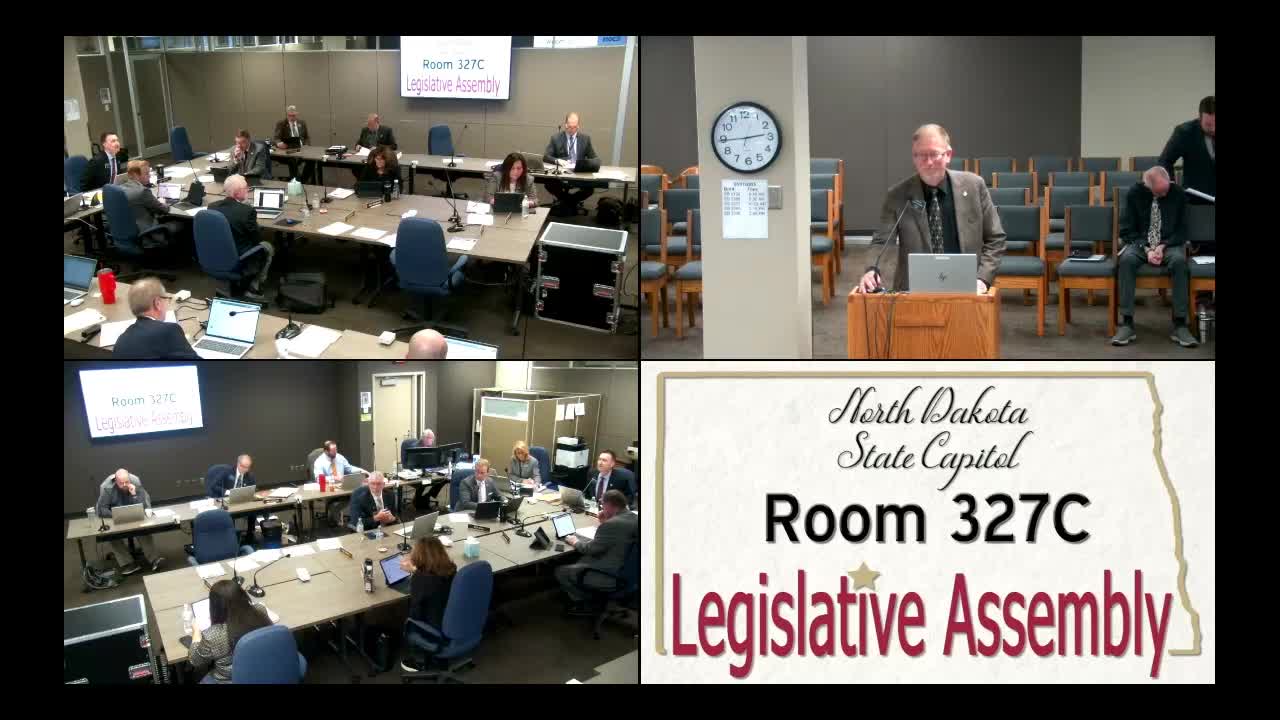
Senate Bill 2396, which asks the Legislative Management to contract with an independent third party to perform a performance audit of the North Dakota Development Fund and the Department of Commerce for activity covering 2020–2024, drew extended testimony and questions on scope, cost and access to records during a committee hearing Wednesday.
Senate Bill 2396, which asks the Legislative Management to contract with an independent third party to perform a performance audit of the North Dakota Development Fund and the Department of Commerce for activity covering 2020–2024, drew extended testimony and questions on scope, cost and access to records during a committee hearing Wednesday.
Senator Kent Weston, R-District 15, sponsored the measure, saying concerns about the handling of funds by Department of Commerce programs arose after a specific company’s matter and subsequent media statements. Weston told the committee he wants transparency and recommended increasing an appropriation that had been reduced from $350,000 to $200,000 for the audit; he said an audit performed for the state auditor had a budget near $500,000 and used $285,000, and he argued a fuller scope might warrant a higher appropriation.
Kurt Swenson, an engineer and business owner testifying as a private citizen, urged a thorough performance and conflict-of-interest audit focused on the North Dakota Development Fund. Swenson said he reviewed the fund's audited financial statements and flagged several figures he called troubling: he testified that the development fund recorded a $2,609,453 charge-off in 2023, converted $4,600,000 of loans into equity and then accrued $2,000,000 in losses against that equity; he said 96% of the value of equity investments in 2023 had provisions for losses and that in 2022 roughly 72% of outstanding loan value was provisioned for loss. Swenson said he had submitted an open-records request, paid a $100 fee for redaction, and did not receive all promised records; he asked the committee to narrow the audit to the North Dakota Development Fund and to require analysis of return on investment, loans to board‑related companies, charge-offs, and employment figures tied to funded projects. Swenson attributed several of these figures to audited fund reports and to his open-records efforts; the account represents his testimony and was presented as such.
Lawmakers questioned scope, timing and remedies. Representative Casper asked whether the bill's language that sets the contract period to the 2025–27 biennium conflicts with Weston’s stated intent to review 2020–2024 activity; Weston agreed the language could be clarified and said the audit should examine the past four years. Representative Schauer and others asked whether the request was retaliatory; Weston denied that and said he sought transparency. Several legislators asked whether the State Auditor's office could conduct the work.
State Auditor Josh Galien appeared as a neutral witness and said his office conducts performance audits and has the technical skill to do the work, but current workload and scheduling make it difficult to complete an additional audit in the bill’s timetable. Galien said the auditor's office completed a performance audit of the Department of Commerce covering the biennium ending June 30, 2023, and that performance audits require hundreds of labor hours. He said there are private firms that perform performance audits and that some would bring teams from out of state; his office can assist in drafting scope language to ensure auditors have access to sensitive information while protecting proprietary company data.
Committee members raised practical questions about cost and timing. Committee testimony indicated the appropriation for an out‑of‑state auditor had been set at $200,000 in the bill; Senator Weston urged restoring the earlier $350,000 figure or higher so the audit could be more comprehensive. Auditor Galien said a prior comparable performance audit cost about $285,000; he suggested a private firm could complete contracted work faster than the State Auditor but likely at higher cost, while the State Auditor's office could perform the audit without additional billing but not within the bill's proposed schedule because of other existing commitments. He estimated a privately contracted audit could begin later in the year after an RFP process (8–12 weeks) and complete work in roughly the following January–March timeframe, with a full report to legislative management after fieldwork and reporting phases.
No formal committee vote on Senate Bill 2396 was recorded at the hearing; the committee closed the hearing and said it would take the bill up in committee work later.
The hearing included repeated calls from several lawmakers and public witnesses for greater transparency about the Development Fund’s investments, loans converted to equity, charge-offs and the potential for conflicts of interest when board members have ties to recipient companies. Supporters of an audit argued the review would clarify whether policies and practices followed industry best practices and whether taxpayers received appropriate value for funds deployed. The State Auditor's office said it can perform such a review but that scheduling, staffing and timing are practical constraints that the legislature must consider when choosing between an in‑state auditor and a private contractor.