Get Full Government Meeting Transcripts, Videos, & Alerts Forever!
Get email alerts on the Higher Education topic
No spam. Unsubscribe anytime.
Dickinson State leaders ask appropriations committee for $48.5 million campus renovation, other support
Summary
Dickinson State University officials told the House Appropriations Committee they need large one-time and ongoing state investments — including a $48.5 million plan to modernize May Hall and Stickney Hall — to address deferred maintenance, accessibility and program growth such as nursing and workforce training.
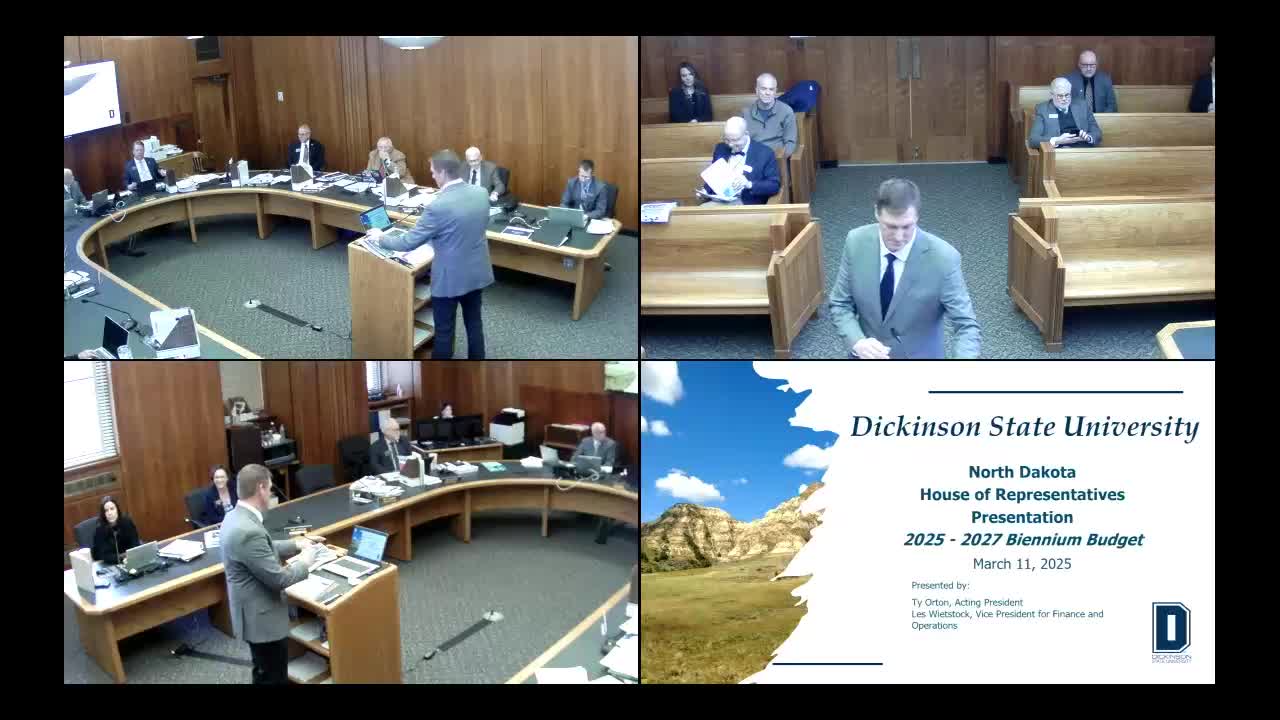
Dickinson State University officials told the North Dakota House Appropriations Committee’s Education and Environment Division on Tuesday that the campus needs significant state support to finish deferred-maintenance work, expand academic and student-support space and sustain program growth.
"My name is Ty Orton. I'm the acting president and executive director of the DSU Heritage Foundation at, Dickinson State University," Orton told the committee as he opened Dickinson State's budget presentation. He and Les Wheatstock, the university’s vice president for finance and administration, outlined capital, operational and program requests and described maintenance problems that campus leaders say are hindering operations.
The administration’s largest ask is a $48.5 million proposal to modernize May Hall and renovate Stickney Hall to create a Center for Teaching and Learning Excellence, improve accessibility, and reduce the university’s footprint and deferred-maintenance liability. Wheatstock told the committee the renovation plan would remove roughly $28 million in deferred maintenance from the campus inventory and would demolish one dormitory to reduce campus square footage by about 19,000 square feet.
Why it matters: Dickinson State is a regional public university whose officials say many graduates stay and work in western North Dakota and nearby states. Administrators argued that the proposed projects would both update classroom and student-support spaces and help the institution recruit and retain students — including in high-demand areas such as nursing, welding and diesel technology.
Key program and capacity details
- Nursing: Orton said the university has an active pre-nursing pool and a rebuilding program. He told the committee eight students will graduate this year with the RN-to-bachelor’s degree, 20 are expected next year and 25 the following year; a 32-student cohort is planned to begin in 2026. Orton said about 58 students were pre‑nursing applicants for the coming fall.
- Workforce programs and enrollment: Orton described a 16‑bay welding program and a growing diesel‑technology program, both supported in part by local donors. He said DSU’s enrollment rose after the COVID downturn and then fell modestly (about 30 students) in the most recent fall, with spring enrollment essentially flat.
Campus safety, deferred maintenance and utilities
Wheatstock and Orton described recurring facilities failures that they said require immediate attention. They noted a long‑running steam‑tunnel problem that has frustrated attempts to secure contractor bids and said that replacement of a deaerator — a boiler component that removes oxygen from feedwater — carried a bid of $875,000. Wheatstock also said replacement of emergency generators previously cost about $2.8 million and that deferred‑maintenance needs frequently force the campus to cover major repairs with limited reserves.
"In 02/2023 [deferred maintenance] made up 17% of our operating expenses," Wheatstock said, arguing for an inflation adjuster that would cover non‑salary operating costs such as maintenance and utility increases.
Campus security was another topic. The campus previously had a larger security office but, after budget cuts, now employs only a campus safety officer. Wheatstock described the university's need to maintain accurate Clery reporting (the federal campus crime reporting requirements) and cited recent Clery penalties elsewhere as a reason to restore or strengthen campus security functions.
Capital projects and financing
Administrators said roughly $10 million of a prior $17.1 million legislative appropriation went to an ag classroom building and that the indoor rodeo arena included in that package is expected to be weathered in by fall 2026. The Woods Hall residence project is about $7.5 million to complete; the university said it has bonding authority and may seek up to $12.5 million in bond capacity that would include bridge financing — roughly $5 million — to support rodeo arena fundraising until donor pledges are realized.
Shared services and operating requests
Wheatstock described how Dickinson State has contracted financial services from the University of North Dakota and North Dakota State University for accounting, student accounts receivable and other functions. He said a $200,000 system planning fund for shared services would pay for design and organization of a shared services model; the university expects to continue paying for contracted service delivery in any operational model.
Tier funding and matching
Committee members asked about tiered funding and local matches. Wheatstock said Dickinson State has been able to provide matches for tier 2 and tier 3 programs through fundraising and auxiliary revenue and that tier funds have been used for deferred‑maintenance projects such as rooftop units, chillers and carpeting.
The Theodore Roosevelt Center and other requests
Dickinson State is seeking continued support for the Theodore Roosevelt (TR) Center. Orton and Wheatstock said the campus has digitized more than 100,000 items for the TR digital collection and that the TR Center is a campus priority tied to the forthcoming presidential library. The administration requested additional recurring support (discussed in the hearing as both a $1 million per biennium ask and as a $500,000‑annually figure during parts of testimony) to fund staff and digitization work. The DSU Heritage Foundation said it currently provides about $1.4 million in scholarships and has raised roughly $60 million in eight years.
Committee exchange and next steps
Committee members including Representatives Sanford and Richter asked for clarifications about housing, accessibility and how many graduates stay in the region; Wheatstock and Orton answered with program and enrollment details and reiterated that many DSU graduates remain in western North Dakota and nearby states. Wheatstock said the State Board of Higher Education will be involved in the presidential search and expected the board to meet in Dickinson the following week.
No formal votes were recorded during this hearing; the presentation was informational and intended to inform the committee’s budget deliberations.
Ending: The committee recessed after the session closed; Dickinson State officials said they would continue to work with committee staff on specific cost estimates and implementation details for the capital and operational requests.