Get Full Government Meeting Transcripts, Videos, & Alerts Forever!
Get email alerts on the Alcohol Regulation topic
No spam. Unsubscribe anytime.
Committee considers higher proof‑gallon limits and new ready‑to‑drink definition for distilleries
Summary
House Bill 1466, as amended, would shift distillery production limits from gallon counts to proof gallons and add a definition for diluted/ready‑to‑drink canned cocktails; proponents argued the change supports industry growth and agricultural markets.
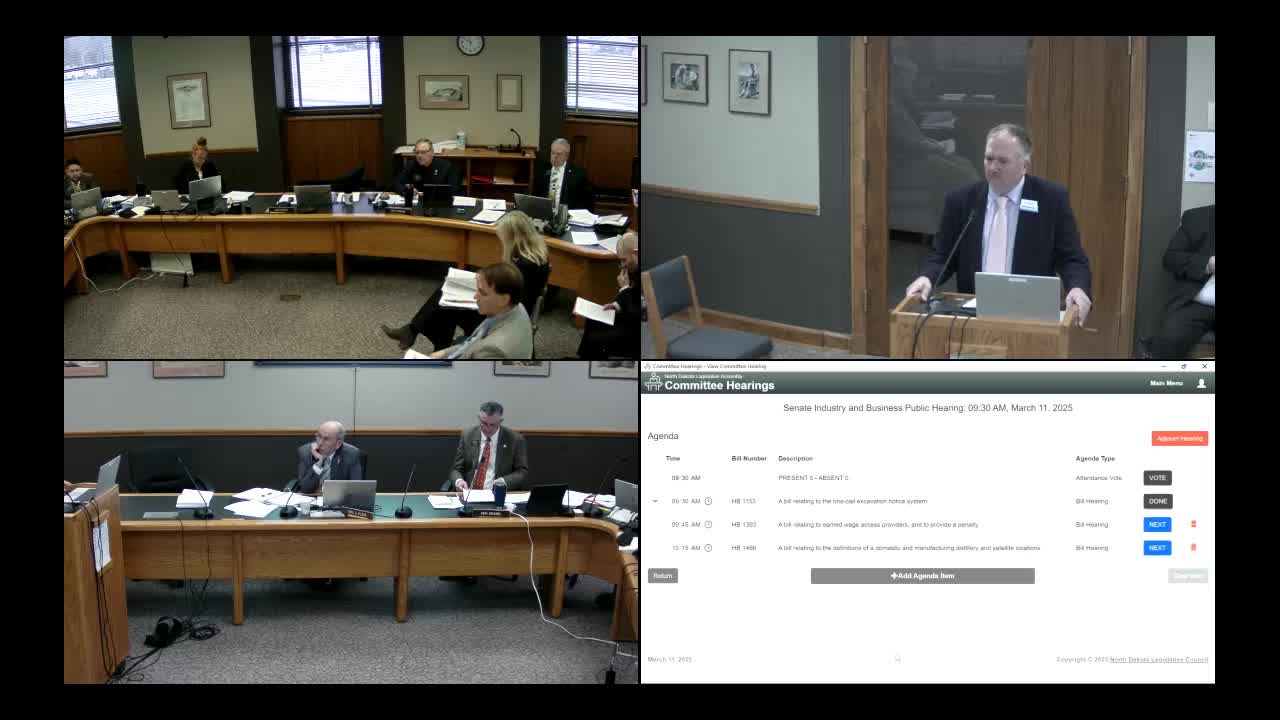
The Senate Industry and Business Committee heard House Bill 1466, which modifies definitions and production limits for distilleries. Proponents told the committee the amendments would convert volume limits to proof‑gallon measures, add a definition for diluted or ready‑to‑drink (RTD) canned cocktails, and raise production thresholds for certain manufacturing distilleries.
Representative Jason Dockter said the changes respond to practical problems distillers face under current law, particularly where aging and inventory can count against a statutory gallon cap. "Once you start growing your product, then you'd run into where you'd have to stop production because you reached the 50,000 gallon limit," he told the committee.
John Ward of the North Dakota Wine and Liquor Wholesalers Association supported the amendment, calling it cleanup language and saying it was negotiated with the bill proponents. He explained the draft adds a definition for "diluted beverages" — ready‑to‑drink canned cocktails that contain a small amount of distilled spirit blended with other nonalcoholic ingredients — and moves an existing "proof gallon" definition into the general definitions section. Ward said the manufacturing‑distillery production ceiling in the amendment increases from 25,000 gallons to 40,000 proof gallons for the category that produces from raw North Dakota ingredients.
Shiloh Perry, marketing director and production coordinator for Big Dog Distillery, described the RTD market and gave concrete production impacts. "With the distilled ready‑to‑drink canned cocktails, we would have, at least for our ready‑to‑drink canned cocktail out of Big Dog Distillery, we have 1.76 ounces of alcohol in there...Under the current century code, it was 25,000 gallons; our first run of ready to drink canned cocktail for this year would account for 5,000 gallons of our yearly allotment," Perry said. She added that converting to proof gallons would reduce the RTD product's impact on an annual cap (for her example, the same production would represent roughly 700 proof gallons under the amended measurement rather than 5,000 gallons), allowing more runs and stronger market participation.
Wholesalers and distillery proponents said the change would help small manufacturers scale production, support the agricultural supply chain and avoid having firms abruptly stop production after hitting a volume cap. Witnesses noted that North Dakota has multiple small distilleries and that at least one regional distiller is already above the current cap.
Committee members asked whether the bill applied to product actually distilled in‑state and whether off‑site event sales would be preserved; proponents said the amendment was crafted to preserve existing event‑sales authority (on‑ and off‑premises) and to align definitions across the code.
No committee vote was taken; the committee closed the hearing. Proponents said the amendment being presented reconciles competing stakeholder concerns and was intended as the text to be considered by the committee.
Why it matters: Converting to proof gallons and clarifying how RTD canned cocktails are measured affects how much product a small distillery can legally manufacture and sell in a year. Supporters said the changes protect farm‑to‑distillery businesses and community economic development.
What’s next: Sponsors signaled readiness to proceed with the negotiated amendment; the committee did not record a final vote at the hearing.