Get Full Government Meeting Transcripts, Videos, & Alerts Forever!
Get email alerts on the Special Education Funding topic
No spam. Unsubscribe anytime.
Bill would create interim study of special education funding; advocates request parent representation
Summary
House Bill 1547 would create a legislative study committee to examine how North Dakota funds special education, including high-cost students and resident placements; advocates urged adding a parent organization representative to the committee.
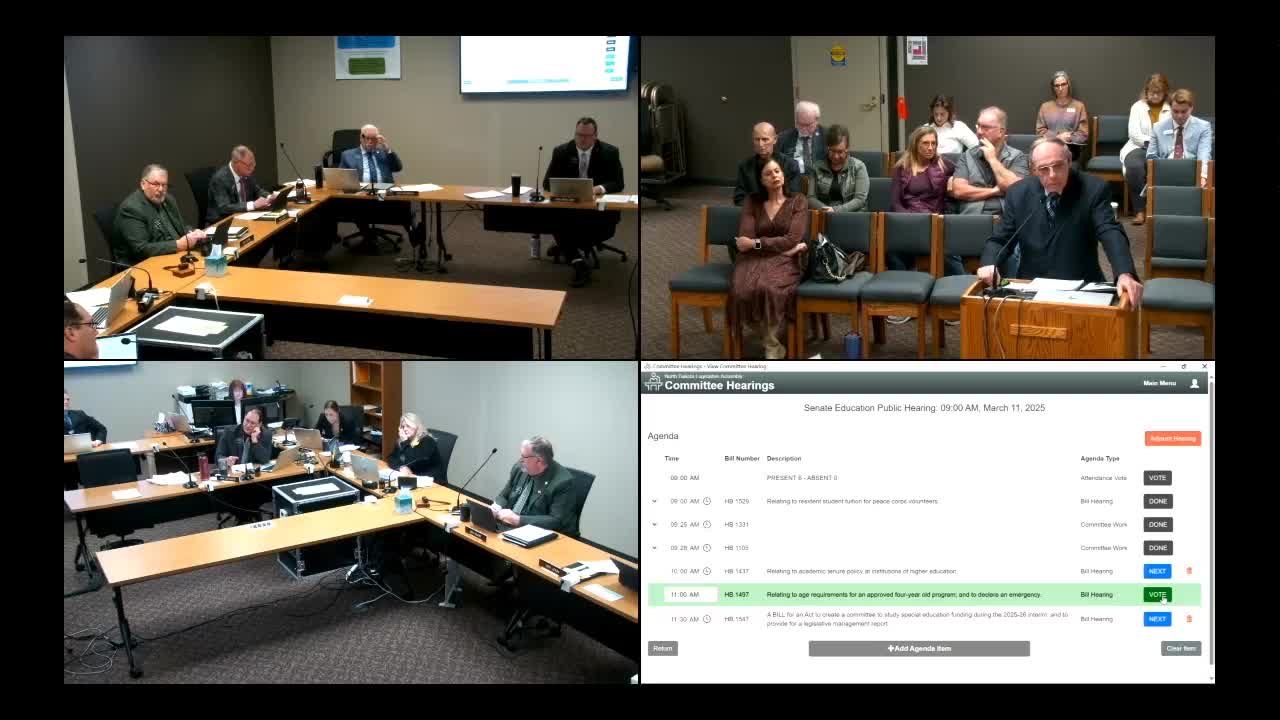
House Bill 1547 proposes a legislative interim study of special education funding in North Dakota. Representative David Richter (Williston) described the bill as a "shell study" to create a committee that will review how special education dollars are distributed, whether the current weighting model best serves districts, and specific issues such as high-cost students, resident placements, Medicaid reimbursements, and other program elements.
Richter explained that North Dakota currently funds special education as a weighting factor applied to a district—s total student count rather than as funding tied to identified special education students. He provided fiscal figures referenced in testimony: for the 2024-25 funding formula, roughly $113,000,000 was identified for special education, $24,000,000 for high-needs special education, and about $34,000,000 in federal funding. Richter said there are 32 special education districts in North Dakota with varying structures (some counties combine schools; larger cities may be their own special ed district).
Supporters included Roxanne Romanek (Designer Genes in North Dakota), who urged the committee to add an amendment so a representative from a statewide family support organization be included on the study committee because discussions would include Medicaid reimbursement issues that require parental permission and touch on parental rights.
The bill lays out committee membership, includes legislative and non-legislative members, and lists study topics such as student contacts, high-cost student supports, resident placements, and Medicaid reimbursement.
Committee members discussed the formula mechanics and transparency issues. Representative Richter and witnesses said the study aims to examine whether the state—s investment (roughly $184 million annually across state and federal streams, per testimony) is targeted effectively and whether reporting or allocation changes could increase accountability and support for students.
The committee closed the hearing on HB 1547 with no roll-call vote recorded during the session.