Get Full Government Meeting Transcripts, Videos, & Alerts Forever!
Get email alerts on the Records Sealing topic
No spam. Unsubscribe anytime.
Committee hears competing views on bill to seal dismissed or acquitted records; court staff warn retroactive sealing would be administratively heavy
Summary
Lawmakers heard competing testimony about House Bill 11‑66, which would automatically seal records after acquittal, dismissal or pardon; supporters say sealing protects privacy and employment prospects, while court staff warned retroactive sealing with an emergency effective date would be administratively burdensome.
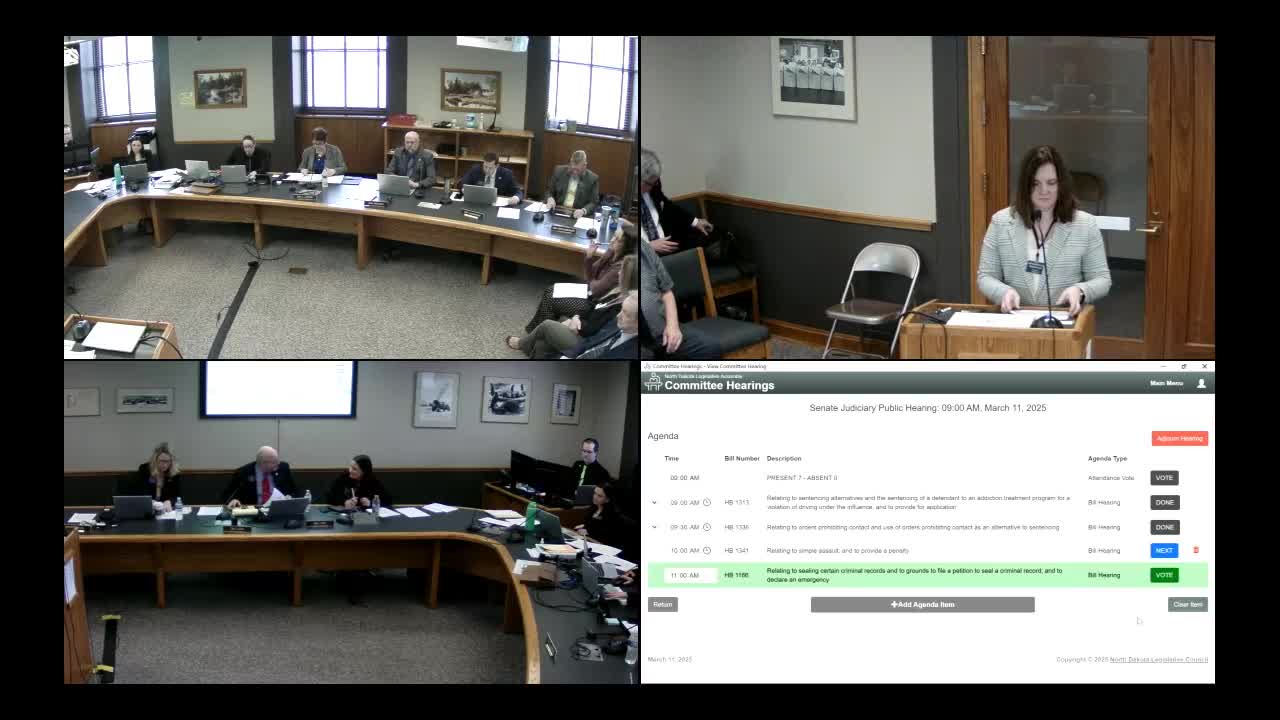
The Senate Judiciary Committee heard testimony on House Bill 11‑66, which would create a process to seal criminal records when charges are dismissed, a defendant is acquitted, or a governor’s pardon is granted. Supporters said sealing the records prevents undue stigma, helps with employment and licensing, and restores the practical effect formerly produced by court administrative practice. Court staff and other officials testified that retroactive sealing and an immediate effective date would create large administrative and IT burdens and recommended more narrowly tailored language or phased implementation.
Sponsor Representative Brandy Pyle said changes in North Dakota Administrative Rule 41 left some dismissed or not‑guilty records accessible through name searches on the court website, including older cases. “Some of these records were 30 to 40 years old,” she said, and described unintended consequences for people seeking jobs, housing or relicensing. Jackie Hall of the North Dakota Association for Justice and other supporters urged reinstating a retroactivity clause to restore protections for older cases opened by the administrative change and asked the committee to add an emergency clause.
Opposition and neutral testimony focused on technical and transparency concerns. Sarah Barrons, staff attorney for the state court administrator, said the court rewrote public‑access rules and removed language that had previously prevented name searches; she emphasized that sealing a record differs from restricting remote access. Barrons said the courts’ forthcoming case‑management replacement system will not support the same name‑search restriction and that retroactive, emergency sealing would require extensive manual work by IT and clerks and could be impossible within an emergency timeframe. Cammie Shook, a court business analyst, explained the existing system had been modified to comply with prior practice; the vendor’s new application does not include the same back‑end customization, and adding it would require additional work, funding or an enhancement.
Other supporters included the Commission on Legal Counsel for Indigence (Todd Ewell), Protection Advocacy (Brad Peterson), defense attorneys and a newspaper‑association witness who asked for a short delay window so journalists covering breaking stories can confirm dispositions. Adam Justinger, a criminal defense attorney, described a client whose dismissed DUI remained visible online and said the bill would make the sealing process consistent with other sealing paths that already exist for deferred sentences and pretrial diversion.
The committee discussed possible amendments and clarifications — including limiting the bill’s scope to court electronic records rather than prosecution archives, clarifying that all charges in a case must be dismissed before sealing, and setting a short public‑notice delay to allow media to report on dispositional changes. Court staff urged removing an emergency clause if the bill is amended and suggested technical fixes or appropriations might be needed to implement retroactive sealing.
Ending: The hearing record shows stakeholders on both sides and multiple technical options for amendments; the committee closed the hearing and asked staff and parties to confer on drafting and implementation details. No committee vote on HB 11‑66 is recorded in the transcript.