Get Full Government Meeting Transcripts, Videos, & Alerts Forever!
Get email alerts on the Consumer Finance topic
No spam. Unsubscribe anytime.
Committee hears competing views on regulating earned‑wage access; industry split over proposed real‑time database
Summary
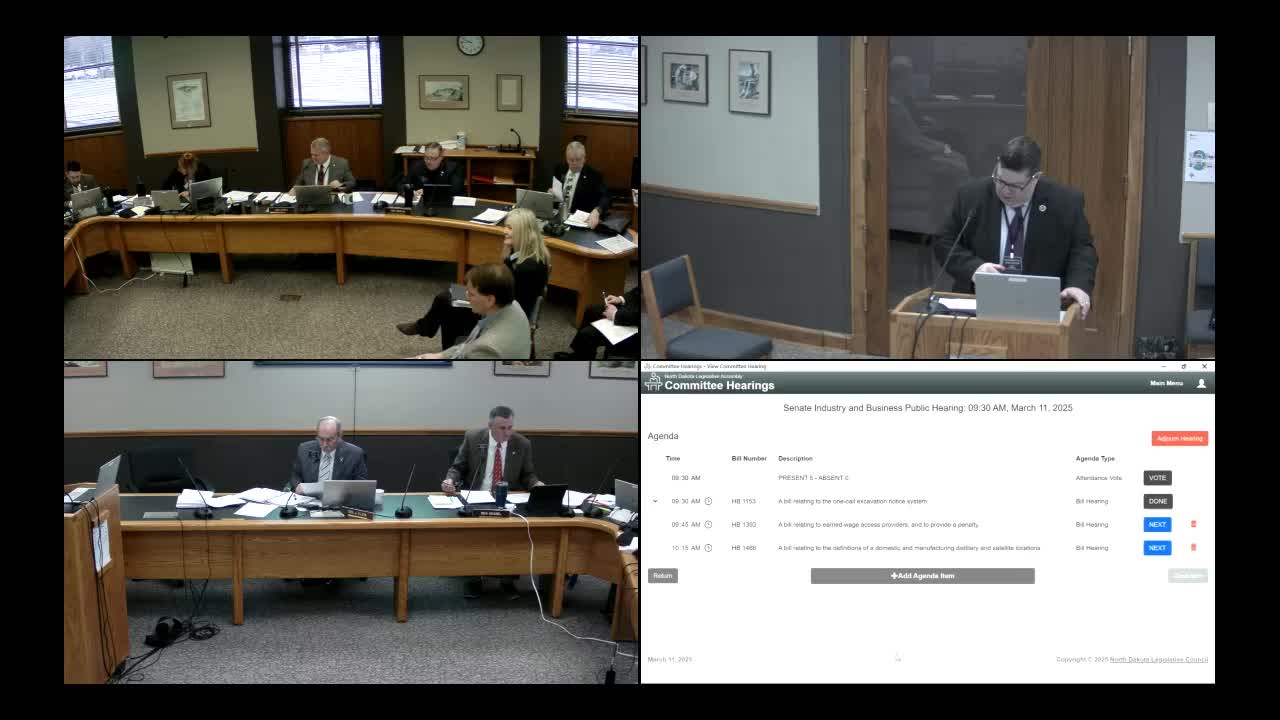
The Senate Industry and Business Committee heard competing testimony on House Bill 1393, which would regulate earned‑wage access providers; witnesses split over whether to require a real‑time transaction database.
The Senate Industry and Business Committee heard testimony on House Bill 1393, a measure to regulate earned‑wage access (EWA) providers and to add penalties for noncompliance. Testimony laid out a clear industry split: vendors that provide direct‑to‑consumer advances and regulatory consultants pressed for a real‑time transaction database; employer‑integrated providers and fintech trade groups opposed a database requirement, saying it would raise costs, raise privacy concerns and may not address real harms seen in EWA.
Representative Jason Dockter introduced the bill as an effort to bring online EWA providers onto an "even playing field" with brick‑and‑mortar deferred‑presentment businesses that report to a statewide database. "If they want to go brick and mortar, they can. If they want to do it on a phone app, they can. They just should follow the same requirements for giving their information," Dockter said.
Bill Kalanick, representing the North Dakota Pawnbrokers Association and Catalyst companies, urged an amendment to require direct‑to‑consumer providers to submit transaction data to a statewide database. He cited research showing frequent EWA use: a California Department of Financial Protection and Innovation (DFPI) analysis reported an average of nine advances per borrower per quarter (about 36 per year) and indicated some borrowers took dozens of advances; one provider told the committee it estimated about 250,000 advances in North Dakota in the prior year.
John Barnes of Catalyst Regulatory & Compliance and other proponents described two business models: employer‑integrated EWA (which integrates with payroll) and direct‑to‑consumer EWA (which advances funds independently). Barnes said direct‑to‑consumer providers have no reliable way to know whether a borrower already has advances from another platform and argued a centralized, real‑time compliance database is “critical for consumer protection.” He referenced Florida and other states that use centralized systems for short‑term credit products.
Opposition focused chiefly on the costs and practicality of a high‑speed, real‑time database. Alex Kelsh and Ryan Naples of DailyPay, an employer‑integrated provider, argued employer‑integrated models already use payroll data to limit advances and that a centralized database would not prevent problematic behavior in an employer‑integrated context. Naples noted California required transaction‑level reporting under MOUs for four years and ultimately did not adopt a mandatory database after review: "After 4 years of this data, there was no database, required," he said.
Industry witnesses and trade groups warned that a database would introduce per‑transaction fees paid by consumers and could raise instant‑transfer costs above current low levels (DailyPay described a common flat‑fee instant transfer around $3.49 and a free ACH option). Catalyst and pawnbroker witnesses said a database paid by transaction fees could be structured so the consumer pays a small fee per transaction and that a database could be self‑funding. The Department of Financial Institutions, represented by Assistant Commissioner Corey Krebs, said no state has yet implemented an EWA database; he estimated roughly 16 companies in the market, projected revenue from licensing/exam fees of about $43,000 and baseline DFI expenses of roughly $15,000, but cautioned a database would increase fiscal impact and could require additional FTEs and higher costs (a prior payday‑lending database estimate had been about $250,000 over a biennium).
Committee members asked about potential caps and limits. Some proponents suggested a dollar limit (for example, $1,000), while others discussed pay‑period limits. Proponents of a dollar cap said it could be simpler to enforce than a pay‑period limit.
No committee action was taken; the committee closed the hearing on House Bill 1393 and did not record a vote. Sponsors indicated they planned to circulate an amendment addressing the database concept and fiscal impacts.
Why it matters: EWA products alter how workers access earned pay and have both supporters who say they reduce late fees and opponents who warn of repeat borrowing. The committee heard technical testimony on enforcement mechanisms, privacy and implementation costs that lawmakers will weigh if they pursue statutory regulation.
What’s next: Committee staff and proponents signaled an amendment was forthcoming; regulators said reporting provisions in the bill would give them data to evaluate whether further changes are needed.