Get Full Government Meeting Transcripts, Videos, & Alerts Forever!
Get email alerts on the Tenure Policy topic
No spam. Unsubscribe anytime.
Tenure overhaul bill draws broad testimony; committee hearing closed without a vote
Summary
House Bill 1437 would require institutions to adopt standardized post-tenure review timelines and procedures. Supporters said it creates consistency and accountability; university system representatives and faculty groups urged the committee to remove prescriptive committee-composition language.
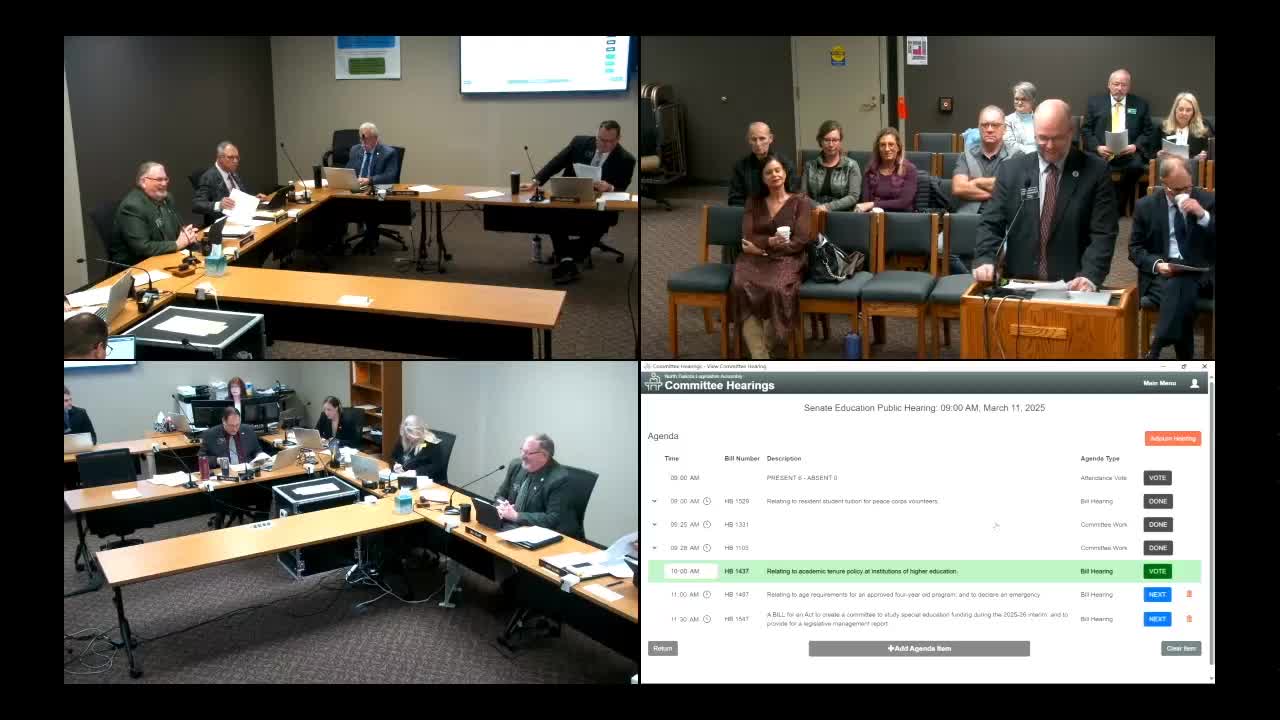
The Senate Education Committee closed the hearing on House Bill 1437 after more than two hours of testimony and discussion but did not vote on the measure.
Representative Mike Matzenbacher (District 47) introduced the bill as a clarification and standardization of tenure and post-tenure review procedures across the North Dakota University System (NDUS). The bill sets a timeline requiring institutions to have policies in place by July 1, 2026; it also prescribes a first post-tenure review within three years after enactment and subsequent reviews at least every five years. Matzenbacher said the bill does not eliminate tenure but clarifies procedures, post-tenure review frequency, and how institutions should specify whether positions are tenure-track.
Supporters, including Representative Mike Lefor (District 37), Dr. Megan Salyers (assistant dean at a North Dakota institution), and other faculty members, said the bill creates consistent expectations for post-tenure review and accountability while still allowing institutions flexibility. Dr. Salyers and other witnesses proposed a revision to wording in section 1(d) to ensure review committees include administrative supervisors and allow institutions to choose committee sizes appropriate to their missions. She suggested committee composition should require at least one-third and no more than one-half faculty representation where applicable.
Opponents included Nick Archuleta, president of North Dakota United, Lisa Montpleasure (NDSU Faculty Senate president), and Lisa Johnson (Vice Chancellor for Academic and Student Affairs, North Dakota University System). They urged a do-not-pass recommendation if the bill retained prescriptive committee-composition language. Their principal objections were that the bill, as drafted, would:
- Prescribe committee composition in a way that could exclude appropriate content experts and established multi-layer review practices; and - Encroach on the State Board of Higher Education—s statutory authority and on institutional autonomy to adopt policies tailored to mission and size.
Johnson and Montpleasure said the State Board and an ad hoc committee had already spent extensive time revising board policies and recommended the legislature defer to the board on committee composition. Johnson also flagged that the bill's wording around timing needs a clarification: the sponsor's amended language should specify "every five years or more frequently" to avoid an interpretation allowing very infrequent reviews.
Committee members asked technical questions about definitions, how the proposed timelines would compare to current practice, who would serve on review committees, and the effect on small departments. Matzenbacher said the bill reflects negotiated changes with NDUS and that a final drafting by the Legislative Council could refine language.
The committee closed the hearing without taking a vote. Members indicated potential willingness to consider amended language that removes the prescriptive sentence about committee composition and preserves institutional flexibility while keeping the timeline elements.
No formal motions or votes on HB 1437 were recorded during the hearing.