Get Full Government Meeting Transcripts, Videos, & Alerts Forever!
Get email alerts on the Protective Orders topic
No spam. Unsubscribe anytime.
Committee advances bill to allow protective orders up to sentencing and to provide removal process
Summary
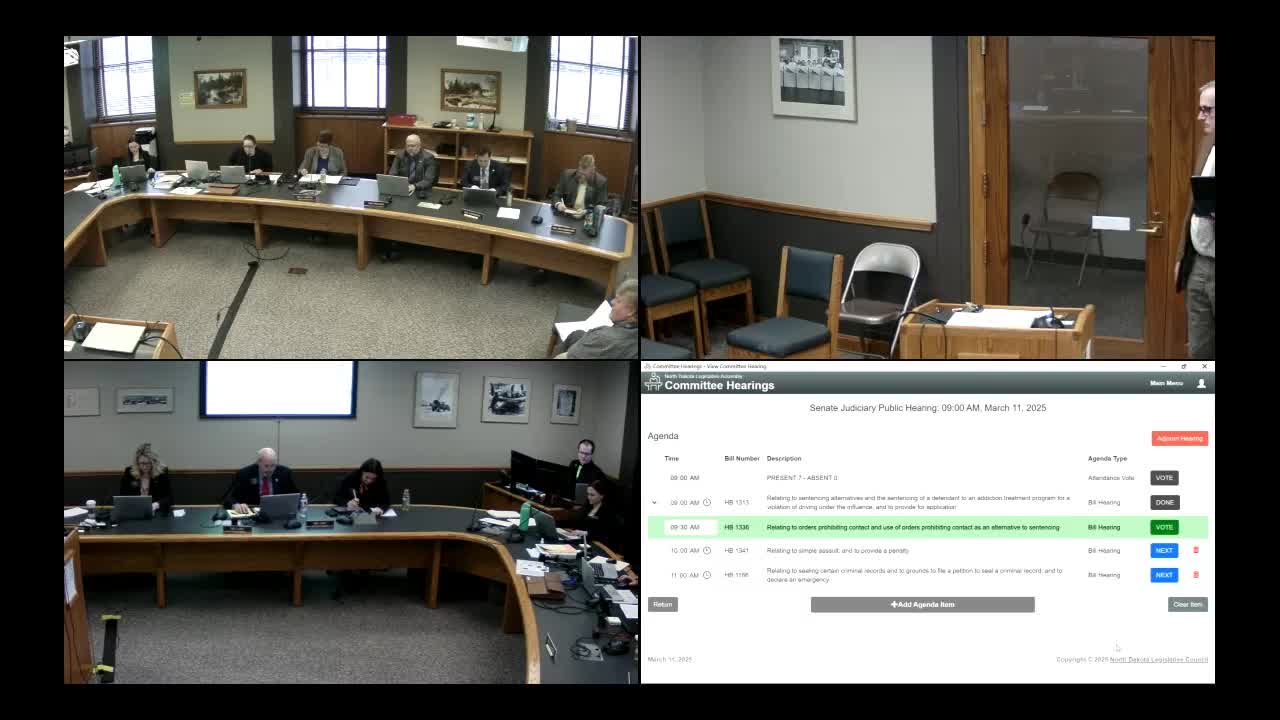
House Bill 13‑36, which extends the timeframe for orders prohibiting contact up to sentencing and creates a process for removing such orders, received a do‑pass recommendation from the Senate Judiciary Committee.
The Senate Judiciary Committee voted to advance House Bill 13‑36 after a brief hearing. Representative Bernie Satrim presented the bill and described it as similar to the earlier item on sentencing‑based no‑contact orders but focused on allowing orders prohibiting contact through the period up to sentencing and adding a process to remove those orders.
“For the record, my name is Bernie Satriman,” Satrim said in the hearing. He described a scenario in which a victim and a convicted defendant both attend a public event and said without this change a victim might have to contact a probation officer and wait while a potential revocation is considered. Satrim said the bill “extends rights to victims” and argued the burden of proof has already been met at conviction, so requiring a civil order is unnecessary in those circumstances.
There was no recorded opposition in committee testimony, and Chair Larson closed the hearing after receiving no requests to testify in opposition or neutral testimony. Senator Castaneda moved a due‑pass recommendation; Senator Myrtle seconded. On roll call, members present recorded affirmative votes and Chair Larson announced the motion carried. A committee member volunteered to carry the bill to the floor.
Discussion vs. decision: The committee record shows support from the bill sponsor and no opposing witnesses; the committee took formal action (do pass) and named a floor sponsor. No amendments were recorded.
Ending: With the committee vote recorded in favor, committee staff and members discussed sequencing bills on the floor to present them back‑to‑back.