Get Full Government Meeting Transcripts, Videos, & Alerts Forever!
Get email alerts on the Victim Protection topic
No spam. Unsubscribe anytime.
Senate Judiciary Committee gives ‘do pass’ recommendation to bill letting courts impose no-contact orders at sentencing
Summary
The Senate Judiciary Committee heard testimony and voted to advance House Bill 13-13, which clarifies that courts may enter no-contact orders for victims at the time of sentencing rather than requiring a separate civil petition. The committee voted to give the bill a ‘do pass’ recommendation and selected a floor sponsor.
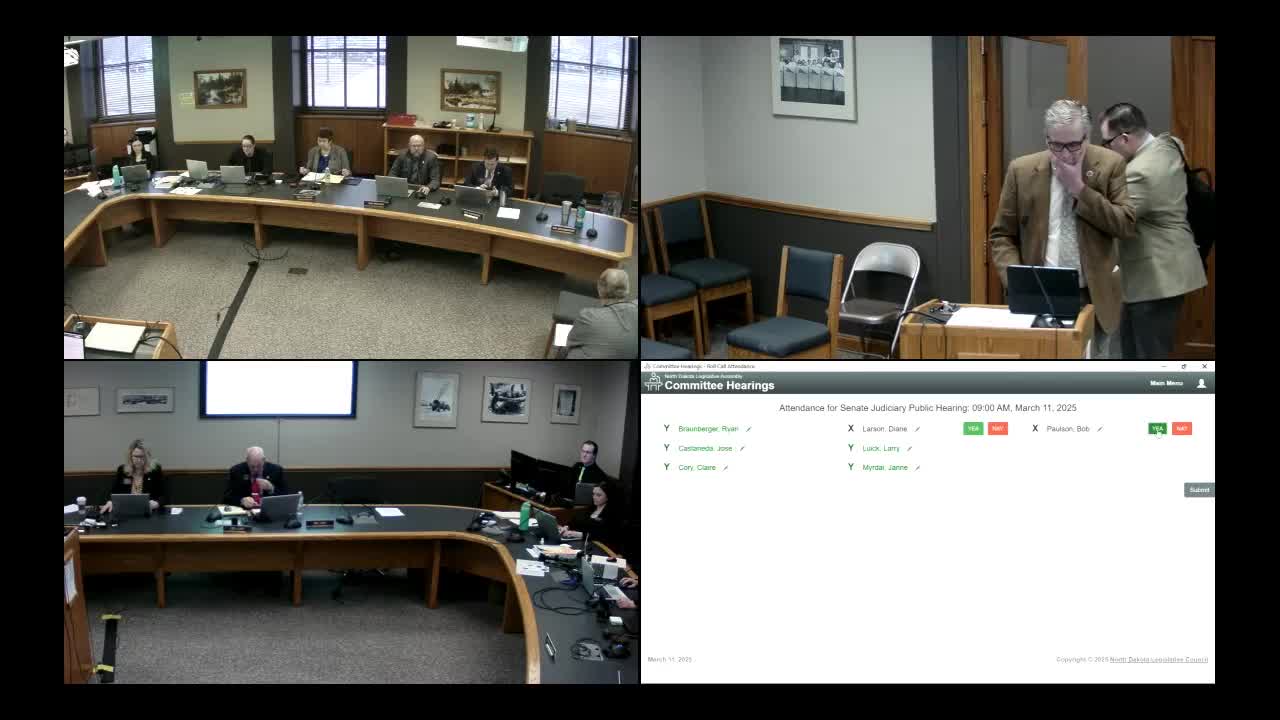
The Senate Judiciary Committee voted to give a ‘‘do pass’’ recommendation on House Bill 13‑13, which allows courts to impose no‑contact orders for victims during sentencing rather than requiring victims to file a separate civil petition. Senator Bridal moved the committee recommendation, and Senator Lewick seconded the motion; the committee then recorded affirmative votes and advanced the bill.
The bill’s sponsor, Representative Bernie Satrim, told the committee the change is intended to spare victims the trauma and cost of filing a separate civil action. “It just makes it very clear that during sentencing, they can put together a no contact order,” Satrim said. He described the change as “very simple but very important.”
Jonathan Byers, testifying for a state prosecutors’ group, said prosecutors support HB 13‑13 but raised a question about language on page 3 that previously told the Department of Corrections it could prohibit contact during imprisonment. Byers said the language was removed because the new sentencing subsection duplicates it but added that leaving the prior text in would not be objectionable.
Committee members discussed whether the authority to enter a no‑contact order already exists in law and whether the bill is largely clarifying statutory language. Senator Lewick said the change “should be in the law already.” Representative Satrim and others explained the bill is more prescriptive in the sentencing context and preserves judicial discretion to impose or not impose the order depending on circumstances.
After discussion, the committee took a roll call and recorded affirmative votes from members present; Chair Larson announced the motion carried. Senator Castaneda agreed to carry the bill on the floor.
Discussion vs. decision: The hearing included testimony in support and clarifying questions about whether the change duplicates existing authority. The committee made a formal recommendation (do pass) and chose a floor sponsor. No amendments were adopted in committee.
Ending: With the vote completed, committee leadership set timing to schedule floor action and moved on to other agenda items.