Get Full Government Meeting Transcripts, Videos, & Alerts Forever!
Get email alerts on the Public Defense topic
No spam. Unsubscribe anytime.
Proposal would presume indigence for people jailed at initial appearance, increasing counsel access
Summary
Senate Bill 2226 would presume that incarcerated individuals at initial appearance are indigent for the narrow purpose of setting release conditions, prompting debate about cost, timing and a pending federal appellate case that could make the change required by court order.
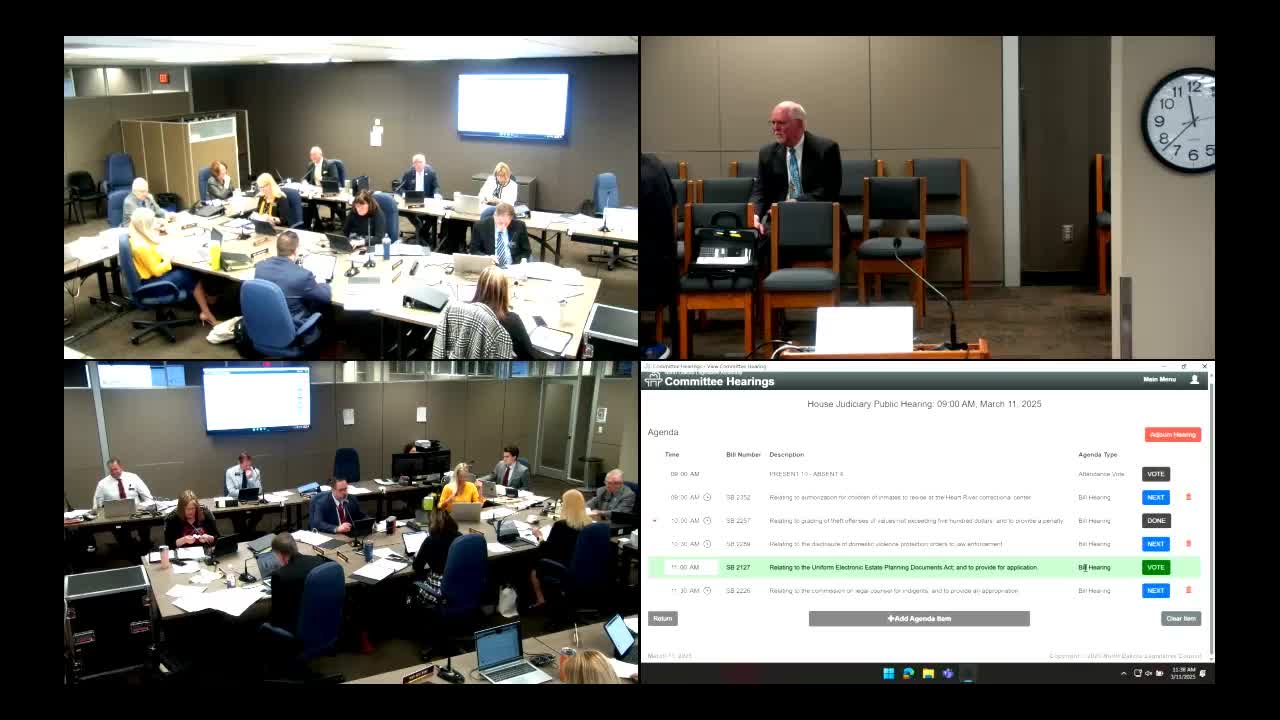
Senate Bill 2226, discussed at a House Judiciary Committee hearing, would change state law to treat an incarcerated person as presumed indigent for the limited purpose of appointing counsel at the initial appearance where the judge determines release conditions.
Sponsor Senator Jonathan Sickler (District 17) said the change responds in part to litigation in the Eighth Circuit (a federal district-court decision from the Western District of Arkansas) that found counsel at initial appearance to be a constitutional right in that jurisdiction. Sickler said North Dakota’s rules already contemplate counsel at initial appearance but that appointed counsel is not consistently provided statewide because indigence determinations are typically made after the initial hearing.
Travis Fink, executive director of the Commission on Legal Counsel for Indigence, told the committee the agency supports the change and provided a fiscal and implementation overview. Fink said the commission calculated the appropriation request by estimating the number of initial appearances statewide and projecting counsel-hour needs. The commission expects to use contract attorneys for initial‑appearance coverage and asked the committee for flexibility on implementation timing. The governor's office said it would support an effective date of Jan. 1, 2026 to give the court system, the commission and stakeholders time to implement required rule and operational changes.
Debate and questions: Committee members raised questions about cost, capacity and what would happen if a federal appellate decision ultimately rejects the constitutional claim. Fink and the sponsor said the bill is appropriate even if the Eighth Circuit were to rule otherwise because the change is a standalone expansion of counsel access that serves public‑safety and equity goals. Supporters also cited research and internal analyses showing counsel at early stages may reduce pretrial detention time and downstream costs.
Next steps: No vote was taken at the hearing. The commission said it would supply revised appropriation figures if the committee adopts a delayed effective date and the governor’s office indicated it favors a Jan. 1, 2026 effective date to coordinate rules, training and staffing.