Get Full Government Meeting Transcripts, Videos, & Alerts Forever!
Get email alerts on the Estate Planning Digitalization topic
No spam. Unsubscribe anytime.
Uniform act proposed to allow electronic trusts, powers of attorney and other non‑wills estate documents
Summary
A uniform‑law proposal to authorize electronic signing and storage of non‑testamentary estate planning documents drew support from banks, credit unions and financial regulators but county recorders asked the committee to clarify how certified paper copies of electronic documents will be authenticated for recording.
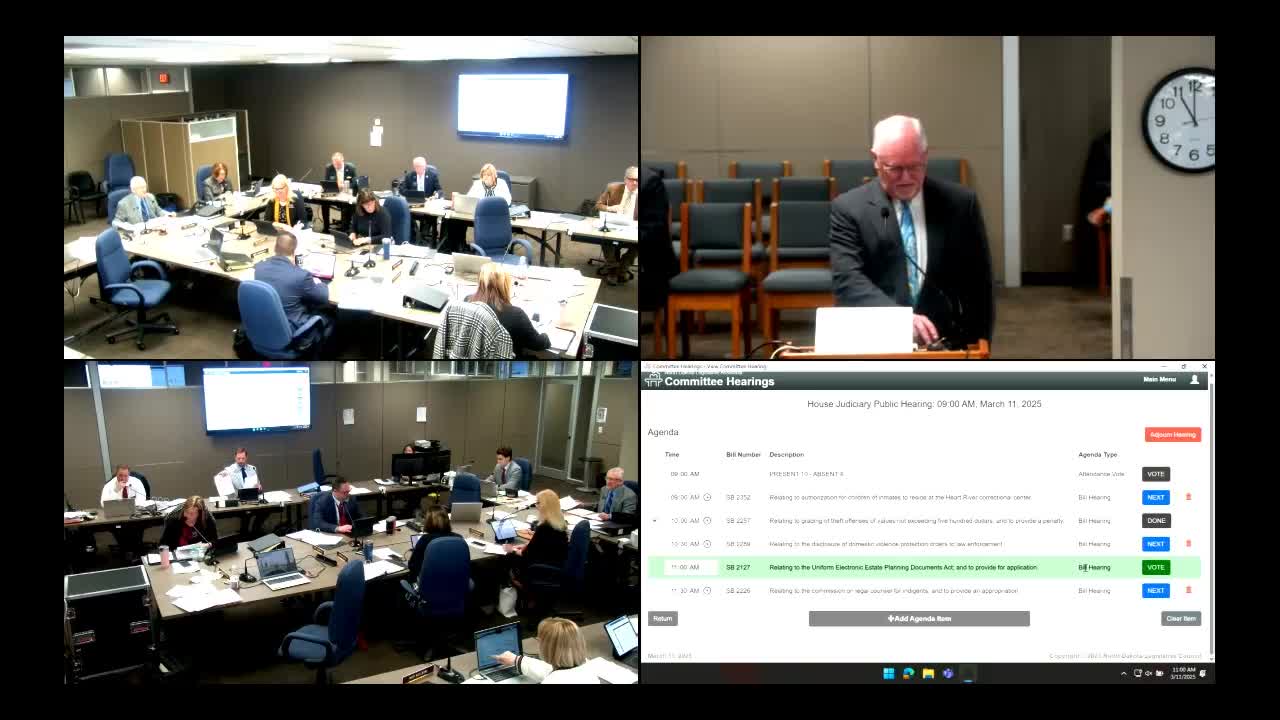
The House Judiciary Committee heard Senate Bill 2127, which would adopt the Uniform Electronic Estate Planning Documents Act to permit electronic execution and legal effect for estate planning documents that are not wills — for example, trusts and powers of attorney.
Bradley Myers, a commissioner for the Uniform Law Commission and a University of North Dakota law professor, told the committee the model statute fills a gap: the Uniform Electronic Transactions Act allows electronic commerce and the recent Uniform Electronic Wills Act addresses electronic wills; UEEPA would allow non‑testamentary estate documents to be created and signed electronically and not be denied legal effect solely because they are electronic.
Support and benefits cited: Rick Kleberg of the North Dakota Bankers Association and John Alexander of the Dakota Credit Union Association urged adoption, saying clearer law helps banks, credit unions and customers in a rural state where in‑person execution is sometimes difficult. Lisa Cruz, commissioner of the Department of Financial Institutions, told the committee that clarity would help industry modernization and interstate consistency.
Recorder concerns: County recorders raised a technical concern about how papered‑out copies of electronically executed documents would be certified for recording. Morton and McKenzie county recorders asked the committee to clarify which parties may issue a certified copy of an electronic non‑testamentary document (for example, a notary, an attorney or a recording office) and how that certification must be presented so recorders can accept it for the land records. Several recorders said if an electronic document is submitted through an approved e‑recording vendor, the existing e‑recording certification processes address the concern, but they sought a statutory clarification for paper copies of electronic documents that are later presented for recording.
Next steps: Committee members said they would consider a drafting amendment to clarify who may certify a paper copy of an electronic estate document for recording and how the certification must be presented.