Get Full Government Meeting Transcripts, Videos, & Alerts Forever!
Get email alerts on the Domestic Violence Protection Orders topic
No spam. Unsubscribe anytime.
Sponsor asks for help giving law enforcement timely access to protection orders in computer systems
Summary
A senator told the House Judiciary Committee a small but dangerous gap in records access can leave protection orders invisible to officers responding to late-night domestic-disturbance calls; the committee discussed using court case systems to supply the information but deferred action pending consultation with the courts.
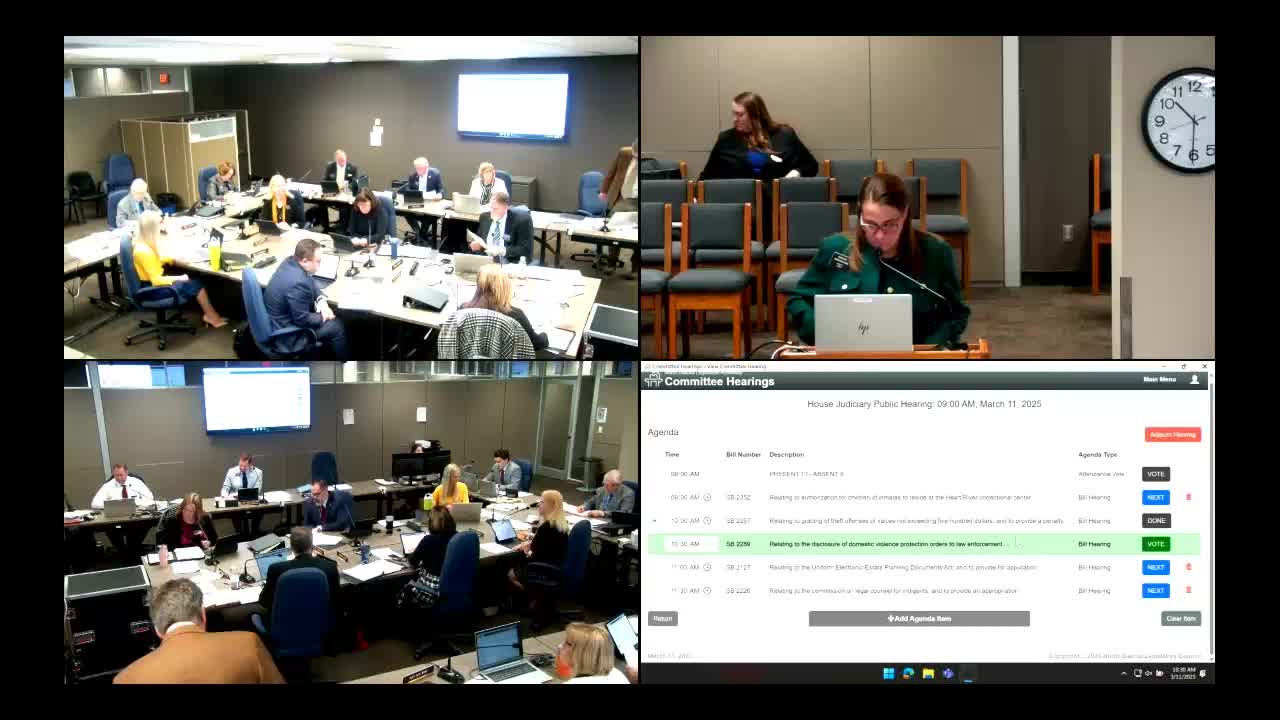
Senator Kristen Rohrs (District 27) asked the House Judiciary Committee to consider Senate Bill 2289, which would authorize disclosure of domestic‑violence protection orders to law‑enforcement systems so officers responding to emergency calls can confirm the existence and status of orders even when the order has not yet been uploaded to national indices.
Rohrs described repeated calls from sheriffs whose deputies encountered victims who said they had just obtained protection orders — sometimes earlier the same day — but the officers could not see the order in the law‑enforcement database they use in the field. “They look in their computer system … and there’s nothing there,” Rohrs told the committee. She asked whether limited read-only access to the court case-management system (Odyssey) or a statutory duty to disclose could solve the problem so law enforcement can verify an order while officers are still on the scene.
Support and concerns: Committee members and the sponsor said they sought a narrowly tailored mechanism to allow officers to check court records without creating broader public-access rules for sensitive orders. A member suggested victims could carry paper copies of the order; the sponsor replied that officers must be able to trust a source they can access electronically and not depend on unverified paper at 3 a.m.
Privacy and procedure questions: Committee members noted that some protection orders and sexual‑assault restraining orders are confidential under state rules; witnesses and written comments from the North Dakota Domestic and Sexual Violence Coalition (filed with the committee) asked that the bill be amended to include sexual‑assault restraining orders and that any disclosure safeguard confidentiality and avoid unintended public dissemination.
Next steps: Committee members said they would consult with the state Supreme Court and court administrators before advancing statutory language. No vote was taken.