Get Full Government Meeting Transcripts, Videos, & Alerts Forever!
Get email alerts on the Prison Nursery topic
No spam. Unsubscribe anytime.
Committee hears plan to allow infants to live with mothers at Hart River Correctional Center
Summary
A bill to authorize children of incarcerated parents to live at the new Heart River Correctional Center drew broad support from corrections staff, human services directors and advocacy groups at a House Judiciary Committee hearing, while justice advocates urged stronger safeguards on liability and policy development before the program opens.
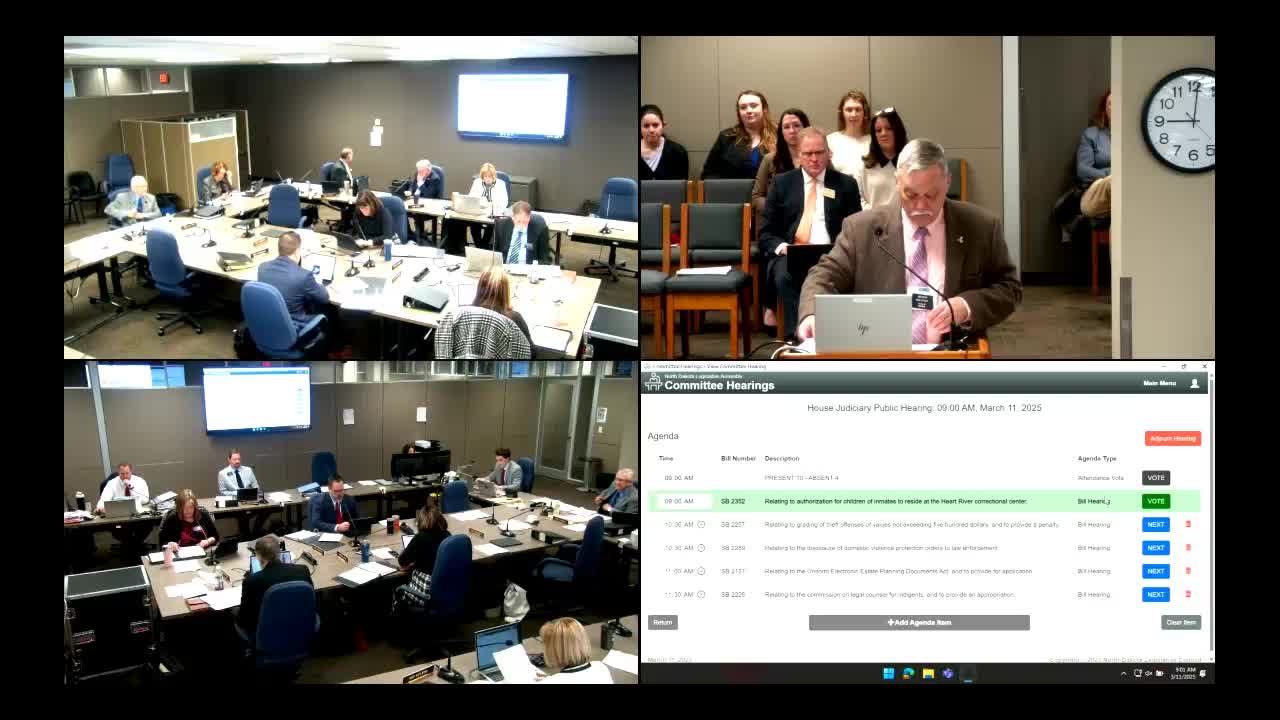
The House Judiciary Committee on Oct. 12 heard testimony on Senate Bill 2352, which would authorize children to reside with incarcerated mothers at the Heart River Correctional Center (HRCC) once the facility opens.
Supporters, including the bill sponsor and Department of Corrections and Rehabilitation officials, said the proposal aims to strengthen mother–child bonding, reduce recidivism and reduce foster-care costs. Cheryl Thomas, women's services manager for the Department of Corrections and Rehabilitation, told the committee the agency has a draft policy, floor plans and a proposed application process for participation.
The bill sponsor, Senator Dever (District 32), outlined research from other states showing very low return-to-prison rates among mothers who participated in prison-nursery programs and said federal Title IV‑E funds can pay some child-care and welfare costs. “It is necessary that corrections plan for that, and I think it necessary that they have the support of the legislature to do it,” Dever said.
Why it matters: Supporters argued the program will promote rehabilitation by preserving family bonds and could be less expensive than placing infants in foster care. Multiple human services and child-welfare speakers testified that careful policy and interagency coordination would be required to protect children.
Key details and program design: Department testimony and handouts describe a dedicated building within HRCC designed with four apartment-style units intended to be segregated from general population. The plans presented to the committee show each apartment could contain up to six bedrooms; the Department said the apartment building could house up to 24 mothers (without children) and up to 32 residents if used as general housing. The draft policy circulated by the Department says the program would begin at the child’s birth and—per the draft policy text—extend “to 18” (the policy wording appears to differ from other testimony about an 18‑month participation window; the committee discussed both an 18‑month eligibility window and language in the draft policy). The Department said participation would require an application and review process and listed eligibility factors including pregnancy at admission to HRCC, a plan for the mother to be the child’s primary caregiver upon release, parole or good‑time release within the stated participation period, medical and mental‑health clearance, immunizations and background checks; registrable offenses involving children would disqualify applicants.
Funding and oversight: Department and supporters said Title IV‑E foster-care funds and other federal benefits (WIC, SNAP, TANF) may be available for children in the program; the Department also said Medicaid would cover the child’s medical care. The committee questioned whether the Department of Health and Human Services or the Department of Corrections should submit fiscal notes; the sponsor and Department representatives said they had consulted DHHS leadership and were coordinating on policy and funding questions.
Concerns and conditions: Jackie Hall of the North Dakota Association for Justice testified in opposition, saying the bill lacked required parameters to ensure safety and adequate oversight before a program launch. Hall urged either statutory language that requires interim reports or a final report to the Legislature on policies and procedures before the program admits children. She also repeated concerns raised earlier about liability releases and statutory caps on damages for injuries to children in state custody.
Other testifiers included Dennis Meyer, director of the 3 Rivers Human Service Zone, who urged interagency collaboration and training requirements for staff and caregiving residents, and Missy Barranca of Aspire ND, who described the developmental and mental-health harms that separation can cause and urged the program as a public-health and prevention step.
Committee discussion: Members asked about the program’s effect on recidivism, staffing and training, security and how long children would remain in the program. Committee members repeatedly asked whether the facility’s planned design (locks, counters, changing stations and a segregated apartment unit) will be finalized and whether policies will require criminal-history checks, pediatric CPR, mandated‑reporting training and formal agreements with child‑welfare agencies.
What’s next: Committee members did not take a vote at the hearing. Several lawmakers asked the Department and stakeholders to finalize policy language, provide clearer fiscal notes that identify which agencies will absorb costs if federal funding changes, and confirm whether the draft policy’s wording about the program’s length is 18 months or until the child is age 18. Department witnesses said construction for HRCC is proceeding and that they will continue work with DHHS and zone directors on policy details.