Get Full Government Meeting Transcripts, Videos, & Alerts Forever!
Get email alerts on the Water Infrastructure Budgeting topic
No spam. Unsubscribe anytime.
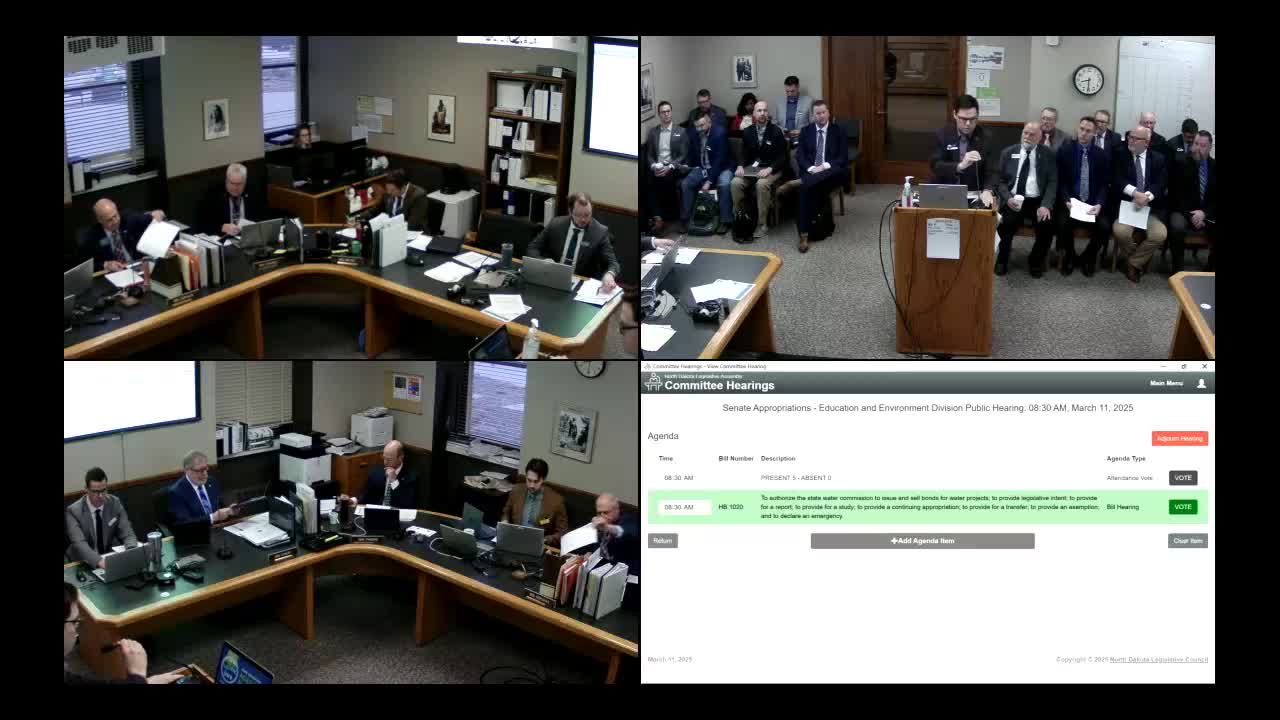
Senate E&E reviews Department of Water Resources budget, backing projects from Minot flood control to NAS operations
Summary
Department of Water Resources officials outlined the funding and project priorities in House Bill 1020, warning of a multibillion-dollar long‑range need and urging preservation of Resources Trust Fund allocations while project sponsors described timelines, inflation impacts and local funding gaps for flood control and regional water systems.
The Senate Appropriations Education and Environment Division heard officials from the North Dakota Department of Water Resources and project sponsors Tuesday on the department’s portion of House Bill 1020, covering staffing requests, a multi‑year project plan and enacted and proposed funding tools including state bonding and a Bank of North Dakota line of credit.
The department’s director, Rhys Haas, told the committee the agency’s 14‑year inventory of water needs totals about $5.2 billion, and that “the state’s share of that, assuming all of them would come to the Water Commission for cost share, would equal $3,400,000,000.” He also urged keeping the Resources Trust Fund allocation at 20.5 percent of oil tax receipts and said a proposed reduction to 15 percent would create “somewhere between a $1.3 and a $1,600,000,000 shortfall” over the 14‑year timeframe.
Why it matters: The hearing combined an overview of the department’s budget request with detailed presentations from project sponsors who are relying on HB1020 line items and on federal and local matches. Committee members pressed staff on schedules, construction costs and the department’s staffing needs to operate and oversee expanding state‑run projects.
Most important details
- Budget and statewide planning: Haas described the department’s prioritization guidance and a proposed new approach for the biennium that relies on a $200 million line of credit from the Bank of North Dakota and a $100 million bonding package for the Southwest Pipeline Project to accelerate project spending and capture inflationary savings in the near term. The House’s version of HB1020 separates several large capital items—Southwest and NAS—into distinct line items rather than lumping them under capital assets.
- FTEs and operating requests: The department requested seven new FTEs; the House approved six. Haas and administrative director Chris Katamis asked for one additional FTE for in‑house general counsel and explained several other special‑funded FTEs (accountant, deputy director, NAS operator and federal‑funded NFIP/risk‑map positions) are funded from special funds or federal reimbursements, not general funds.
- Resources Trust Fund risk: Haas drew the committee’s attention to a scenario analysis showing a lower allocation of oil tax receipts to the Resources Trust Fund would materially reduce the state’s ability to meet projected cost‑share needs.
Project presentations and sponsor concerns
- Mouse (Souris) River / Minot: Tom Ross, mayor of Minot, and Ryan Ackerman, administrator of the Souris River Joint Board, asked for the state share reflected in HB1020 to keep the Mouse River Enhanced Flood Protection Project on schedule. Ackerman said the updated FEMA risk maps will place roughly 3,000 additional homes into the 1% annual‑chance floodplain in Minot and estimated the annual economic hit to the community at about $14 million if the project is delayed. He told the committee the first milestone of work — including the maple diversion — is expected to begin construction in 2026 and that inflation and supply constraints have pushed bid prices sharply higher on several components. "We think it's a combination," Ackerman said, referencing contractor feedback about labor and backlog. He presented alternative completion scenarios showing total state shares rising under 3–5% inflation models.
- NAS (North Area Supply) project and Biota treatment plant: Sindhuja Espalai, Water Development Division director, briefed the committee on the North Area Water Supply (NAS) program and the Biota Water Treatment Plant. She reported progress on reservoir, pipeline and pump upgrades but warned of a contractor dispute that delayed the Biota plant and said, "we are expecting that project to be completed sometime in 2025," while stressing that timeline remains uncertain. The NAS presentation also included a request for an NAS operator FTE to be funded from NAS rates; Espalai said the system’s geographic size means operations require local, in‑region staffing.
- South Bismarck flood control: Gabe Schell, city engineer for Bismarck, described a FEMA‑awarded Flood Mitigation Assistance (FMA) grant for the South Bismarck project. He said the city had been awarded $50 million through FEMA and explained the project is designed to meet FEMA accreditation standards (pump stations and conveyance improvements) so properties can be removed from the 100‑year floodplain. Schell noted the FEMA grant must be spent and the project completed within the federal timeline (three years with possible extensions), and he described a phased schedule that anticipates construction through 2029.
- Valley City and other basin projects: Valley City officials updated the committee on multi‑phase flood protection work, asked for a $16 million appropriation for the next phase and said prior phases reduced emergency response needs and sandbagging by large amounts. Mayor Dave Karlsruhe and city administrator Gwen Crawford emphasized steady, phased progress tailored to local capacity.
- Rural and regional water systems: Eric Volk (North Dakota Rural Water) and Matt Gardner (North Dakota League of Cities) summarized the demand for rural water and municipal water projects. Volk said the rural/regional systems provide service to roughly 160,000 rural residents over 71,000 connections and asked the committee to support a substantial rural water bucket; the House and Senate proposals differ in amounts. Gardner highlighted municipal water needs — including lead service line replacement and operator workforce shortages — and cited Department of Water Resources estimates that municipal water line, treatment and storage needs could total hundreds of millions over the next decade.
Committee and process notes
Committee members repeatedly pressed presenters about inflation‑driven bid increases, contractor availability, and the timing of federal matches. Director Haas and other presenters emphasized that many department FTE requests are funded from special funds or federal grants. Senators asked whether the department was presenting the House bill or the department’s original request; Haas said the presentation combined both, noting coordination with the Governor’s office and the House during budget development.
Ending
Department staff said they would return with additional details on some items if the committee wanted them; no formal votes were recorded at the hearing. Presenters urged the committee to consider the multi‑year implications of decisions on the Resources Trust Fund and on one‑time financing tools so that priorities such as Minot flood protection, South Bismarck mitigation and NAS completion can proceed with secured matches and staffing to operate completed infrastructure.