Get Full Government Meeting Transcripts, Videos, & Alerts Forever!
Get email alerts on the Community College Capital Workforce topic
No spam. Unsubscribe anytime.
Lake Region State details enrollment rebound, wind turbine program, and $6M deferred‑maintenance request
Summary
Lake Region State College told appropriators it has recovered from pandemic lows, expanded career and technical enrollment (notably nursing), hosts unique wind and apprenticeship training, and seeks capital funds to fix roofs, parking and electrical upgrades totaling roughly $6.0 million.
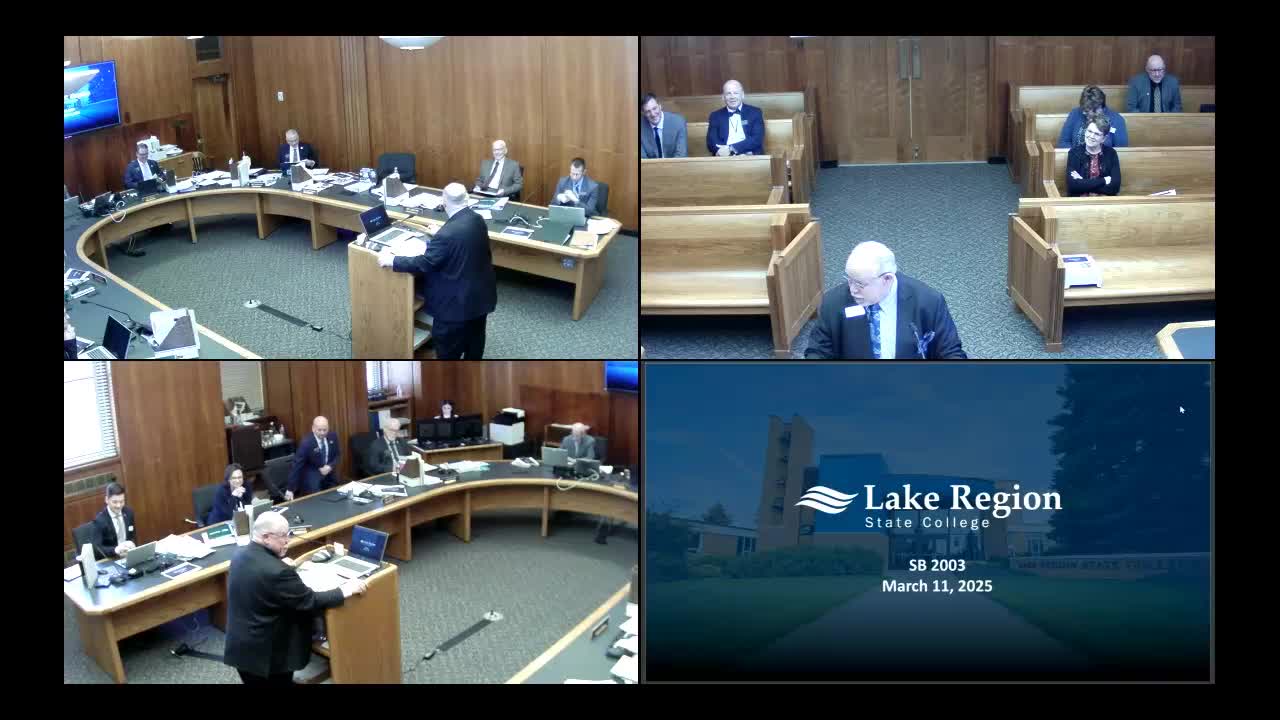
Lake Region State College President Doug Darling told the Appropriations - Education and Environment Division that the college has regained and modestly exceeded pre‑pandemic enrollment levels and is seeking capital funding and legislative attention to deferred maintenance and program expansion.
Darling said Lake Region’s fall and spring enrollments have risen to roughly 1,900 students and that the campus now places a larger share of students in career and technical programs (about 71%) than in traditional transfer tracks. Nursing enrollment has notably expanded: the program has grown from about 40 students several years ago to 126 in the most recent fall intake, and the college operates nursing cohorts in multiple locations, including a site that will move onto Altru Health’s Grand Forks campus.
Why it matters: Lake Region described several campus‑level and regional workforce initiatives — including wind‑turbine technician training, Global Wind Organisation (GWO) certification, apprenticeship work with employers and the tribal colleges, and a nascent solar installation program — that the college says support regional employers and North Dakota’s energy and national‑security workforce needs.
Capital requests and deferred maintenance: Finance vice president Joanne Kitchens presented Lake Region’s capital priorities and a multi‑part deferred‑maintenance package that leaders said is time‑sensitive: - Roof restoration: the college asked for a remaining $3,200,000 to complete a superior membrane restoration across 29 roof areas (Phase 1 completed at $626,000). Kitchens said completing the restoration now saves roughly 30% compared with full replacement later, and that the warranty window requires work by 2027 on the earliest segments. - Parking, curb and gutter repairs and additional parking: roughly $2,500,000 requested to finish previous work, add about 4,100 square yards of parking and repair pavement damage. - Electrical/voltage upgrade: about $360,000 requested to bring campus equipment into compliance with Otter Tail Power’s planned distribution‑voltage changes in 2027.
Kitchens told the committee that available tier 1–3 capital funds and possible matches would not cover the total request in a single biennium; even with maximum matches the college estimated the package would stretch multiple biennia to complete.
Other campus items: Darling said the college has invested local and philanthropic resources — the foundation’s corpus tripled from $4.5 million to $13.6 million since the Challenge Match program — and used those dollars chiefly for scholarships. Lake Region also noted expanded student life offerings (men’s and women’s hockey, eSports) that have added full‑time students and improved retention.
Wind turbine and insurance: Darling described technical training on an aging campus wind turbine used as a training platform. The turbine required an expensive gearbox repair two years ago and Lake Region had to purchase private insurance because state risk management would not insure the asset; the private premium rose materially (presenter said the premium increase was “substantial”) but the turbine remains a training asset.
Ending note: Lake Region asked legislators to consider timing and scale of capital appropriations and to weigh tools such as low‑interest revolving funding for auxiliary capital needs. Campus leaders stressed that promised tier and capital funding would be essential to maintaining facilities and the workforce pipeline the college serves.