Get Full Government Meeting Transcripts, Videos, & Alerts Forever!
Get email alerts on the Housing And Zoning topic
No spam. Unsubscribe anytime.
Montgomery County public hearing draws wide debate over ‘More Housing Now’ zoning and tax pilot
Summary
Hundreds of residents, organizations and developers testified for and against a package of zoning text amendments and a proposal for a 25‑year property tax abatement aimed at converting commercial buildings and allowing denser housing along corridors. No council vote was taken; planning and fiscal work sessions were scheduled.
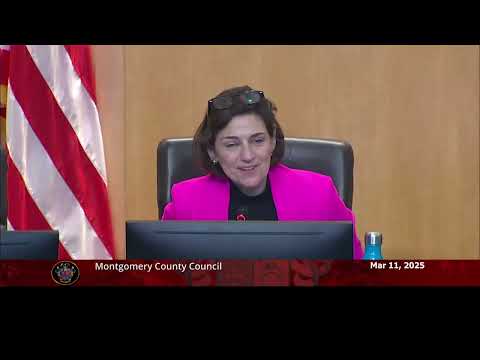
Montgomery County Council heard more than three hours of public testimony March 3 on a package of proposals dubbed "More Housing Now," which would allow new residential building types on designated corridors, expand options for converting vacant commercial buildings to housing, and create a 25‑year payment‑in‑lieu‑of‑taxes (PILOT) pilot to encourage conversions.
The package’s sponsors and opponents framed the debate around affordable‑housing supply, neighborhood impacts and fiscal risk. Artie Harris, chair of the Montgomery County Planning Board, said the planning board "strongly support[s] the More Housing Now package," urging the council to use the proposals to address a two‑decade decline in middle‑income residents. "Our county has been steadily losing our middle income residents," Harris said, citing planning board figures that the county has lost tens of thousands of middle‑income households over 20 years.
Why it matters: supporters said the changes add practical tools to create workforce and middle‑income housing and to repurpose vacant offices; opponents warned about traffic, schools, stormwater, displacement and insufficient affordability guarantees. The council did not vote; sponsors and staff scheduled committee work sessions later in March to refine the measures.
Developers, business groups and housing advocates organized in favor. Samantha D'Amato, president of the Greater Capital Area Association of Realtors, described the package as "a strong start" to address a deficit of tens of thousands of units affordable to households at about 70–120% of area median income. Richard Padlin, testifying for his congregation, cited a State Housing analysis the county needs roughly 31,364 new units for current job holders, and said the gap stifles economic growth.
Nonprofit housing providers endorsed some elements while urging changes. Jeffrey D., president and CEO of Habitat for Humanity Metro Maryland, said the package "provides more tools that can help families at various income levels have housing that they can afford," and welcomed proposals to expand down‑payment assistance.
Opposition came from a mix of residents, civic associations and advocacy groups. Residents cited traffic congestion on narrow corridor streets, risks to tree canopy and stormwater systems, and school overcrowding. Lyric Winick, who said she helped form the countywide "Press Pause" coalition, urged the council to slow the effort, saying the math underpinning some projections "simply don't add up." Several speakers asked that corridor changes not be allowed to be extended to interior lots by lot‑“chaining.”
Several civic associations and neighborhood groups urged retention of site‑plan review, arguing that eliminating public site‑plan review would reduce community participation and transparency. Multiple witnesses asked the council to require clearer limits on lot consolidation, stronger stormwater and tree‑canopy protections, and stricter parking rules tied to unit size.
On the PILOT proposal—Bill 2‑25—the county’s Office of Legislative Oversight and several labor and equity organizations raised fiscal and equity questions. Lisa Blackwell Brown of UFCW Local 1994 testified in opposition, saying a 25‑year full property tax exemption would "deprive Montgomery County of a significant source of revenue" and that the 15% affordability minimum is too low to address deep affordability needs.
Process and next steps: multiple speakers, including planning board officials, requested more data on the county’s unbuilt pipeline and infrastructure capacities. Sponsors responded that work sessions with Planning, Housing and Parks and with fiscal committees were scheduled; the council will accept written comment before those meetings. No legislative votes were held at the hearing.
Voices heard (selected): Artie Harris, chair, Montgomery County Planning Board; Samantha D'Amato, president, Greater Capital Area Association of Realtors; Jeffrey D., president and CEO, Habitat for Humanity Metro Maryland; Irene Lane, mayor, Town of Chevy Chase; Debbie Heller, council member, Town of Somerset; Maury Mechanic, council member, North Chevy Chase; Scott Goldberg, Bethesda Chamber of Commerce; Lyric Winick, resident and coalition organizer; Kevin Bromberg, resident (opposed).