Get Full Government Meeting Transcripts, Videos, & Alerts Forever!
Get email alerts on the Strategic Plan Operations topic
No spam. Unsubscribe anytime.
Millcreek Township SD presents strategic plan and midyear operations update
Summary
District staff summarized a multi-year strategic plan and a midyear operational report covering transportation bidding, an in‑house alternative education program, elementary-capacity feasibility, cybersecurity, construction progress, HR and staffing, and projected food-service and transportation pressures.
Millcreek Township School District staff presented a multi-year strategic plan and a midyear state-of-operations update to the Financial Operations Committee, outlining priorities that include a forthcoming transportation contract, creation of an internal alternative education program, an elementary‑school feasibility study, energy and cybersecurity initiatives, and staffing and facilities work.
The plan "is the outcome of all those efforts," district staff member Mr. O'Toole said, noting the strategic plan grew from a committee convened in January of last year that included representatives from Erie Insurance, Penn State Behrend, local accounting firms and community members.
Why it matters: the plan collects operational actions that affect day-to-day school services and multi‑million‑dollar capital work. Several items require vendor bids, grant awards or future board approvals, so they could change before implementation.
Key points and near-term steps
Transportation: The district is out to bid for student transportation. A mandatory pre-bid meeting is scheduled for Jan. 21, with bids expected in early February and a recommended contractor to be presented to the board in roughly March. The district reported 65 drivers on its payroll, five on leave, and 66 routes; staff said driver shortages and increased special-education and homeless transports are contributing to late buses.
Alternative education: The plan proposes an in‑district alternative education program intended to be cost‑effective and available by the next school year. Staff cited current spending on placements at Percy’s House and said an internal program would provide greater placement flexibility.
Elementary feasibility study: The district will complete a feasibility study to assess long‑term enrollment trends and elementary‑school capacity. Staff said several elementary buildings are approaching capacity, driven in part by shifting special-education ratios.
Revenue and fundraising: The district will pursue non‑tax revenue options, including exploring naming rights for facilities and establishing a new foundation focused on capital-campaign funds for extracurricular facilities. Staff said this would keep certain facility improvements off the taxpayer base.
Energy and innovation: The strategic plan recommends exploring solar and wind projects and pursuing available grants to reduce operating costs and improve energy reliability at sites the presenter identified as having unstable power, such as Asbury and Walnut Creek. The district also wants to evaluate autonomous cleaning equipment and other efficiency technologies.
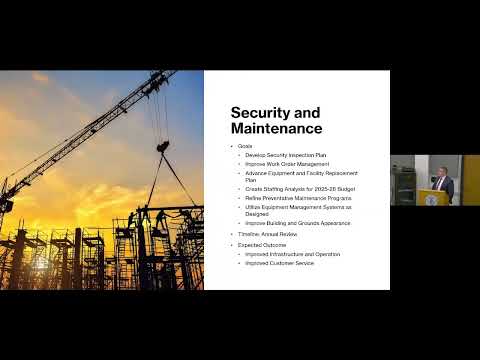
Cybersecurity and IT: The district has prioritized cybersecurity improvements: implementing CIS controls, developing an incident response plan, instituting employee cybersecurity training, evaluating a password manager (Bitwarden), and automating student-account management. Mr. O'Toole said, "We want to be ahead of that game" to avoid breaches. The district replaced more than 2,000 Chromebooks at the high school level, more than 500 iPads for kindergarten, purchased 384 Wi‑Fi access points under E‑rate funding and reported over 5,000 work orders since July 1, many related to device support.
Maintenance and facilities: Staff reported 8,107 work orders completed in 2024 and roughly 1,700 planned‑maintenance work orders for the year. Current and upcoming construction projects include multi‑phase work at McDowell, Asbury Elementary, Tracy Elementary and MIHS (auditorium work planned), and a baseball/softball project. Staff noted that Ridgefield, Chestnut Hill and McDowell lacked air conditioning before renovations and now have it, and that overall energy consumption has fallen about 10.7% from Feb. 2019 to 2023, saving roughly $100,000 annually.
Human resources and operations: The HR update covered a comprehensive wage‑structure and internal equity analysis, consolidation of workplace condition plans from 11 to 7, integration of employee onboarding systems (reduced from 12 to 5 platforms), and hiring activity: staff said 140 individuals were hired in the prior 10 months to fill existing vacancies. The district reinstated Act 45 training for administrators and automated acceptance and board letters through its HRIS.
Finance and grants: The business office said it submitted and received competitive grants totaling more than $3,700,000 in the last fiscal year and managed $37,000,000 in bond‑fund spending in a single year for construction. Staff warned that many new state funds arrive as grants with monitoring and reporting requirements.
Food service: Staff reported staffing shortages in food service (reported as seven open positions and four substitutes) and said changes to federal programs since COVID reduced the number of families eligible for free or reduced-price meals; staff projected that shift could translate into about a $225,000 change from last year. The district is out to bid for its food-service contract and is piloting additional POS locations and non‑disposable service items at the high school.
Operational directions and monitoring
Staff said the district will monitor progress monthly and report annually, align the strategic plan with the budget cycle, and make adjustments as needed. Specific near-term directions identified in the presentation include completing the transportation procurement and food-service bid processes, conducting the elementary feasibility study, implementing cybersecurity controls and employee training, and completing a staffing analysis to inform the 2026 budget.
What’s next: The presentation materials and a more detailed plan (referred to in the meeting as the WER document) were uploaded for board review. Several items noted in the update—contract awards, grant approvals and feasibility‑study recommendations—require future board action before they take effect.