Get Full Government Meeting Transcripts, Videos, & Alerts Forever!
Get email alerts on the Braille Transcription Program topic
No spam. Unsubscribe anytime.
Committee backs $400,000 ongoing appropriation for prison-based braille transcription program
Summary
The committee recommended Senate Bill 1439, a $400,000 appropriation to continue and expand a braille transcription program run through the Arizona Department of Corrections, citing educational needs for K–12 blind students and workforce training for participants.
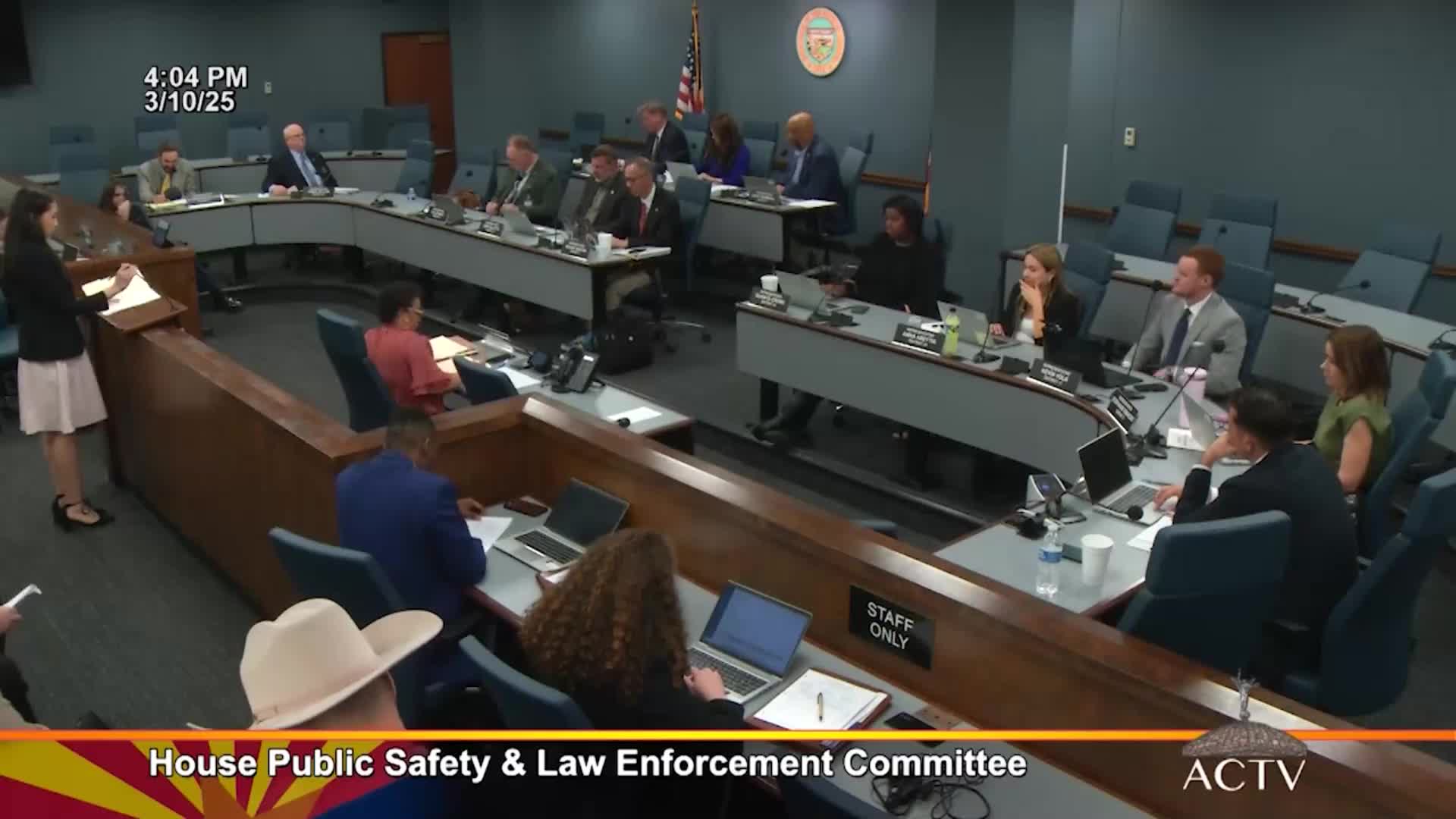
The Arizona House Committee on Public Safety and Law Enforcement returned Senate Bill 1439 with a due-pass recommendation, supporting a $400,000 appropriation from the State General Fund for a braille transcription program operated in partnership with the Department of Corrections and the Foundation for Blind Children.
Senator Karen Warner, sponsor of the measure, described the program as inmate training that produces braille materials for children who are visually impaired so they can continue learning with their peers. Edie Lafavere of the Foundation for Blind Children told the committee the program began in 2021 and expanded more quickly than expected: “We’re currently at 130 transcribers. 18 of those have been released on parole and 0 have recidivated,” she said, and added that most materials go to K–12 students.
Lafavere explained the requested $400,000 would build on an existing ongoing $200,000 appropriation and cover staff and training needs for the expanded program (reported staffing: one director, one lead braille instructor, two braille instructors, and a proofreader). She described the specialized training required to transcribe complex educational materials, including textbooks with graphs and maps.
Some committee members raised procedural and fiscal questions. Representative Collin questioned the lack of a detailed expenditure breakdown and expressed concern about lobbying costs tied to the request; Collin voted present and asked sponsors to provide a clearer budget breakdown before the floor. Representative Simicak, Representative Taylor and others voiced support for the program’s rehabilitative outcomes and its role in delivering educational materials to blind students.
The committee voted to return SB 1439 with a due-pass recommendation; the chair recorded 12 ayes, 2 present and 1 absent. Members who supported the bill cited both the educational benefit for K–12 students and the vocational training and reentry opportunities the program provides to incarcerated individuals.
Clarifying details in committee testimony included that the program began in 2021, expanded from an expected 50–90 transcribers to 130, and that 18 former participants had been released and reportedly had not recidivated. Testimony also cited contractor rates for some braille transcription work (one witness said some contractors earn about $70 per hour on transcription work).