Get Full Government Meeting Transcripts, Videos, & Alerts Forever!
Get email alerts on the Library Referendum topic
No spam. Unsubscribe anytime.
Cottage Grove holds informational session as village prepares April ballot referendum on new library at 312 W. Cottage Grove Road
Summary
Village staff outlined a proposed referendum that would allow up to $1.3 million in additional annual levy to buy, demolish and build a new library at the former Learning Ladder site and to operate it; officials and residents raised questions about cost, site constraints, funding timelines and timing of Dane County tax relief.
Village Administrator Mac Ezey said Wednesday night that the Village of Cottage Grove will ask voters on the April 1 ballot whether to allow up to $1,300,000 in additional annual property tax levy to purchase, construct and operate a new municipal library at the former Learning Ladder property, 312 W. Cottage Grove Road.
The question was authorized earlier by the village board; staff described the session as educational only and said they were not advocating for a yes or no vote. "We're here exclusively to educate and inform," Village Administrator Mac Ezey said.
The referendum language asks for both operating and capital authority, staff said, because the village board elected to present the public with the full estimated cost of the service. Architects Engberg Anderson recommended demolition of the existing building and construction of a new library; that option is estimated at $8,200,000 for capital work, staff said. The village does not yet own the Learning Ladder property; the village has an option to purchase with an option payment of $40,000 and a listed purchase price of $1,400,000, according to staff remarks.
Why the referendum matters
If a majority of voters approve, the village would have authority to levy up to $1,300,000 more annually to pursue the purchase and to operate the library. Staff repeatedly emphasized that operational levy increases require voter approval under state tax levy limits, while the inclusion of capital costs in the ballot question was a board decision to present the "full freight" of the proposed service.
Operational and capital details presented
- Capital: Engberg Anderson recommended demolish-and-rebuild as the preferred option for the Learning Ladder site; the consultant's cost estimate presented by staff is $8,200,000 (all-in capital estimate, including soft costs and furnishings). Staff said there is a contingency incorporated in that estimate and that the building design has not been completed. - Purchase: option payment $40,000; full purchase price $1,400,000 (staff stated the village has an option to purchase that would be exercisable only if the referendum is approved). - Operating: Dane County library standards were cited by staff as the basis for operating requirements. Staff estimated 6 to 8 full-time equivalent positions would be needed and that the facility would be open about 45 hours per week to meet county standards. - Funding offsets: the village is running a capital campaign with a $1,000,000 goal and said it has roughly $500,000 in pledges contingent on a yes vote. Staff identified active grant pursuits (state WEDC, CDBG and a potential congressional request) but said no grant awards had been received as of the session. - County tax interplay: staff said the Dane County library tax is separate from the village levy and currently amounts to about $34 per $100,000 of equalized value; in time, if county standards are met, county levy amounts would be reallocated and the village portion could be reduced but that process could take multiple years after a library opens.
Concerns and questions from residents
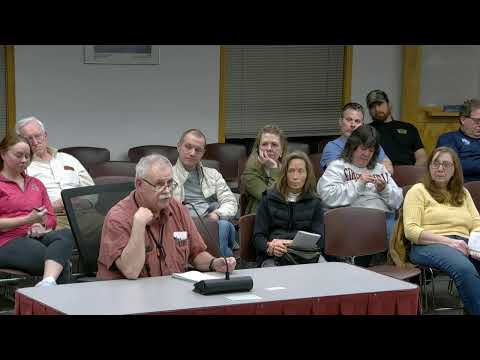
Residents raised repeated questions about site choice, comparative cost, long-term expansion limits, parking and traffic, fire access, soils and stormwater requirements, the accuracy of cost estimates without schematic designs, the effect of tariffs and supply-chain delays on price and schedule, and the timing of Dane County tax relief.
- Several residents asked why the village is focusing on the 1.9-acre Learning Ladder site rather than a larger parcel owned by Friends of the Library (about five acres). Staff answered that the Friends parcel had been considered earlier but that it did not advance into the village capital plan and that the Learning Ladder property became available; they also said Engberg Anderson’s assessment found demolition and new construction at the Learning Ladder site to be the recommended option. - On design and cost precision, multiple speakers noted there are no architectural drawings or final engineering plans yet; staff confirmed schematic design and detailed site work (for parking, stormwater and fire access) would follow only after referencing the referendum outcome and any subsequent decisions by a future board. - On tax math and valuation, staff explained that the village used equalized (fair market) value in published projections rather than assessed value and that revaluation processes can redistribute tax burdens; they provided examples and directed residents to AccessDane for property-specific equalized values.
What a yes or no would mean
Staff said a yes vote would authorize the village to levy up to the stated amount and would allow the village to exercise the option to buy the property and proceed with design and construction steps, subject to further board decisions. A no vote would mean the village would not move forward with the library service at that location under the referendum terms, staff said.
Formal actions recorded in the session
Session presenters repeated that the village board previously voted to place the referendum on the April 1 ballot, but the session itself was informational and contained no formal new board actions. Staff noted pledge documents for capital campaign donors are contingent on a yes vote and that no cash donations had been deposited by the village at the time of the meeting.
Next steps and public resources
Staff pointed attendees to a project web page with the Engberg Anderson report, the village financial management plan update, frequently asked questions and contact information, and provided an email address for follow-up. Village Clerk Lisa Clota said election details (absentee and in-person options) can be found at MyVote.wi.gov and through the village clerk's office.
Context and limits
Presenters repeatedly emphasized that the meeting was not intended for advocacy and that library board members were not asked to participate in this forum to avoid crossing that line. Staff also cautioned that capital estimates are preliminary and that if costs rise materially, future elected boards would need to weigh whether to proceed, reduce scope, seek additional funding, or pursue another referendum for increased operating authority.
Ending
The session closed with staff offering to continue individual and small-group follow-up conversations and to post additional answers and materials on the project page as they become available.