Get Full Government Meeting Transcripts, Videos, & Alerts Forever!
Get email alerts on the Elections And Voting topic
No spam. Unsubscribe anytime.
Residents say redaction software purchase risks election auditability; court told to reconsider
Summary
During public comment, several Brazos County residents urged the court to rescind or reconsider a purchase of redaction software for cast vote records, arguing redactions make audits impossible under current countywide voting practices.
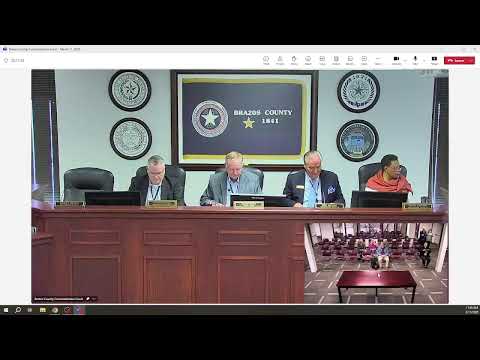
Residents told the Brazos County Commissioners Court on March 11 that a recent county purchase of software to redact cast vote records (CVRs) could make legally required election audits impossible and urged the court to reconsider the expenditure.
At issue: Commenters cited a contract the court approved to add a digital imaging and redaction component to the county’s elections system. The contract, described in the meeting packet as a purchase from Hart (the county’s voting system vendor) for a document-management automation and the Vista SG system, was recorded in the packet at $12,875; several public commenters referenced the cost as approximately $13,000.
Why it matters: Speakers argued that redacting information from CVRs—specifically precinct and polling-location identifiers—destroys the ability to audit countywide elections. "By requiring redaction, the county demonstrates that countywide voting fundamentally violates constitutional requirements and must be replaced," Karen Simpson said during public comment. Speakers cited Texas Election Code section 122.001 and the state constitution when arguing that counties must supply records that support auditing.
Several citizens, including Kathy Beans and Cindy Wilde, described the redaction practice as a direct conflict between ballot secrecy protections and the public’s right to audit. Wilde referenced Sewell v. Chambers as the only Texas case she said addresses the tension between secrecy and auditability and urged the court to rescind the motion that authorized spending on the software.
County staff and earlier court action: The meeting record shows the court approved the purchase of the redaction/digital-imaging component in a prior vote; commenters asked the court to revisit that decision. County staff told the court in follow-up remarks that the new system is intended to speed redaction and reduce manual-hours and that the change responds to recent guidance from the Office of the Attorney General.
Unresolved questions: Commenters disputed whether redacting precinct or polling-location fields renders CVRs unauditable and pointed to a broader structural concern: they said countywide voting creates unique auditability problems because ballots are not tied to precincts in the way they would be under precinct-based voting. The court did not rescind the purchase during the March 11 meeting.
Ending: Petitioners asked the court to reconsider and requested additional legal and technical briefing on how the redaction will affect legally required election audits; staff acknowledged the concerns but did not indicate a reversal of the earlier purchase during the session.