Get Full Government Meeting Transcripts, Videos, & Alerts Forever!
Get email alerts on the Property Taxes topic
No spam. Unsubscribe anytime.
Supervisors approve tax-payment suspension for disabled property owner; treasurer outlines tax-sale process and possible city transfers
Summary
Board approved Resolution O3102502 to suspend collection of March taxes for a property whose owner applied for disability status; treasurer explained how county tax sales work, investor redemption periods and options to transfer unclaimed county-held tax sale certificates to cities.
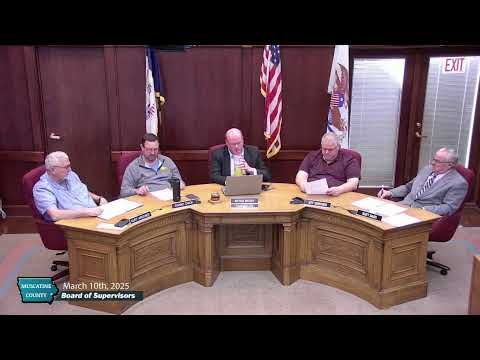
The Muscatine County Board of Supervisors on March 10 approved Resolution O3102502 to suspend the collection of March taxes and subsequent taxes for a property where the owner submitted documentation of a disabling injury, while delinquent taxes previously sent to tax sale remain due.
Treasurer Amy explained that suspension removes the March due date and penalties but does not erase prior delinquent taxes that went to tax sale in 2024; a tax-sale certificate holder remains in place for those delinquencies. She said the property owner has been provided a disability application to seek future tax reduction or forgiveness based on income.
Amy gave a detailed description of the county’s tax-sale process for the board: the county holds an annual online tax sale in June to collect unpaid taxes; investors bid in a lottery-style online system and pay delinquent taxes, then earn 2% interest per month on unpaid taxes. Most tax-sale amounts are redeemed within two or three months; only a small percentage proceed toward deed transfers. If a purchaser must pursue a deed, the owner has two years to redeem; the purchaser then must serve a 90-day notice and complete steps that can take up to three years from the sale date.
Amy also described a county-held tax-sale pathway for properties unsold by investors: if an investor does not purchase a property it becomes a public bidder item and, if unsold the following year, it becomes a county-held tax sale. The county typically avoids taking deed title because of liability. She said the county is discussing a process, likely by resolution and possibly ordinance, to allow faster transfers of county-held tax-sale certificates to cities that have an interest in unwanted properties (for example, those with nuisance abatements or demolition costs). That approach could shorten the timeline for the city to pursue assignment and redevelopment by enabling the city to start the 90-day notice process sooner; Amy said there are roughly five such properties in Muscatine city that might qualify.
A supervisor moved approval, another seconded, and the board approved Resolution O3102502 by roll call (Jeff, Scott, Danny and Kurt each voted aye). The treasurer said staff will work with county attorney Jim to draft a standing annual resolution and any necessary ordinance to formalize transferring county-held tax-sale certificates to cities going forward.