Get Full Government Meeting Transcripts, Videos, & Alerts Forever!
Get email alerts on the State Legislation topic
No spam. Unsubscribe anytime.
Council hears state legislative briefing; budget shortfall and solar preemption singled out
Summary
Montgomery County Council staff briefed members on a range of pending state bills and budget developments, including a $347 million statewide revenue write-down, potential state preemption of local solar siting rules, education funding changes, and multiple public-safety and health-related bills that remain unresolved.
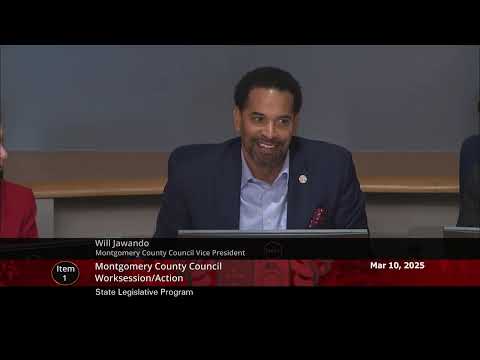
Montgomery County Council members received an overview of key state legislative items and the status of the budget at a session to review state legislation, county staff said.
Intergovernmental Relations lead Kathleen Boucher told the council that a new revenue projection by the state’s Board of Revenue Estimates reduced expected receipts by about $347,000,000, complicating a supplemental budget that had been expected to leave roughly a $100 million surplus for fiscal 2026. She said committee schedules and subcommittee budget decisions were behind the normal pace and that capital budget decisions are being held until the operating budget is resolved.
The budget outlook frames discussion of several county priorities, staff said. On developmental disabilities funding, staff reported that the governor restored roughly 95% of proposed cuts for the current fiscal year and about $150,000,000 for the next fiscal year but that approximately $300,000,000 in cost-containment proposals remain. Staff noted that changing the geographic rate differential used by county providers would require a waiver from the Centers for Medicare & Medicaid Services before the state could eliminate that payment.
On housing, staff said the governor’s Housing for Jobs Act has not moved and that the county (which has been an active participant in discussions) continues to oppose the bill unless significant amendments are adopted. Leslie Frye reported that the good-cause eviction (just-cause) proposal has not been scheduled for a vote in either chamber and that, while there are rumors of amendments, there is no concrete action to report.
Education-related provisions tied to the governor’s budget package also moved through the House with substantial changes. County staff said the Excellence in Maryland’s Public Schools Act initially included pauses and formula changes that would have reduced county aid; House amendments removed the fiscal-impact provisions so the formulas remain under current law while the state allows a temporary pause in mandated collaborative time implementation.
Environmental staff described two major energy bills under active consideration. Garrett Fitzgerald of the Department of Environmental Protection said HB1036, a solar siting bill, would “remove local land use and taxation authority and essentially allow solar everywhere as long as it conforms to new statewide siting standards.” He said the council voted to oppose the bill but is working with stakeholders to add amendments, including changes to livability standards and removal of taxation preemption. Staff said a likely amendment under discussion would cap the percentage of a county’s agricultural preservation area that may be used for utility-scale solar, but the specific cap is unresolved.
Fitzgerald also briefed the council on HB49, the state Building Energy Performance Standards (BEPS) clarifying bill. He said the bill has attracted many amendments aimed at adding compliance flexibility for building owners and that an outstanding question is whether state law will explicitly allow counties to implement and have the state approve their own BEPS programs or otherwise preserve the primacy of county programs. Staff described that outcome as an active negotiation and estimated roughly even odds that the state will add explicit language recognizing county programs.
On health and public-safety bills, staff reported that HB429 and SB376 (a nursing-home inspection delegation bill) have not moved; the draft would allow counties to request nursing-home inspection authority from the Maryland Department of Health but requires the department to split inspection costs with the requesting county. Sarah Morningstar described a House subcommittee’s action on a bill to increase speed camera fines (moving the first-offense fine from $40 to $50 and removing a prior top cap on very-high-speed fines at the judiciary’s request) and said a reckless or aggressive-driving bill is being held on fiscal grounds due to potential court and prosecution costs. Staff also noted two paths for expanding speed-camera authority: a statewide bill for state roads and a separate local-authority bill for county and local roads; county staff said they prefer the local approach.
Staff reported a federal update as well: the continuing resolution discussions in Congress have removed earmarks in the short-term package, which could mean losing about $14,000,000 in previously planned earmarks for fiscal 2025; county departments nevertheless submitted project requests for FY 2026 pending further federal action.
Separately, staff described a Howard County local delegation bill related to the Patuxent River Wildland (appearing in the Senate as SB 9608 / Howard County local bill 5-25 in the transcript). That draft would permit the Maryland Department of Natural Resources to enter agreements with volunteers who use motor vehicles or motorized equipment to maintain passable trails in the Wildland. Staff reported the county’s Parks Department and WSSC do not own the affected property in Montgomery County and that the councilmember representing the area said she had heard no opposition from constituents.
The briefing concluded with staff advising that many of the items remain under negotiation and that the county will continue to press for amendments on solar siting, clarity on BEPS county authority, and advancing bills of priority where possible. No formal county votes were taken during the briefing.