Get Full Government Meeting Transcripts, Videos, & Alerts Forever!
Get email alerts on the Courts Data Magistrate Reform topic
No spam. Unsubscribe anytime.
Chief Justice John W. Kittredge urges magistrate-court reform, data reporting and expansion of treatment courts
Summary
Chief Justice John W. Kittredge told a joint assembly the state judiciary is collecting new workload data, urged uniform magistrate pay and standards, and highlighted expansion of treatment courts such as drug court as a way to reduce recidivism.
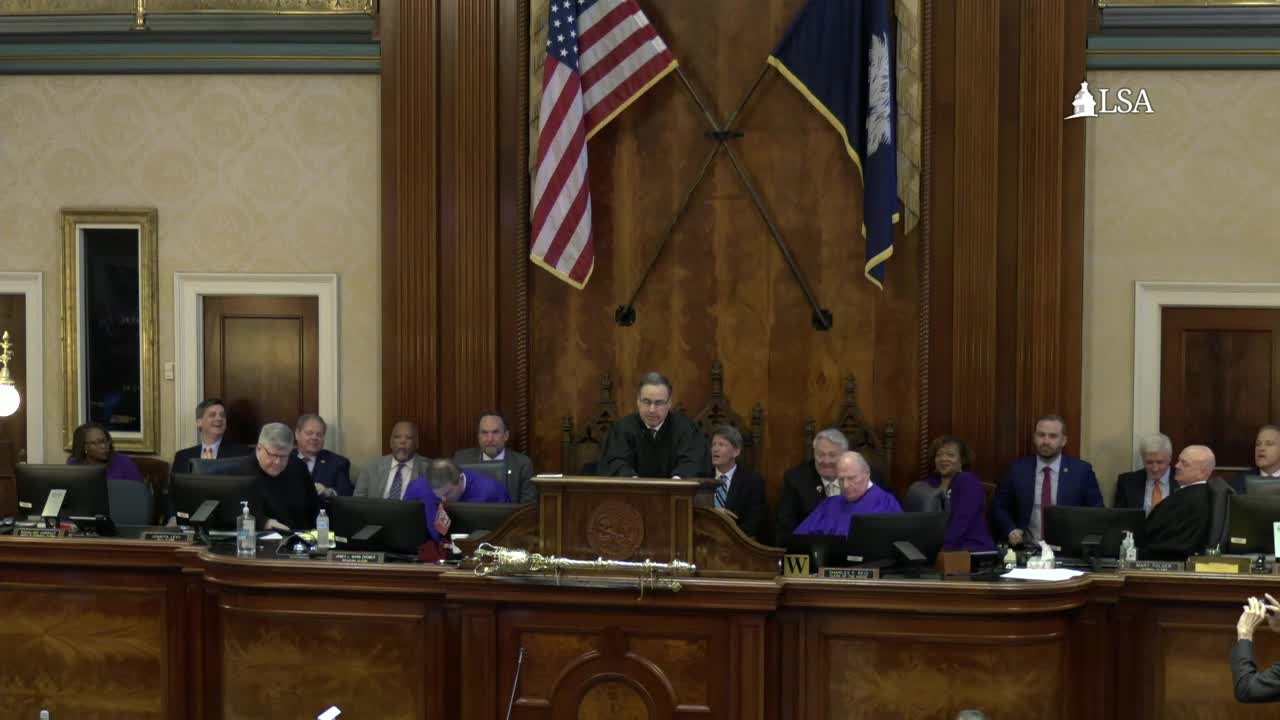
Chief Justice John W. Kittredge addressed a March 5 joint assembly of South Carolina lawmakers and described priorities for the judicial branch, including better data on trial-court workloads, uniformity in the magistrate system and broader use of treatment courts.
Kittredge said the judicial branch is developing an interactive report intended to show filings and dispositions across trial courts by year and county, and praised preliminary work being done by the branch’s IT staff. “When it is complete, the judicial branch, you, and the public will be able to access this site and obtain the most current data about the workloads in our courts,” he said.
Why it matters Kittredge tied the data work to court management and resource allocation, noting population growth and rising caseloads across the state. He asked the legislature to include the judicial branch in discussions about magistrate reform and singled out magistrate pay as an issue of concern, saying the statutory pay system produces large disparities that make recruiting judges in rural counties difficult.
Treatment courts The chief justice described treatment courts — including drug courts, veterans courts and mental-health courts — as a model that blends accountability with rehabilitation. He told lawmakers that treatment courts show lower recidivism for appropriate cases and that judges, solicitors and public defenders volunteer time to support those programs.
Numbers cited Kittredge said the trial courts handle more than a million matters each year and that the branch’s partial data indicate “conservatively, 1 and a half million case filings” in 2024. He also listed judicial positions in broad terms to give a sense of scale: circuit, family, masters-in-equity, magistrate, probate and municipal judges.
What the chief justice asked for - A seat at the table as the legislature considers magistrate court reforms, including possible jurisdiction changes and merit-selection proposals. - Attention to uniform pay and professionalism standards for full-time magistrates. - Continued investment in judicial-branch transparency tools and statistics to inform resource decisions.
Ending Kittredge closed by urging lawmakers to temper accountability with mercy in the justice system, and praised treatment courts as an example of justice that balances both.