Get Full Government Meeting Transcripts, Videos, & Alerts Forever!
Get email alerts on the Governance topic
No spam. Unsubscribe anytime.
McMaster calls for more income tax cuts, $50,000 starting teacher pay and disaster relief in state of the state address
Summary
Governor Henry McMaster delivered his eighth state of the state address, urging further income tax reductions, a $50,000 minimum starting teacher salary, accelerated permitting and infrastructure funding, expanded disaster relief for Hurricane Helene, and cabinet changes to improve behavioral‑health accountability.
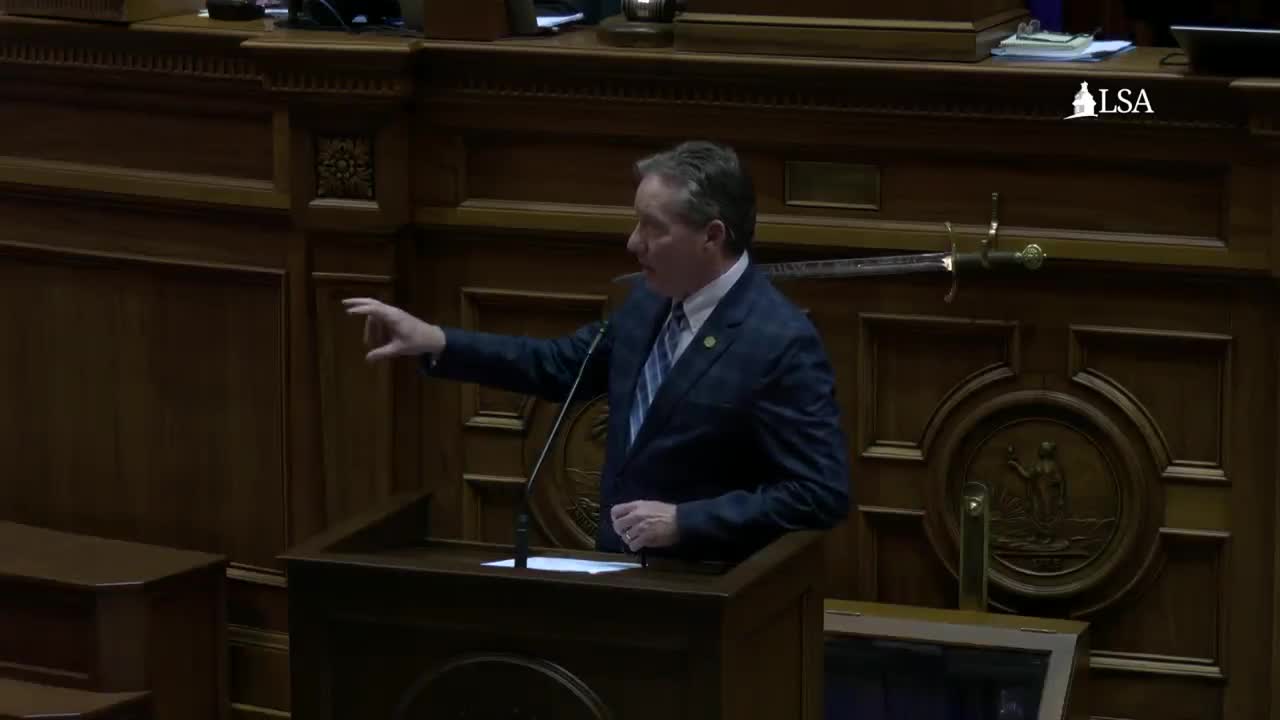
Governor Henry D. McMaster delivered the 2025 State of the State address to a joint assembly of the General Assembly, laying out priorities that include additional personal income tax cuts, higher starting teacher pay, disaster‑recovery funding for Hurricane Helene, investment in permitting capacity, and restructuring parts of the behavioral‑health system.
The governor opened with acknowledgements and a list of service members and first responders the state lost in the previous year before moving to economic highlights. He described South Carolina’s recent economic performance — noting multi‑billion dollar capital announcements and job creation — and said the state’s fiscal position supports accelerated tax reductions, proposing a cut from 6.2% to 6.0% and saying the long‑term goal should be full elimination of the personal income tax.
Education and workforce: The governor repeated a multi‑year request to raise the minimum starting teacher salary to $50,000 (he said the starting minimum is currently $47,000), framed the step as essential to recruit and retain teachers, and proposed additional lottery and higher‑education funding measures: freezes in college tuition in exchange for performance funding; $80 million for Pell‑eligible students; $95 million for workforce scholarships at technical colleges; and a review of public higher‑education programs to align degrees with workforce needs.
Hurricane Helene recovery and disaster funds: McMaster described the hurricane’s toll — dozens of deaths, widespread power outages and property damage — and requested a state public‑assistance program appropriation (he proposed $150,000,000) to mirror federal assistance and help local governments and nonprofits with damage unreimbursed by FEMA. He also requested specific appropriations for DOT debris removal and bridge repairs and to replenish resilience grant funds.
Permitting, power and infrastructure: The governor sought funding to staff the new Department of Environmental Services and to enforce a 90‑day permitting target, citing permitting certainty as key to attracting investment. On energy, he urged a reexamination of restrictions on natural gas use and asked the Legislature to pass energy‑related bills quickly, including measures tied to a state‑led effort to coordinate advanced energy research and resilient power planning (including work on the restarted VC Summer reactors). He recommended continued bridge and roads investments and proposed $100,000,000 more for DOT bridge work.
Behavioral health and agency accountability: McMaster urged structural change at the Department of Mental Health and the Department on Disabilities and Special Needs by making them cabinet agencies directly accountable to the governor, explaining the current commission structure makes accountability unclear. He also called for a single, statewide review of behavioral‑health funding and delivery and requested investments in a new neurological care facility and increased prison medical and mental health resources.
Law enforcement, corrections and public safety: The governor asked for additional pay for law enforcement and a $2,000 state income tax credit for frontline public safety personnel. He asked for appropriations to improve phone‑contraband interdiction and medical services at correctional facilities.
Conservation and culture: McMaster called for continued investment in land and cultural preservation and cited several major conservation acquisitions in 2024. He closed by framing the next 100 years as an opportunity to preserve South Carolina’s identity while continuing economic growth.
Quote: “This is the best place in the world to live, work, and raise a family. And the best is yet to come,” he concluded.
Next steps: The governor’s recommendations will move to the House and Senate appropriations processes. Several proposals (teacher pay, disaster grants, tax rate reductions) carry major budget implications requiring negotiation in the months ahead.