Get Full Government Meeting Transcripts, Videos, & Alerts Forever!
Get email alerts on the Education Transparency topic
No spam. Unsubscribe anytime.
Senate committee advances bill requiring school boards to livestream meetings, extends posting deadline
Summary
The Senate advanced S 77, a bill that would require school boards to livestream meetings or post recordings within seven days; lawmakers debated implementation costs and an amendment to fund equipment from the state lottery fund was withdrawn and later narrowed.
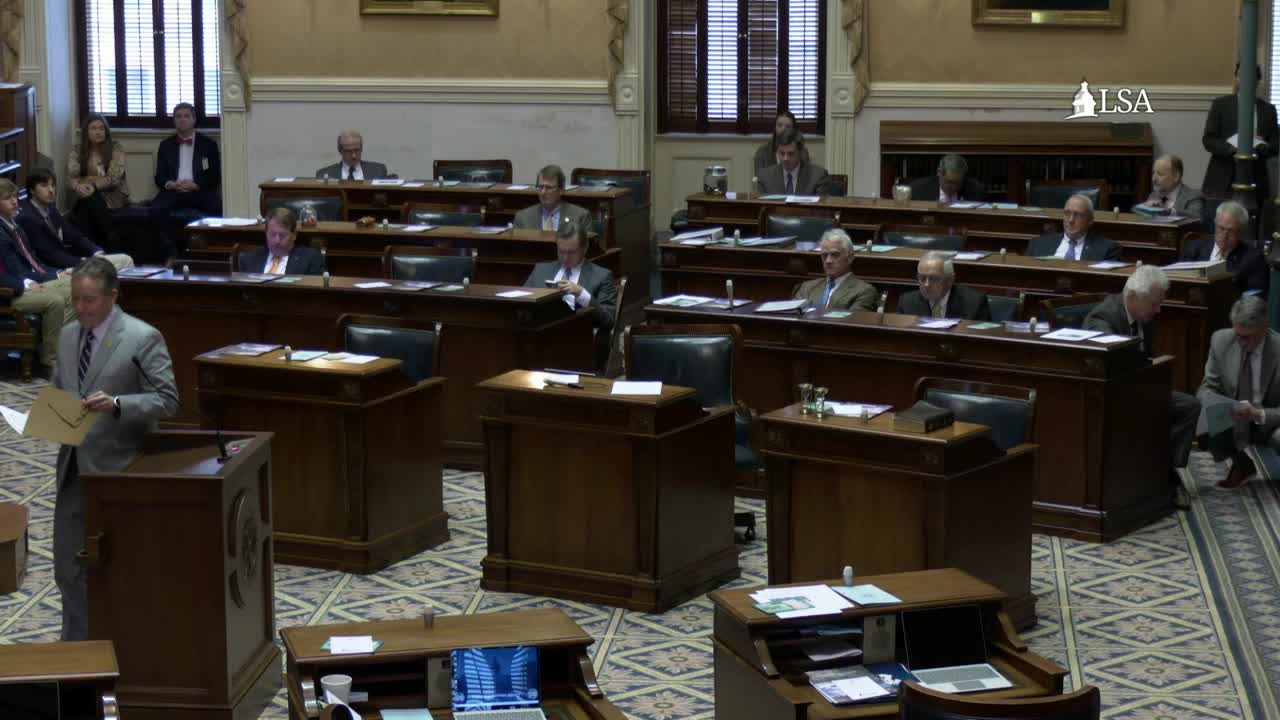
The South Carolina Senate on the uncontested calendar advanced S 77, a bill that would require school boards to livestream their meetings and, if unable to livestream, to post recordings within seven days, lawmakers said during debate.
The bill’s sponsor explained the measure’s intent and the committee amendment and said the change lengthened the posting window from two days to seven days to address compliance and accessibility concerns. “S 77 is a bill that would require school boards to livestream their meetings,” said Senator Mori, who presented the committee report. “The committee amendment changed that 2 days to 7 days.”
The measure would apply to meetings already subject to the state Freedom of Information Act, and the committee amendment clarified implementation and timing. The sponsor told colleagues the revised timeline also accounts for Americans with Disabilities Act accommodations that can require additional processing time for transcripts or other accessible formats.
Lawmakers questioned how much new equipment or support districts might need. Senator Walker, a senator from Richland, asked whether most school districts already livestream meetings; Mori replied that “the majority of school districts livestream their meetings currently” while acknowledging a small number of districts still do not.
Senator Martin, the senator from Spartanburg, proposed an amendment to allow school districts to use lottery funds to pay for camera systems, arguing the lottery fund had available balance to help districts. “I just wanted to give this body an option,” Martin said, explaining the amendment would permit use of lottery money to fund camera systems for districts that lack them.
Senator Hembry, the senator from Horry, sought to table Martin’s first amendment; Martin withdrew that proposal. A later Martin-Jackson amendment that would require the state to provide funding for districts without systems was discussed, debated and then adopted in a narrowed form that limits state funding to districts that do not already have livestreaming in place. Senators on the floor emphasized they expected the budget process to resolve funding details rather than create an open-ended appropriation on the statute.
The Senate gave the committee report and subsequent floor amendment voice approval; votes were taken by voice for the committee report and for a later amendment. Legislators said districts would have until the bill’s implementation date to make technical and budgetary arrangements; the committee amendment sets an implementation date of Jan. 1, 2026.
The bill’s supporters framed the measure as transparency and accountability for local school governance. Opponents and questioners repeatedly raised small-district capacity concerns; sponsors said low-cost options such as an iPhone on a tripod could meet minimum compliance while districts could choose higher-end systems at their own expense.
The measure will return to the calendar for further action after the adjustments adopted on the floor. The clerk recorded the adoption of the committee report and related amendments; the floor record shows the bill carried over for refinement at senators’ request.