Get Full Government Meeting Transcripts, Videos, & Alerts Forever!
Get email alerts on the Higher Education Budget topic
No spam. Unsubscribe anytime.
Analyst: higher education budget at 15‑year highs; legislature balances operations funding, tuition restraint and financial aid
Summary
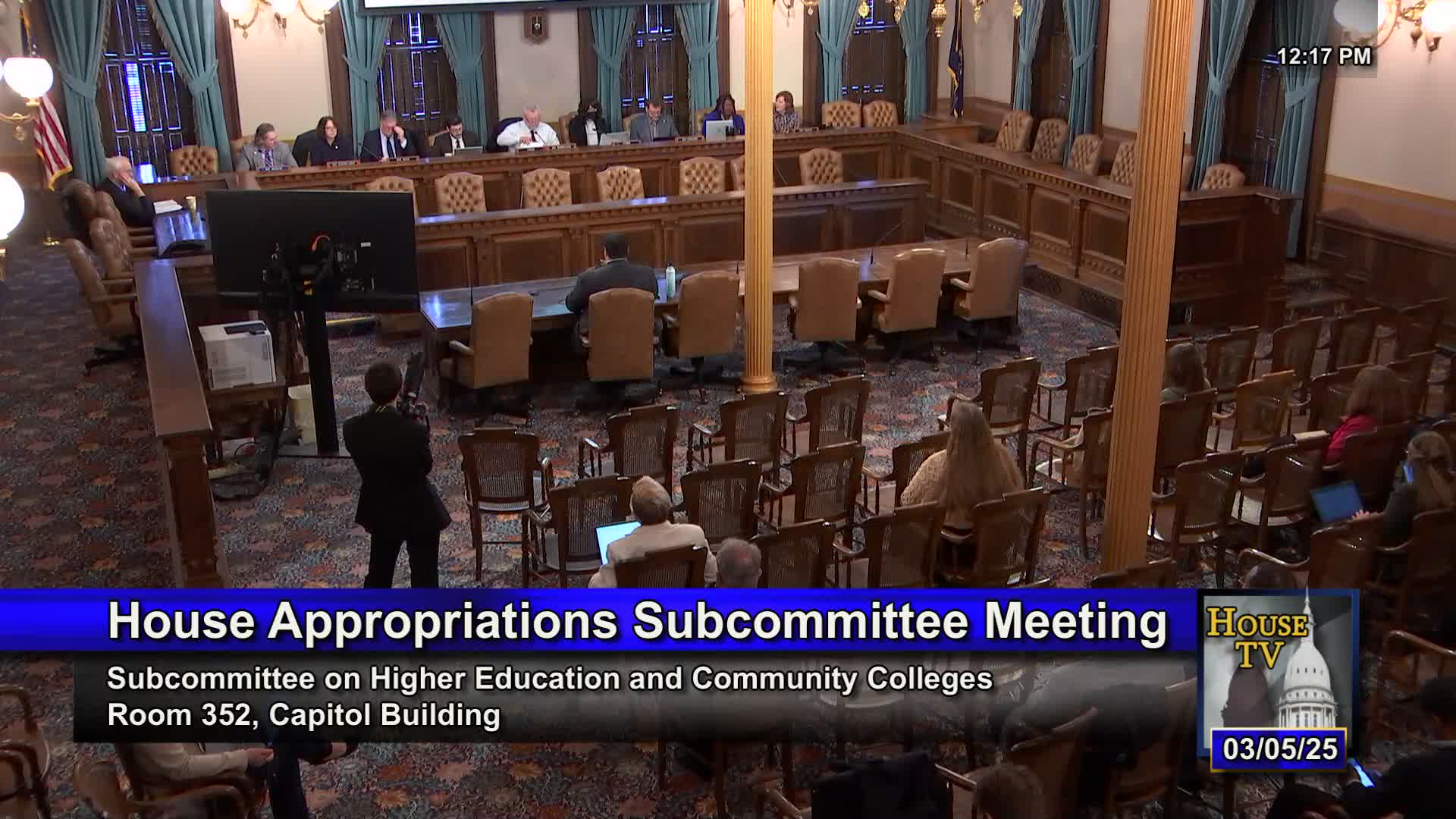
Senior fiscal analyst Perry Zylak told the House Appropriations Subcommittee on Higher Education and Community Colleges that the higher education budget for fiscal 2024–25 totals roughly $2.324 billion, with large state general fund and School Aid Fund shares, and that recent scholarship expansions and operations funding come with conditions such as tuition restraint and transfer‑credit requirements.
Senior fiscal analyst Perry Zylak told the House Appropriations Subcommittee on Higher Education and Community Colleges that the higher education budget for fiscal 2024–25 totals about $2.324 billion and is at nominal 15‑year highs, with approximately 80% of that amount coming from the state general fund and the remainder from state restricted revenue and a small federal component.
Zylak said the higher education budget provides operational grants to 15 public universities, funds a number of state financial aid programs and covers partial costs tied to the Michigan Public School Employee Retirement System (MPSERS). “Higher education is actually in Article 8 of the state constitution,” Zylak said, noting the constitution requires legislative appropriations for public universities but does not prescribe funding methods and that constitutional autonomy creates tension over legislative direction to institutions.
The nut graf: The presentation framed the budget trade‑offs lawmakers face: substantial new state aid for student scholarships and historic operational funding increases have coincided with tuition‑restraint conditions on institutions and increased reliance on the School Aid Fund (SAF) to support postsecondary appropriations. Zylak said higher education accounts for roughly 3% of the $81.4 billion state budget but represents about 13% of the state general fund portion.
Operational funding and conditions: Zylak summarized the three components commonly used to set university operations funding—base funding (last year’s amount), new operations funding (often a formula or across‑the‑board percentage), and reimbursements for the North American Indian tuition waiver program. For fiscal 2025, total operations grants across the 15 public universities were about $1.7 billion, with individual university appropriations ranging (illustrative amounts cited by Zylak) from about $16 million for smaller institutions to $365.7 million for the University of Michigan‑Ann Arbor. Zylak explained that recent increased operations funding was tied to conditions: institutions must limit resident undergraduate tuition and fee increases to no more than 4.5% or a specified dollar cap and must certify participation in transfer and reverse‑transfer practices and other institutional best practices around credit transfer.
Financial aid and major programs: Zylak described the Michigan Achievement Scholarship as the largest single financial aid appropriation in the budget—about $330 million for fiscal 2025—and said the scholarship provides up to $5,500 for eligible new high‑school graduates who enroll at four‑year public or private institutions and a community‑college “guarantee” that covers last‑dollar in‑district tuition and fees for community college students. Other programs he cited included Michigan Reconnect (about $52 million for FY25, a last‑dollar scholarship for students 25 and older), the Tuition Incentive Program for Medicaid‑eligible associate‑degree students, and smaller targeted programs such as My GEAR UP and survivor tuition grants for veterans’ children and children of fallen first responders.
Use of the School Aid Fund and MPSERS: Zylak highlighted growth in the use of the School Aid Fund for postsecondary appropriations. He said combined SAF appropriations for higher education and community colleges for FY25 are approximately $923.4 million, and that removing SAF from postsecondary budgets would require replacement with nearly $1 billion in general fund dollars. On retirement funding, Zylak noted major one‑time payments have reduced the unfunded actuarial accrued liability for MPSERS and that the state believes the UAAL may be at zero pending the latest actuarial valuation; the state continues to provide normal‑cost offsets for employer costs.
Community colleges: Zylak described the community college budget (gross appropriation about $642.2 million for FY25) and the sector’s “three‑legged stool” of support—state appropriations, tuition and fees, and local property tax millages. He explained the community college performance funding formula (30% across‑the‑board, 30% contact‑hour FYES weighting, 10% performance completion improvement, 10% completion numbers, 10% completion rate, 5% administrative costs, 5% local strategic value) and said community colleges generally must comply with tuition restraint requirements (limiting increases to 4.5% or a dollar cap) and certify transfer‑related best practices to receive new funding.
Committee questions and clarifications: Members asked how Michigan compares with other states on higher education funding and about FAFSA modernization impacts; Zylak deferred to agencies for some comparisons and said FAFSA rollout and redesign had created challenges that likely affected student enrollment timing. Representative Roth asked whether TANF had been used historically for certain scholarship programs; Zylak said federal TANF funds were used for scholarship programs previously but federal rules changed and the remaining federal funding in the budget is primarily GEAR UP.
What was not decided: The hearing was informational; no votes or formal actions on appropriations were taken at the meeting. Zylak said many items will involve stakeholder input and future hearings.
Ending: Zylak concluded his presentation and opened the floor to questions; committee members asked for follow‑up materials on out‑of‑state comparisons, FAFSA impact details and financial aid cohort outcomes.