Get Full Government Meeting Transcripts, Videos, & Alerts Forever!
Get email alerts on the 340b Program topic
No spam. Unsubscribe anytime.
Health centers, patient advocates tell committee 340B restrictions are limiting services
Summary
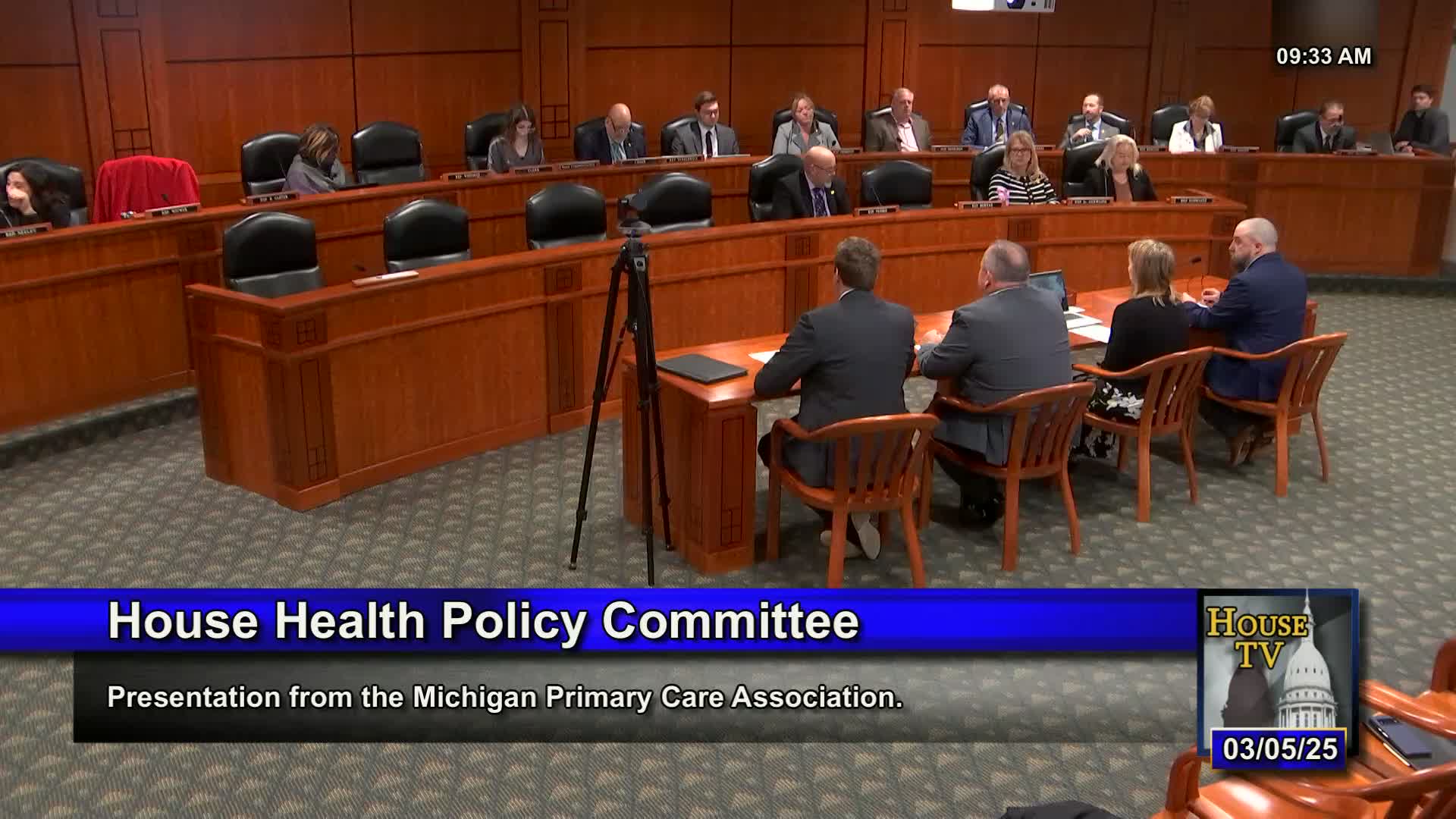
Representatives on the Michigan House Health Policy Committee heard testimony Wednesday from federally qualified health centers and patient advocates who said manufacturer-imposed 340B contract-pharmacy restrictions and inconsistent reporting rules are shrinking clinic revenues that fund services for low-income patients.
Representatives on the Michigan House Health Policy Committee heard more than two hours of testimony Wednesday on the 340B drug pricing program, with federally qualified health centers and patient advocates warning that manufacturer-imposed restrictions and contract-pharmacy rules are limiting clinics' ability to use program savings to serve low-income patients.
Frank Waters of the Michigan Primary Care Association told the committee that health centers in Michigan operate 400 sites serving about 700,000 residents and use 340B savings to support services not otherwise reimbursed, including dental care, transportation and discounted prescriptions.
"Every dollar stays in the community from the 340B savings program," Waters said, describing the program as a non-tax-funded revenue stream that allows clinics to stretch federal resources.
Leaders from Hackley Community Care in Muskegon and Great Lakes Bay Health Centers in Saginaw and Bay City described how restrictions on contract pharmacies have reduced program benefits. Michael Wieses, CEO of Hackley Community Care, said Hackley serves about 23,000 patients across 26 locations and that 340B savings helped offset operating losses. Wieses told the committee that Hackley experienced an operating loss in 2024 and that manufacturer restrictions and administrative burdens contributed to financial strain.
"If there's no action, we will be faced with staffing reductions," Wieses said, listing possible cuts to mobile medical and dental units, outreach and nonreimbursable services such as community health workers.
Speakers said manufacturers increasingly limit which contract pharmacies may dispense 340B-covered drugs for a clinic's patients, often allowing only a single designated pharmacy. Kelly Pardee, pharmacy business director for Great Lakes Bay Health, described burdensome, varying reporting requirements across manufacturers and the need to select one contract pharmacy for dispersed patient populations.
"When our patient doesn't use our pharmacy but goes out to a partner pharmacy in the community ... we have to declare what our one pharmacy is going to be," Pardee said, noting the practical impact for large rural service areas.
Committee members asked for data on trends. Waters said Michigan has 41 federally qualified health centers with roughly 400 clinic locations serving 700,000 residents; Great Lakes Bay told the committee it provided about 244,000 clinic visits last year to 56,000 patients. Witnesses said some centers have seen 340B savings decline in recent years: Hackley reported its 340B savings dropped by roughly 30 to 50 percent over the last three years, while industry-wide 340B dollars have grown in other sectors.
Patient advocates from the Michigan Rare Coalition urged policy changes to ensure hospitals and other 340B entities pass savings to vulnerable patients. Bill Stone, Leslie Baldwin and Kathy Lewis described how rare-disease patients rely on expensive specialty medicines and said hospital participation in 340B has not consistently translated into measurable patient assistance.
Leslie Baldwin cited state and national figures: "As of 2025, there were 87 Michigan hospitals participating in the 340B program," Baldwin said; she added that the national average for hospital charity care was 2.5% of operating costs while Michigan 340B hospitals earmarked on average 0.09% for charity and low-income assistance. "Ninety-seven percent of Michigan hospitals participating in the 340B program fell below the national average," she said.
Advocates urged more transparent reporting that breaks out who benefits from 340B savings and asked the legislature to consider state-level measures to address contract-pharmacy limits, since federal changes have not advanced quickly in Congress.
Representatives asked about possible fixes. Several witnesses urged removal or limitation of contract-pharmacy restrictions, uniform reporting rules across manufacturers, and continuing state oversight to protect clinic revenues that fund nonreimbursable services. Witnesses acknowledged administrative burdens but said the primary problem blocking patient benefit is contract pharmacy policy set by manufacturers.
Committee members thanked the witnesses and said they would continue to monitor the issue; no committee action on legislation was taken at the hearing.