Get Full Government Meeting Transcripts, Videos, & Alerts Forever!
Get email alerts on the Death Certification topic
No spam. Unsubscribe anytime.
Committee hears bills to require physicians to certify deaths in state electronic system
Summary
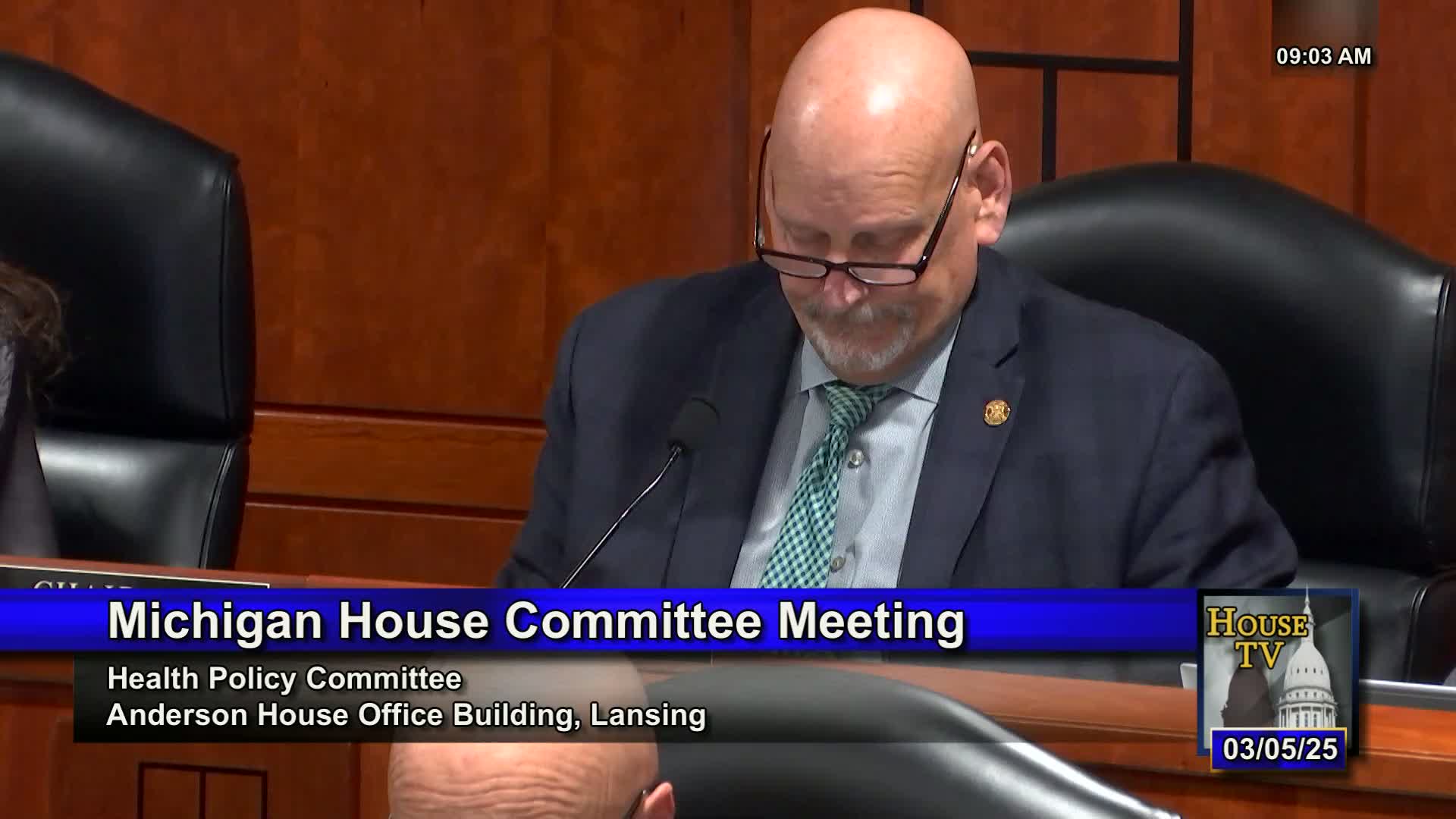
The Michigan House Health Policy Committee on Wednesday heard testimony on House Bills 4077 and 4078, measures that would require physicians to enter cause-of-death determinations directly into the state Electronic Death Registration System (EDRS) and clarify when county medical examiners must certify death certificates.
The Michigan House Health Policy Committee on Wednesday heard testimony on House Bills 4077 and 4078, measures that would require physicians to enter cause-of-death determinations directly into the state Electronic Death Registration System (EDRS) and clarify when county medical examiners must certify death certificates. Representatives Thomas Rogers and Matthew Mueller presented the bills and answered committee questions.
Supporters told the committee that the bills aim to shorten delays families now face when physicians do not use the EDRS and instead provide paper or faxed medical certifications that funeral directors must re-enter into the system.
"When families are forced to wait, it causes all sorts of issues," said Sarah Jensen Vatter, owner and funeral director at Palmer Jensen Bush Funeral Homes in Lansing, who testified with Jared Rozicky of the Michigan Funeral Directors Association. Vatter described cases in which religious rites and burial timelines were delayed because a signed medical certificate was not available.
The bills would require physicians to enter the cause-of-death determination and certify the medical portion of the death certificate directly into EDRS, the web-based system used by the Michigan Department of Health and Human Services (MDHHS). Representative Rogers said HB 4077 would replace the current misdemeanor penalty for failing to complete certification with sanctions applied through the physician's medical license process. Representative Mueller said HB 4078 addresses the statutory timeframe that determines whether a death should be certified by an attending physician or by a medical examiner.
"My bill specifically deals with timeframe," Representative Matthew Mueller told the committee. He described the current statutory rule as tied to whether a physician had medical attendance within 48 hours and said his bill would alter that timing standard. "So basically, all my bill does is make it so if they've seen their primary care physician within a year, the ME is still gonna do the certification," Mueller said in committee remarks.
Dr. Carl W. Hawkins, immediate past president of the Michigan Association of Medical Examiners and a longtime county medical examiner, said his organization supports the bills. Hawkins told the committee that medical examiner offices are burdened by certifying deaths that attending physicians who knew the decedent could appropriately certify.
"We believe these bills will make death certification less burdensome for the medical examiner services," Hawkins said, adding that nonnatural or unexplained deaths should continue to be handled by medical examiner offices.
Committee members asked whether the bills would shift burdens to medical examiners. Representative Randolph Carter asked about potential additional burdens for medical examiner offices; proponents replied that medical examiners and the Michigan State Medical Society had been consulted and expressed support.
Witnesses also cited MDHHS statistics: Jared Rozicky told the committee that, according to the department's vital records division, "over the past five years, 75 percent of all death certificates were not medically certified within the 48 hours that's statutorily required." Rozicky said that delay rate contributes to families' inability to access insurance, complete burial arrangements, and settle estate matters.
Testimony noted operational problems with paper and faxed certificates: funeral directors said they often receive handwritten certificates that must be manually uploaded to EDRS, increasing clerical work and the chance of error. Witnesses said MDHHS is developing an updated EDRS (referred to in testimony as EDRS 2) expected this summer, and that the department would provide training to physicians on the system.
No committee vote on either bill was recorded during the hearing; presenters and stakeholders provided testimony and answered committee questions.
The bills drew support in the room from the Michigan Funeral Directors Association and the Michigan Association of Medical Examiners; Charlie Murden of MDHHS and Kate Dorsey of the Michigan State Medical Society were filed in support but did not speak.
The committee did not take final action on either bill during the session and will decide on next steps at a later date.