Get Full Government Meeting Transcripts, Videos, & Alerts Forever!
Get email alerts on the Public Safety Agency Update topic
No spam. Unsubscribe anytime.
Michigan State Police brief committee on services, labs, recruitment and victim-advocate expansion
Summary
Michigan State Police sergeants presented an overview of bureau structure and services, discussed forensic lab timing, recruit-school changes, victim-advocate expansion request and the Okay to Say tipline, and answered lawmakers’ questions about nonlethal tools and forensic backlogs.
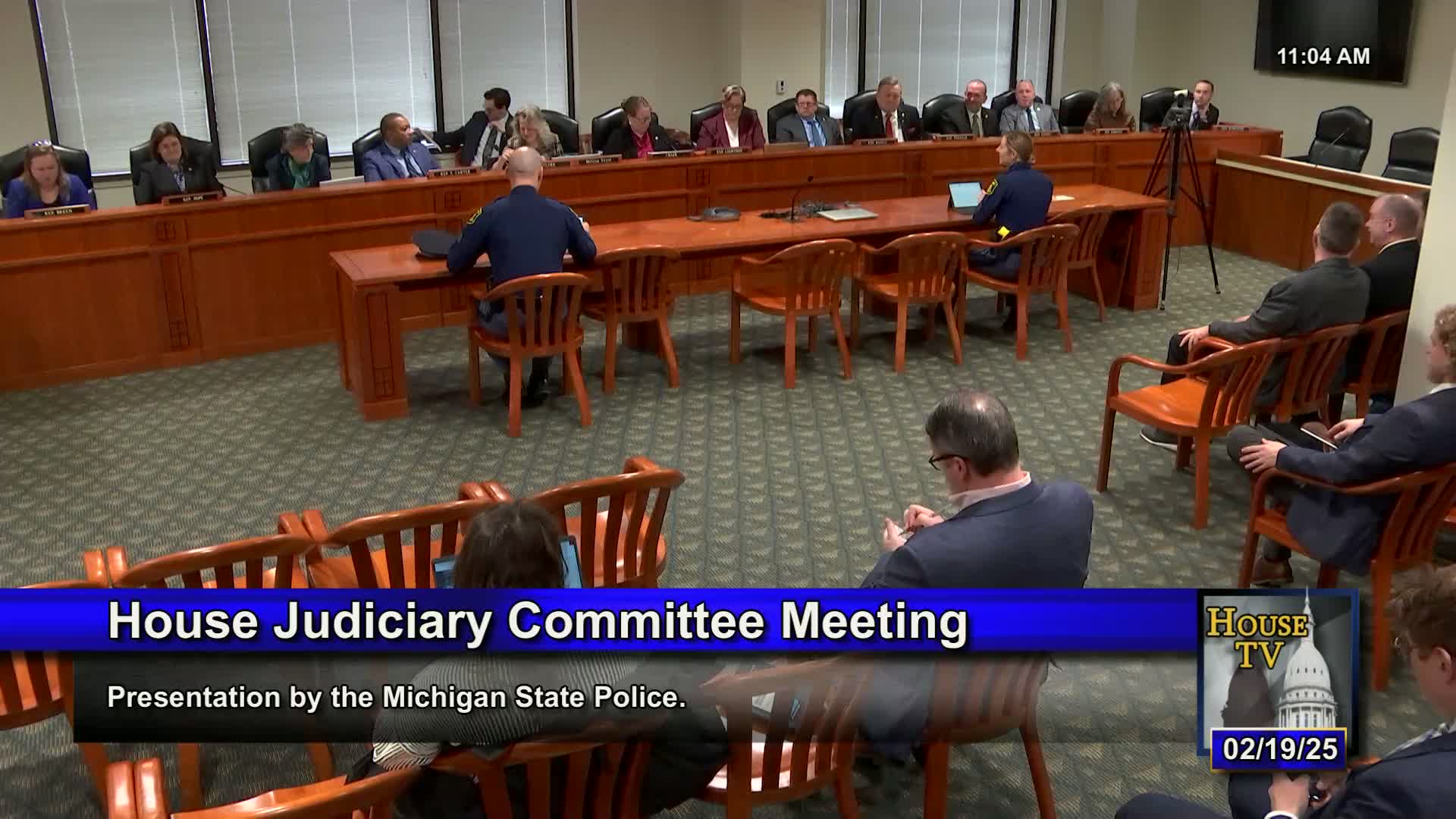
Sergeant Christina Droste and Sergeant Travis Fletcher of the Michigan State Police briefed the House Judiciary Committee on Jan. 30 about MSP organization, services and data the department can provide to lawmakers. "A lot of times when people look at the state police, they think all we do is stop people on the side of the road. That simply is just not true," Droste said, describing bureaus that include Field Services, Professional Development, State Services and Information Technology.
Droste and Fletcher highlighted multiple MSP functions lawmakers may rely on for policy work: aviation, K-9, investigative task forces, a state forensic-science laboratory, recruit schools, a statewide 9-1-1 administration, emergency management and the Michigan intelligence operations center. Fletcher described emergency-management roles and Michigan’s participation in EMAC, the Emergency Management Assistance Compact, which deploys resources to other states during disasters.
Forensic labs and victim services: committee members asked about forensic turnaround times. Droste said MSP publishes average processing times by test type on its public site and noted assault-kit processing is a frequent concern; she said MSP is generally under 90 days but that delays occur because of limited personnel and resources. On victim services, Droste said the governor’s executive budget proposed $1,300,000 to hire eight additional victim-advocate staff to expand the program statewide.
Training, recruitment and nonlethal options: Droste described recruit-school reforms that assign a post before a recruit arrives and a new pre-recruit preparation program to improve retention. Recruitment and retirements have reduced sworn strength: she said MSP is "about 1,800" enlisted members and that number is lower than needed to sustain all services; she offered to follow up to provide exact historical vacancy and hiring figures. On nonlethal options, Droste said MSP is deploying new TASERs and exploring less-lethal technologies and emphasized scenario-based training.
Programs and youth safety: the MSP described the "Okay to Say" confidential tipline that received about 10,000 tips in 2023 and the Office of School Safety’s work with the School Safety and Mental Health Commission. Droste and Fletcher offered department data resources — crime statistics, crash reports and criminal-history records — to assist committee drafting.
Committee members thanked the department and asked for follow-up data on lab backlogs, IRPO implementation outcomes and exact recruitment shortfalls; MSP agreed to provide additional figures.