Get Full Government Meeting Transcripts, Videos, & Alerts Forever!
Get email alerts on the Public Safety Transportation topic
No spam. Unsubscribe anytime.
Bill would permit officers to transport juvenile and adult co-defendants together, with early separation requirement
Summary
House Bill 40 18 would allow officers in certain circumstances to transport an adult and juvenile who are co-defendants in the same vehicle and separate them at the earliest practicable time; supporters called it an officer-safety measure and opponents raised concerns about federal sight-and-sound rules and past vetoes.
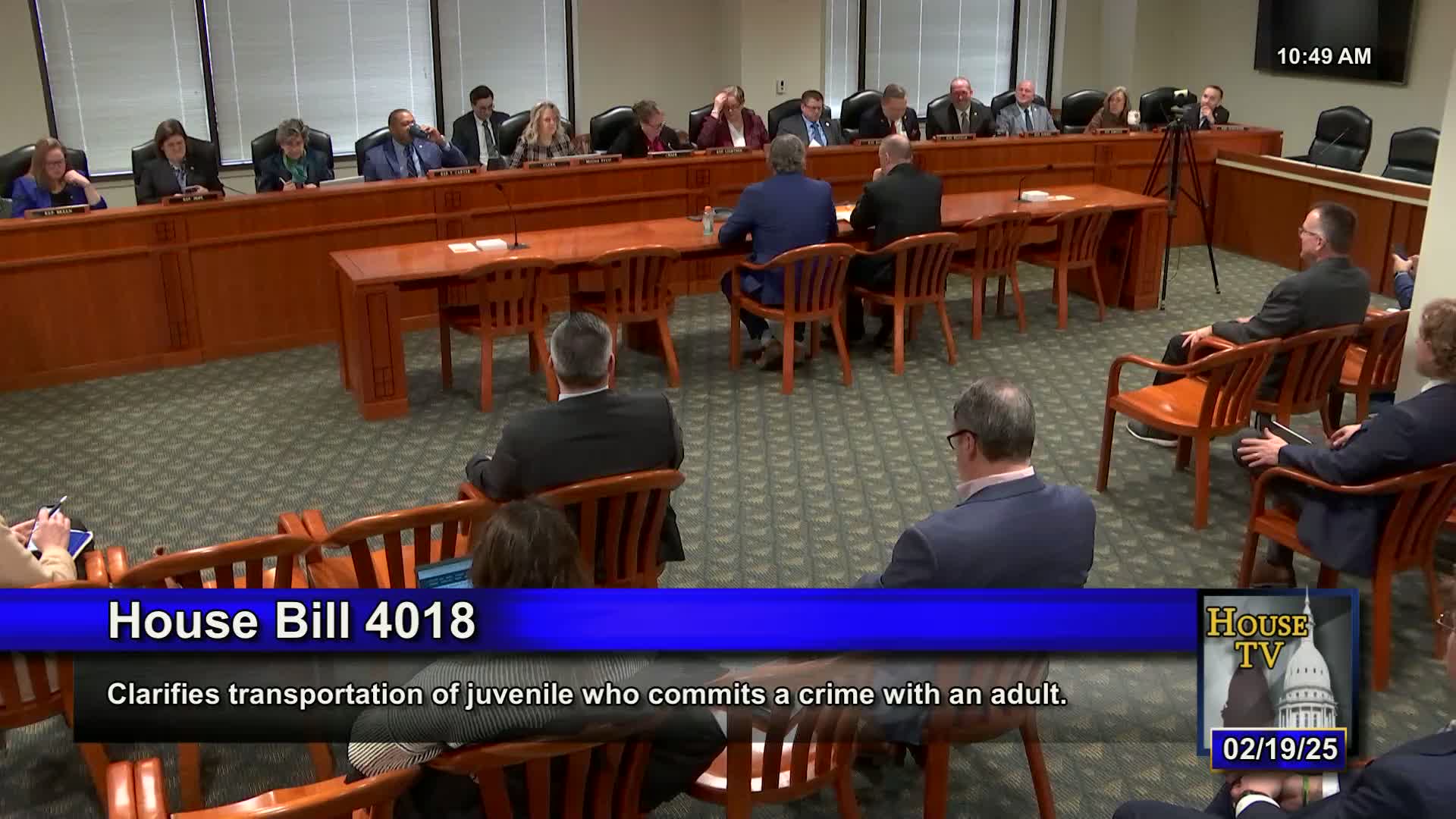
Rep. Matt Mueller introduced House Bill 40 18 to the Michigan House Judiciary Committee on Jan. 30, saying the measure is intended to address an officer-safety and logistical problem when only one patrol vehicle is available. "It's an officer safety issue," Mueller said, describing situations in rural and busy urban areas where another patrol car may not be immediately available.
The bill would permit transporting an adult and a juvenile who were involved in the same offense in a single vehicle provided the juvenile is separated from the adult “as soon as is practicable.” The bill text discussed in committee includes an age-related limitation that the adult not be older than 25, a compromise detail Mueller said his colleagues on the other side of the aisle requested to reduce the risk of an older person manipulating a younger co-defendant.
Michigan Sheriffs Association deputy director Dan Fonas testified in support, saying the change addresses staffing and safety challenges and does not violate federal sight-and-sound rules because those rules apply to juveniles held in secure facilities rather than the limited-duration transport that the bill contemplates. "These restrictions only apply to juvenile offenders that are being held in a secure facility. They do not apply to situations that occur at the time of the initial detention or arrest by law enforcement," Fonas told the committee.
Opposition and previous veto: committee staff noted that the Michigan Department of Health and Human Services (DHHS) had opposed similar language in the past, arguing a vehicle is not a "facility," and that a prior version of the measure was vetoed by the governor. On the record, DHHS submission (Shardae Burton, Legislative Affairs) opposed the bill but did not speak in committee. Multiple law-enforcement organizations filed support statements (Police Officers Association of Michigan; Michigan Association of Counties; Michigan Fraternal Order of Police). The Michigan State Police also filed supporting written testimony.
Committee members asked for clarification about safeguards. Rep. Johnson asked what other protections apply to juveniles beyond transportation; witnesses and members pointed to existing federal and state requirements that impose sight-and-sound separation once a juvenile is in a secure facility and noted the provision would be a limited-duration transport accommodation prior to facility intake. Rep. Breen and others said they supported the bill as written but could not provide an estimate of how often the practice already occurs; sponsors said officers commonly improvise to protect safety in the field.
No committee vote was recorded on HB 40 18 during the hearing. Written testimony logged to the record included multiple supporters and opponents as described in committee clerk announcements.