Get Full Government Meeting Transcripts, Videos, & Alerts Forever!
Get email alerts on the Military And Veterans Budget topic
No spam. Unsubscribe anytime.
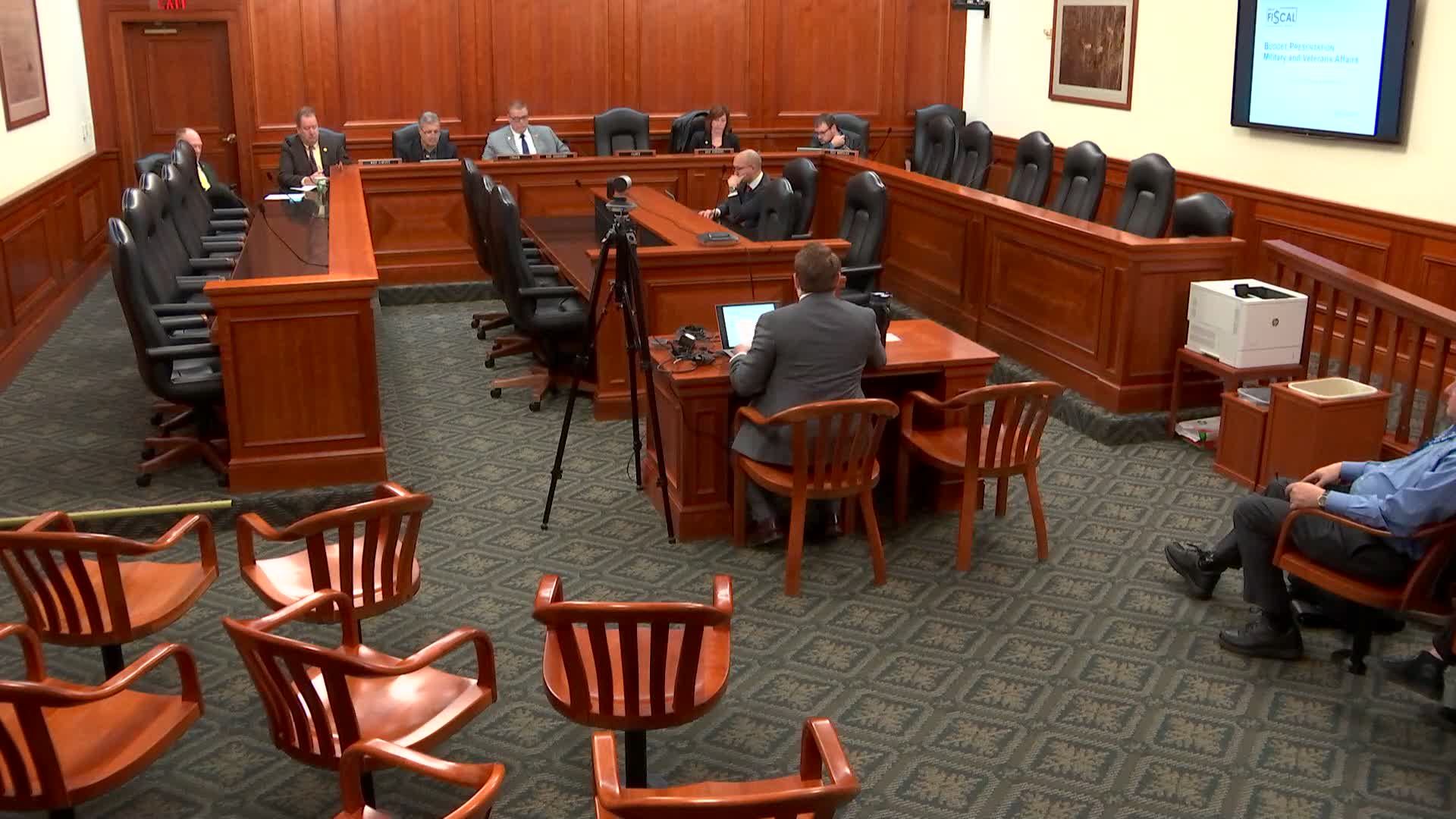
House panel reviews $275.9 million Michigan military and veterans budget
Summary
The House Appropriations Subcommittee on Military and Veterans Affairs received an overview of the Department of Military and Veterans Affairs' fiscal 2025 budget, including funding breakdowns for the Michigan National Guard, veterans homes, tuition assistance and one-time projects at Selfridge Air National Guard Base.
Aaron Meek, a House Fiscal Agency analyst, told the House Appropriations Subcommittee on Military and Veterans Affairs that the Department of Military and Veterans Affairs’ fiscal 2025 gross appropriation totals about $275.9 million, funded primarily by federal grants and state general fund dollars.
Meek said the department “serves a sort of dual purpose. They provide both an operational military force…as well as a network of services and programs to support Michigan veterans and their families.” The subcommittee heard a line-by-line overview of the department’s six appropriation units and several program details.
The nut of the presentation: roughly half of the DMVA budget is federal authorization and roughly 43% is state general fund, with small amounts from state-restricted funds, private donations and interdepartmental grants. Meek said federal and general fund dollars together account for about 95% of the total appropriation.
Meek walked members through the department’s three core units. The military unit supports the Michigan National Guard (about 10,000 members) and contains lines for training sites and support facilities ($45.9 million), administrative functions ($24.4 million), the Michigan National Guard State Tuition Assistance Program (MINGSTAP, about $11.2 million), and the Michigan Youth Challenge Academy (MICA, $10.3 million). He said two-thirds of the military unit’s appropriation is federal authorization and that the remaining third is almost entirely general fund. Meek noted smaller lines including $2.8 million in general fund for the state military retirement obligation and $150,000 in restricted funding from the Military Family Relief Fund.
Meek described MICA as a voluntary, Department of Defense–linked residential program for at‑risk 16-to-18-year-olds that operates two 22-week sessions annually. He said MICA’s $10.3 million gross appropriation breaks down to about $3.4 million general fund, $6.9 million federal, and roughly $90,000 in private donations; Meek added that the state general fund cost per student averages about $5,000 after accounting for federal matching.
Meek told the panel the Michigan National Guard State Tuition Assistance Program (MINGSTAP) was created in 2014 and amended in 2023 to extend benefits to spouses and dependents. By statute, he said, fund balances in excess of $15 million lapse to the general fund. Meek reported the current MINGSTAP fund balance at about $8.7 million, with roughly $2.8 million in expenditures and encumbrances in fiscal 2025.
On education and outreach programming, Meek reported that STARBASE — a nationwide DOD STEM program operating three Michigan locations — remained closed as of Feb. 7 because of paused federal funding releases: “As of that date, these dollars have been expended, and DOD has not yet released additional funds, so all STARBASE programs remain closed throughout the country,” he said.
The Michigan Veterans Affairs Agency (MVAA) unit received about $24.8 million in fiscal 2025, Meek said, with roughly 40% of its gross appropriation for administration and the remainder supporting several veterans grant programs. He listed $4.25 million each for county veteran service grants and veteran service organization (VSO) grants, $2.5 million for Veterans Trust Fund grants plus $1.2 million for administering that fund, and a $2.5 million one‑time appropriation for grants to eliminate veteran homelessness. Meek said most MVAA funding is general fund; the Veterans Trust Fund grants are funded from interest earnings of the trust, not principal.
The Michigan Veterans Facility Authority (MVFA), which operates the state’s three veterans homes (Chesterfield Township; D.J. Jacobetti in Marquette; and Grand Rapids) and an adjacent veterans cemetery, comprises roughly 38% of the DMVA budget. Meek said MVFA’s gross appropriation for fiscal 2025 is approximately $105.2 million, with nearly half coming from federal sources (including about $39.9 million from the U.S. Department of Veterans Affairs Veterans Health Administration and about $10.2 million from the Health Care Finance Administration), and the rest from state general fund and restricted resident-assessment revenues.
Meek told the subcommittee that statewide veteran population estimates are about 473,300 and that residents at the veterans homes have declined over time: “On the whole, the population of the homes across the board has declined by about 48% from fiscal 2002/2009 through last fiscal year, fiscal 24,” he said.
On facilities and projects, Meek reviewed recent and proposed funding for Selfridge Air National Guard Base in Macomb County: since fiscal 2023 the legislature has appropriated about $35.8 million for improvements and a roughly 41,000-square-foot hangar, and the fiscal 2026 executive recommendation includes another $26 million for continued projects. Meek said those projects are aimed in part at accommodating future fighter missions and moving runway infrastructure away from nearby residential development covered by an air installations compatible use zone (AICUZ).
Meek said capital outlay for National Guard armories, veterans homes maintenance and land acquisition totals about $32.5 million in fiscal 2025 (roughly $1.5 million general fund and the remainder federal or restricted). He said the IT unit is small (about $648,700), while MVFA’s IT line is approximately $1.7 million.
Meek closed by listing three fiscal 2025 one‑time general fund appropriations totaling $19 million: $15 million for Selfridge, $2.5 million for the eliminating‑veteran‑homelessness grants, and $1.5 million for grounds and roads maintenance at the VFW National Home in Eaton Rapids.
During questions, Representative Cameron raised how much VSO funding is general fund versus federal; Meek said the VSO grant line is general fund and offered to follow up with the department for precise federal passthrough amounts. When Cameron asked about a proposed veterans cemetery in northern Michigan, Meek said, “Not in fiscal 25. No,” and noted the executive recommendation includes funding for fiscal 2026. Representative Cameron also expressed concern about potential federal cuts to the U.S. Department of Veterans Affairs and the possible local impacts on services.
Representative Madick asked about the sharp drop in veterans home populations; Meek said he could not speak to specifics and suggested MVFA staff could address reasons such as attrition or demographic decline.
No substantive fiscal motions or appropriations were voted on in the hearing. Representative Rogers moved to excuse absent members; the motion was approved without objection and the subcommittee adjourned.
The subcommittee asked the fiscal agency and department staff to follow up on outstanding questions, including detailed VSO funding sources, any RFP or procurement activity related to the northern veterans cemetery, and more specific explanations for long‑term population declines at the veterans homes.