Get Full Government Meeting Transcripts, Videos, & Alerts Forever!
Get email alerts on the Land Access Trespass Signage topic
No spam. Unsubscribe anytime.
Committee hears bill to require no-trespassing signs every 250 feet along property lines
Summary
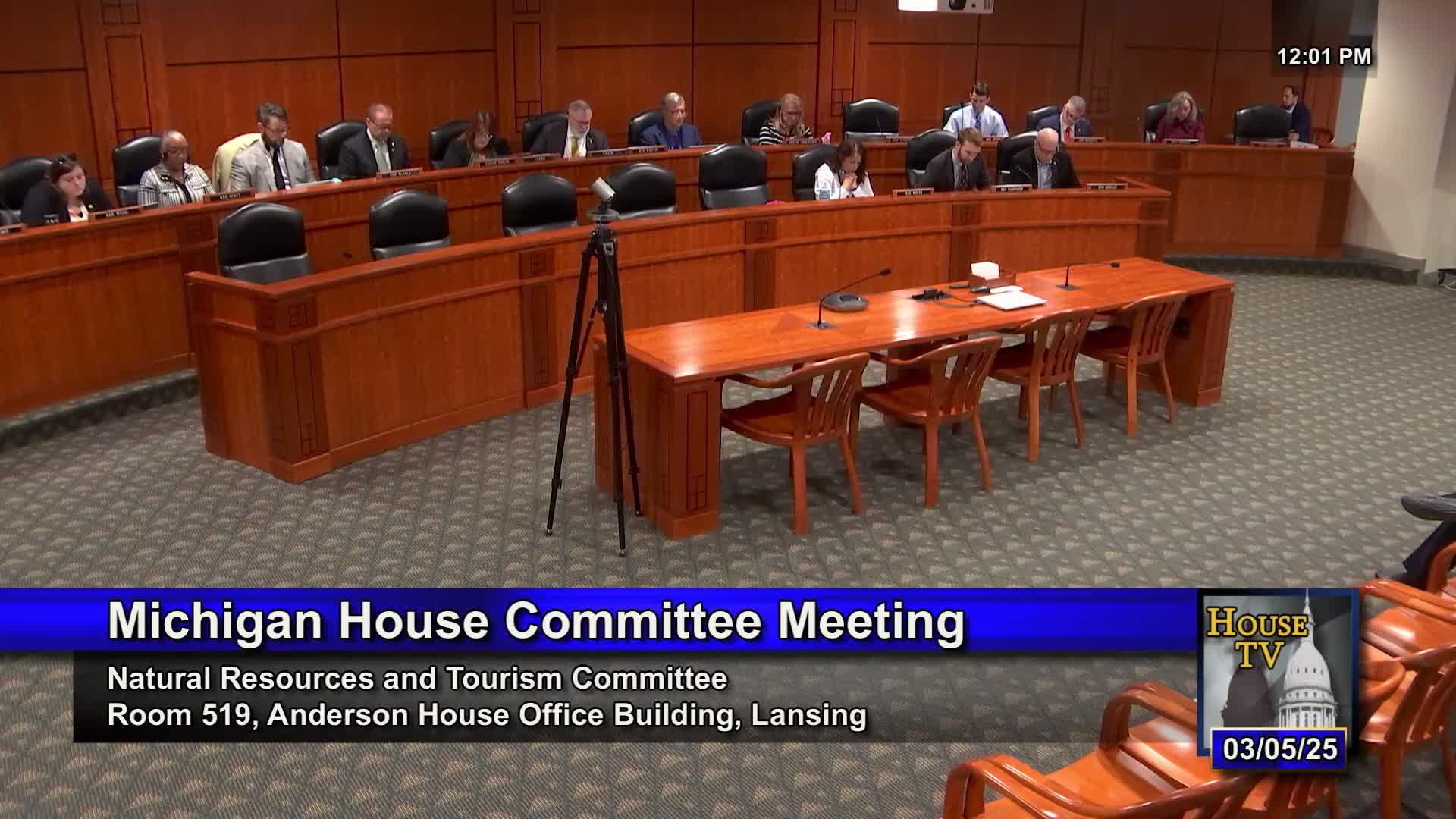
The Natural Resources, Environment, Tourism and Outdoor Recreation Committee heard testimony on House Bill 4013, which would require landowners to post no-trespassing signs at intervals of no more than 250 feet along property boundaries.
The Natural Resources, Environment, Tourism and Outdoor Recreation Committee heard testimony on House Bill 4013, which would require landowners to post no-trespassing signs at intervals of no more than 250 feet along property boundaries.
Representative Slaw, who introduced the measure, told the committee the change is intended to replace the current requirement that signs be posted "at every opening" or be accompanied by a fence. "The signs must be spaced to enable a person to observe not less than 1 sign at any point of entry on the property," he said, describing how the Department of Natural Resources has interpreted "point of entry" to mean any opening in a tree line.
The bill would instead require signs "to be posted at intervals of not more than 250 feet along a boundary," Representative Slaw said, arguing that the fixed distance would "provide a clear, attainable, and reasonable standard for both the property owners and for law enforcement." He said his office reviewed the draft with the United Conservation Clubs, the Michigan Farm Bureau and the Michigan Realtors and that reactions ranged from support to no comment.
Chris Semrinek, legislative liaison for the Department of Natural Resources, told the committee the department supports the bill. "From a law enforcement perspective, [it] sets a clear standard for us to use, again, both for property owners and both from a law enforcement perspective," he said and introduced Jason Haines, the DNR's chief of law enforcement, to elaborate.
Haines described enforcement problems under the current phrasing. "It was certainly a challenge at times to explain to property owners, exactly what it meant to have a sign visible from every point of entry," he said, and added that the 250-foot standard would "certainly simplify things for the property owner" and help prosecutors determine whether the statutory requirements are met.
Haines and Semrinek told lawmakers the bill preserves an existing exemption for farm property and wooded areas connected to farmland; the exemption means very large farm properties would not be required to post perimeter signs under the proposed change.
Lawmakers pressed for details about practical problems. Representative Altman asked how the sponsor chose 250 feet; Slaw said the number "made sense" and that he did not know of a specific industry standard. Representative Woodin asked whether the spacing could leave short sides of a parcel unposted; Slaw said the bill had not resolved that specific scenario but that a landowner intending to bar entry would need some signage on the boundary.
Several representatives raised concerns about signs being removed. Representative Vanderwall described repeatedly replacing signs when they were torn down. Haines said that when signs are taken down, officers commonly document the prior posting with time-stamped photographs and, if the trespass is ongoing in the officer's presence, issue a citation. If the incident is no longer occurring on the officer's arrival, Haines said officers typically document and submit the case to the prosecutor's office for review. "It would come down to the individual prosecutor and what they were comfortable with pursuing," he said.
Representative Ward asked whether officers issue citations on sight or first issue warnings. Haines said that if the trespass occurs in the officer's presence and the statutory criteria are met, the officer would typically issue a citation; otherwise the case would be referred to prosecutors. Representative Preston asked how dispatch triages these calls; Semrinek and Haines said conservation officers take reportable poaching hotline calls when available and that local sheriff's deputies or state police often respond when conservation officers are tied up.
The committee recorded one written card in support from Sean Cecil of Michigan Realtors; Cecil did not wish to speak. The committee did not take a vote on the bill during the hearing.
The exchange left several procedural clarifications on the record: the proposed 250-foot spacing would be measured along the property boundary; farmland and wooded areas connected to farmland remain exempt; property owners would be responsible for posting and replacing signs; and prosecutors retain discretion to decide whether to pursue charges when signage has been removed or when violations are not observed by an officer.
No formal vote or final action on House Bill 4013 was recorded at the hearing.