Get Full Government Meeting Transcripts, Videos, & Alerts Forever!
Get email alerts on the Statewide Transportation Funding topic
No spam. Unsubscribe anytime.
Industry group warns of ‘funding cliff,’ loss of skilled jobs without long‑term road revenue
Summary
The Michigan Infrastructure and Transportation Association told lawmakers a sustained funding increase is needed to avoid a ‘‘funding cliff’’ that could cost thousands of jobs and leave a large share of roads in poor condition.
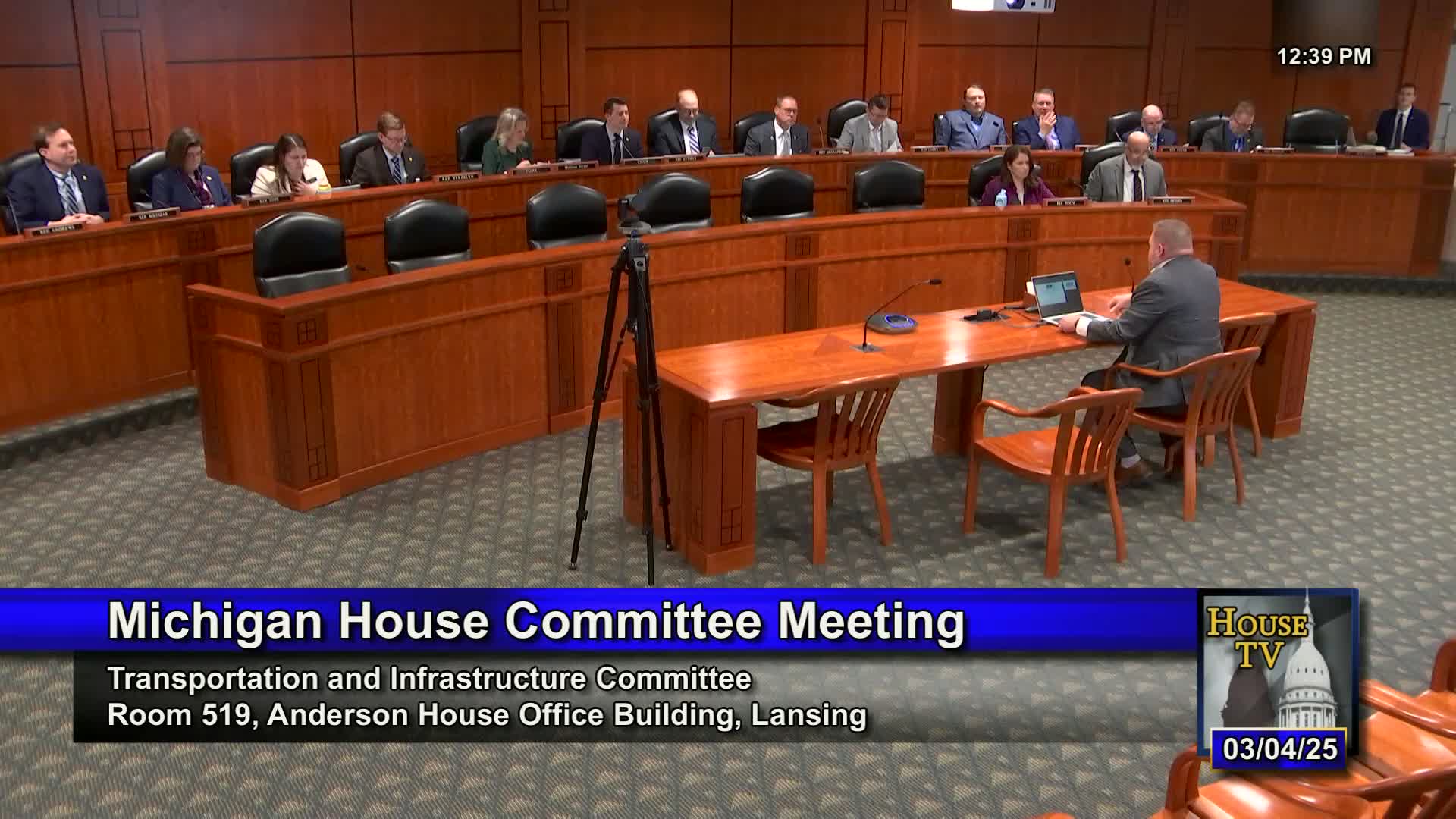
Lance Biannini, vice president for government affairs at the Michigan Infrastructure and Transportation Association (MITA), told the House Transportation and Infrastructure Committee that Michigan faces a multi‑billion dollar annual shortfall to maintain road and bridge condition and a looming funding cliff after one‑time federal and state investments expire.
MITA cited a $3.9 billion annual gap identified by the governor’s Growing Michigan Together council and said that without sustained revenue the state risks returning to rapidly worsening pavement and bridge conditions. "We face a road funding crisis, a road funding cliff," Biannini said.
Biannini said Michigan’s roads currently rate about 67% in good‑or‑fair condition — well short of a legislative 90% goal set years earlier — and that failing to invest early increases future reconstruction costs. He noted the Infrastructure Investment and Jobs Act provides limited short‑term relief and that state bridge and highway bonding programs expire in 2026, leaving uncertainty for 2027 and beyond.
The association warned of workforce impacts: early member surveys indicated firms expect thousands of skilled jobs could be lost if funding declines. Biannini also highlighted permitting and materials access as drivers of rising project costs, citing denied or delayed aggregate (sand and gravel) permits that force long hauls and higher trucking costs.
Biannini summarized elements that appear in competing state proposals — including a sales‑tax‑on‑fuel switch and reinvestment of existing dollars — and said both local and state reforms may be needed, including better access to aggregates and consideration of user‑fee alternatives as vehicle fuel efficiency improves.
Committee members asked about specific reforms, workforce impacts and how federal funding continuations or freezes would affect projects. Biannini said that routine federal aid projects were generally moving forward but that projects with special environmental considerations were being routed for additional federal review.
MITA provided maps and district‑level estimates showing how higher statewide funding levels would translate to county allocations and urged the committee to act on a stable, long‑term funding solution.