Get Full Government Meeting Transcripts, Videos, & Alerts Forever!
Get email alerts on the Local Roads And Bridges topic
No spam. Unsubscribe anytime.
County Road Association details rising bridge, wetland and funding pressures on local roads
Summary
County Road Association of Michigan told the House Transportation and Infrastructure Committee counties manage most of the state's road miles and face growing bridge, wetland‑mitigation and revenue shortfalls, and described software, mitigation‑bank and research programs intended to help.
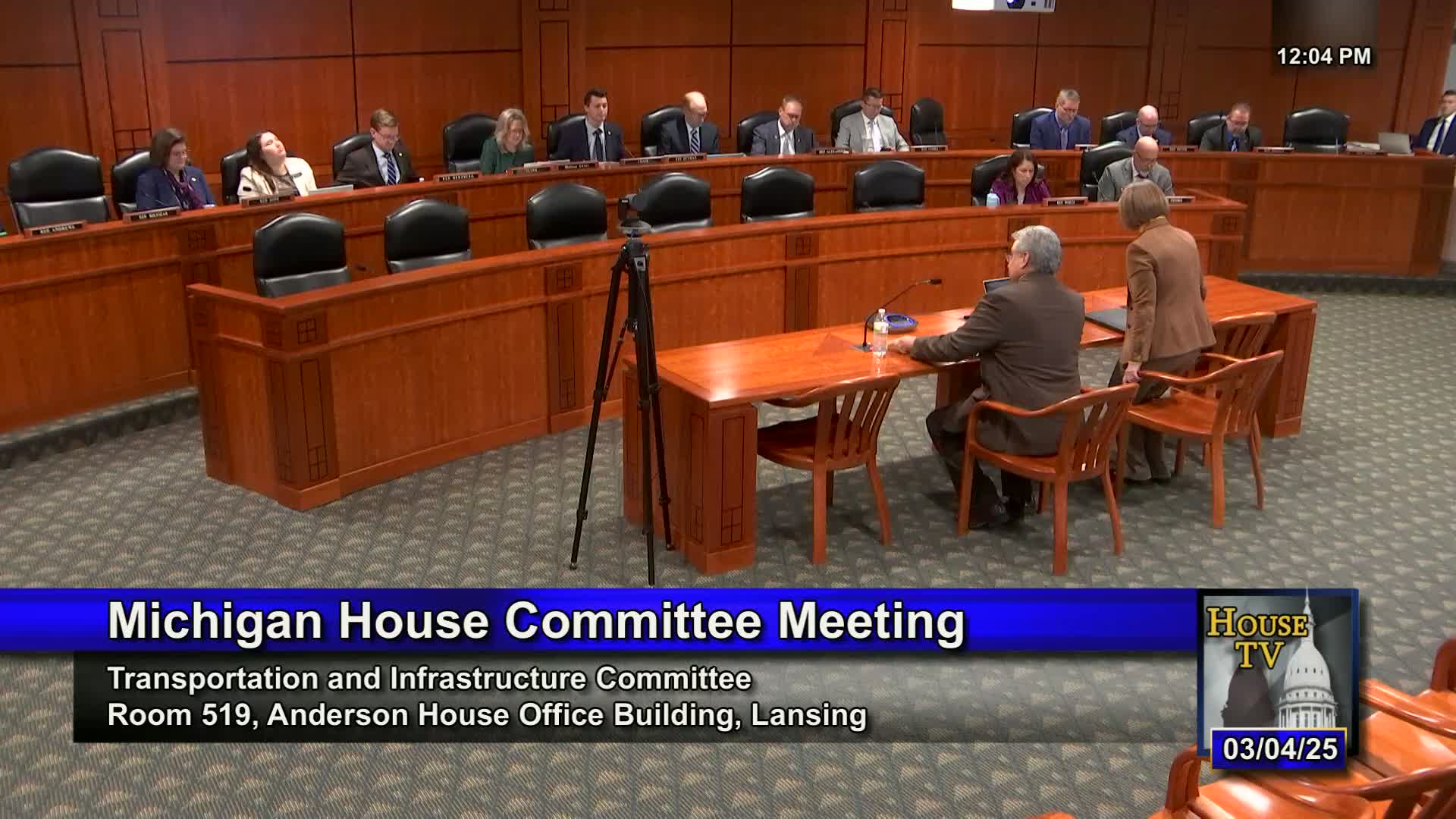
Denise Donahue, CEO of the County Road Association of Michigan, and Ed Noyola told the House Transportation and Infrastructure Committee that county road agencies manage the majority of Michigan’s road network and face growing costs tied to bridges, wetland mitigation and declining fuel‑tax revenue.
The association said counties are responsible for about 90,000 centerline miles — roughly 75% of the state system — and for a little over 5,800 local bridges. "We have 90,000 miles of straight miles, excuse me, centerline miles of road," Noyola said, describing the system the association represents. Donahue highlighted that rules requiring larger culverts and more extensive mitigation mean some culverts now must be treated as bridges, increasing project costs.
That dynamic matters because of how Michigan distributes transportation funds. The association described the Michigan Transportation Fund (Act 51) as holding roughly $4.1 billion in deposits and said, after top‑level allocations, the formula distributes about 39.1% to MDOT, 39.1% to counties and 21.8% to cities and villages. Donahue and Noyola warned that declining gasoline gallons sold and the rise of electric and more fuel‑efficient vehicles are eroding that revenue base.
The presenters outlined several county‑level programs and innovations intended to reduce cost and friction. Donahue described an e‑permitting platform called Oxcart that 78 of 83 counties now use, and a seasonal weight‑restrictions mobile app that notifies heavy haulers and links to county permits. "We believe we are leading the United States, in ease and compatibility of permitting across our 83 counties," Donahue said.
Noyola described a wetland mitigation program the association runs to bank wetland credits for local projects. He said the program receives $2 million per year deposited into an account up to an $8 million cap and that purchased credits are turned over to a conservancy for perpetual maintenance after use. The association said buying or creating mitigation credits is less costly for members than purchasing credit on the open market.
The association also described research and software projects: a Michigan Local Road Research Program seeded with federal grants and state matching funds to develop specs (for example, using scrap tire materials), and a "Road Conductor" project management and financial platform being developed with Michigan Tech and supported by earlier MTF disbursements and a 2024 general fund appropriation.
On disaster response, the association said it sought a standing local disaster relief program to help counties and small municipalities pay ineligible emergency expenses and match requirements. The presenters said a $5 million general‑fund seed from last year lapsed because no program account had been created and asked the committee to consider restoring and enlarging that funding to as much as $20 million–$50 million to cover local disaster needs.
Donahue summarized the association’s investment plan findings: county federal‑aid‑eligible roads are at about 65% good‑or‑fair condition against a 90% goal; non‑federal local roads are at about 44% against a 60% goal. The association reported $1 billion in locally owned bridges that are closed, weight‑restricted or in critical condition and said the 2027 bridge application round drew $515 million in requests while only $80 million is available for the year.
Committee members asked clarifying questions about whether wetland credits could be banked for future projects (the association said yes), how a local disaster relief program might be scoped, and why federal‑aid exchanges do not free up money for non‑federal local roads (they require the funds be spent on federal‑aid‑eligible facilities). The association also emphasized that culvert up‑sizing driven by environmental requirements can convert culverts into bridges, substantially raising project costs.
The association provided committee members printed packets with the county road investment plan, funding charts and a quarterly magazine to demonstrate those data points.
Looking forward, the presenters said the primary revenue challenge is declining MTF receipts driven by fewer gallons of fuel sold and rising vehicle fuel efficiency and electrification; they urged the committee to consider program and funding changes that recognize local needs.