Council committee backs lifting Bethesda development cap, raises park impact payment and seeks clearer monitoring
Loading...
Summary
The Montgomery County Planning, Housing and Parks Committee on March 10 recommended removing the Bethesda overlay development cap, advancing transportation and school adequacy testing, prioritizing a downtown recreation center, and raising the Park Impact Payment to $15.57 per square foot while phasing collection to ease developer cash-flow.
The Montgomery County Planning, Housing and Parks Committee on March 10 held a work session on the Bethesda Downtown Plan Minor Master Plan Amendment, endorsing planning staff and Planning Board recommendations to remove the plan’s development cap, update transportation and school adequacy tests, prioritize a downtown recreation center, and raise the Park Impact Payment (PIP) to $15.57 per square foot while phasing the fee collection.
The committee’s discussion focused on implementation tools and monitoring rather than changes to site-specific zoning. Council staff and Planning Board analysis tested three development scenarios beyond the current development cap — roughly 11 million, 16 million and 21 million additional square feet by 2045 — to estimate effects on travel times, vehicle miles traveled, transit share and school enrollment. Planning Director Jason Sartori said the scenarios showed modest increases in auto and transit travel times and mixed results for vehicle miles traveled per capita; the largest scenario predicted a per-capita decrease in VMT as density reduces driving.
Why this matters: the Bethesda Downtown Plan guides public investments and zoning tools for one of Montgomery County’s largest downtowns. Removing a cap on development could accelerate housing and infrastructure decisions, but it requires an updated monitoring and implementation approach to protect transit, school capacity and public open space commitments.
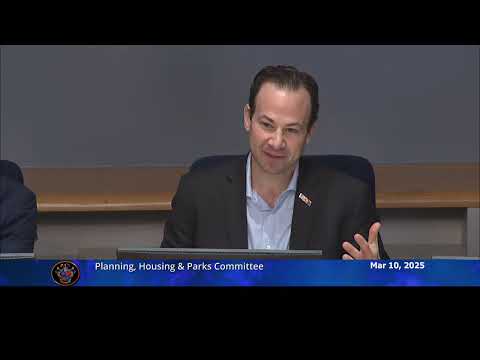
Council Member Andrew Friedson opened the session by recognizing resident frustration about the pace of public amenities and urging clarity in the plan’s language. “There is frustration that public amenities are not moving as quickly as some would like,” Friedson said. He also stressed that private investment has been substantial and that the county must balance incentives and requirements to deliver public benefits.
Transportation and monitoring: planning staff recommended keeping the Bethesda overlay’s transportation-related recommendations largely intact while advancing five targeted actions including continuing local area transportation review (LATR), supporting loading-management districts and a curbside management study with MCDOT, and calling for clearer monitoring metrics. Committee members debated whether traditional intersection-delay standards remain appropriate for an urban, pedestrian-priority downtown. Council Member Fontaine Gonzalez said, “Sometimes we talk about congestion in such a negative way. It’s okay to have congestion, especially in urban areas,” arguing that slower speeds can improve walkability and retail visibility.
Staff and the Planning Board agreed to return before the next work session with a snapshot of intersection delay data from the 2022 monitoring report and a recommended metric set for the committee to adopt as part of a proposed five-year comprehensive review. Council staff recommended replacing the Planning Board’s broader, less-defined “measuring the cumulative experience of implementing the plan vision” with a clearer requirement for a comprehensive five-year implementation review and an accompanying attachment/appendix with monitoring details.
Schools and carbon: Montgomery County Public Schools projections informed the school-impact analysis. Planning staff reported that projected student generation under all three development scenarios would remain within the Bethesda-Chevy Chase cluster’s projected surplus seats at the cluster level, though individual schools or classrooms could face different results; staff emphasized growth will continue to be evaluated through the Growth and Infrastructure Policy and school impact processes. County law requires analysis of carbon impacts; staff reported total emissions would rise under each scenario but would decrease on a per-capita basis, aided by newer buildings’ efficiency and greater density.
Parks, recreation and Veterans Park location: the amendment elevates a downtown recreation center as a top priority and updates how park recommendations are implemented. Mitti Figueredo, Parks director, told the committee that expanding the existing public open space near Veterans Park on the west side of Woodmont Avenue offers the best medium- and long-term path to deliver the Civic Green. “Building on that successful open space is probably the best way to deliver on this recommendation,” Figueredo said. Committee members expressed unanimous, enthusiastic support for the recreation center recommendation and asked parks and planning to refine implementation steps.
Park Impact Payment change and privately owned public spaces: the amendment proposes changing the PIP formula to the cumulative inflation methodology, raising the PIP from the current $12.49 per square foot to $15.57 per square foot. Committee members agreed the fee should be paid in two installments (part at building permit, part at certificate of occupancy) to lessen up-front cost pressure on projects. Andy Frank, chief of the Park Development Division, said parks had no major concerns with the adjustment after financial review.
The amendment also proposes allowing a PIP reduction for publicly accessible privately owned public spaces (POPS) that implement an open-space recommendation in the master plan, subject to Parks and Planning Board approval and maintenance standards. Parks staff said their preference remains permanent public dedication of parkland, but that a well-designed POPS with guaranteed public access can be valuable. Committee members directed staff to draft clearer language that would treat POPS differently from full dedication (for example, a not-to-exceed credit such as 75% of the dedication credit as a possible approach) and to return with specific standards and examples.
Affordable housing and incentives: the committee supported expanding “above-and-beyond” incentives tied to the Bethesda overlay to encourage family-sized MPDUs (three-plus bedrooms) and deeper affordability. The committee reiterated that Bethesda continues to require 15% MPDUs under the optional method (versus 12.5% elsewhere under the transcripted discussion) and asked staff to preserve and highlight preservation projects (including units owned by the Housing Opportunities Commission) in the implementation materials. Council staff agreed to return with an updated map of existing regulated affordable units in the plan area.
Height incentive area: the Planning Board added a recommendation to expand the map of the overlay’s height incentive area to include a small block east of Arlington Road so projects there could seek additional height tied to affordable-housing incentives. Several committee members raised process concerns because earlier briefings had indicated the height incentive expansion would not be part of this minor amendment; those members asked staff and the Planning Board to provide alternative language that proposes studying the expansion rather than recommending immediate inclusion. Planning Director Jason Sartori and the Planning Board agreed to draft compromise wording for the committee to consider at the next work session.
Decisions, directions and next steps: the committee generally concurred with Planning Board and council staff recommendations on the development-level analysis, transportation recommendations, recreation center prioritization, the Veterans Park location update, and the PIP change with phased payment. Several items require follow-up language or metrics, and staff were directed to return at the committee’s second work session on March 24 with revised implementation language, a clearer five-year monitoring approach (with an attachment), an intersection-delay snapshot, a revised POPS/dedication credit approach, an updated map of regulated affordable and naturally occurring affordable housing, and proposed wording about the height incentive area.
Votes at a glance: the committee adopted staff recommendations and consensus directions on the parks CIP item, the technical CIP correction (25-54), the development-level recommendation to remove the development cap and update the Bethesda overlay implementation approach (pending language refinements), transportation recommendations, prioritizing a downtown recreation center, the Veterans Park west-side expansion recommendation, and raising the Park Impact Payment to $15.57 with phased collection. The committee requested follow-up language and additional analysis on POPS credit, a comprehensive five-year monitoring proposal, and the proposed height-incentive-area change before final approvals.
The committee closed by scheduling a return work session on March 24 to consider revised language and the additional materials staff promised to provide.